
If you host on Airbnb, Booking.com or any other platform in South Africa, the short term rental regulations South Africa has been waiting for are finally taking shape. In March 2026, Tourism Minister Patricia de Lille gazetted the Draft Code of Good Practice for Short-Term Rentals. This is the first national STR Code of Good Practice in South African history. The 60-day public comment period closed on 12 May 2026, and while the Code is currently non-binding, it represents a clear signal of where regulation is heading. Hosts who understand it now will be far better placed when binding rules eventually arrive.
Why the Code Was Introduced
Short-term rentals now make up roughly 50% of South Africa’s accommodation sector, according to data from the Short Term Rental Association of South Africa (SASTRA). In Cape Town, around 70% of residential units in the CBD operate as short-term lets, a figure that has reshaped the city’s housing market entirely. Growth has come with tension. Noise complaints, party houses, neighbour disputes, body corporate conflicts, and concerns about housing affordability have all surfaced in recent years.
The Department of Tourism’s response is the Draft Code, published under Chapter 2 of the Tourism Act 3 of 2014. Section 8(a) gives the Minister power to issue Codes of Good Practice to guide conduct relating to tourism services. Importantly, the current Tourism Act doesn’t actually empower the Minister to regulate STRs directly. That requires legislative amendment, which is underway through the 2024 White Paper on Tourism. Until then, the Code is an interim measure that sets out the new Airbnb regulations South Africa is heading towards.
What the New Short Term Rental Regulations South Africa Hosts Must Follow
The Code outlines responsibilities for four groups: hosts (or “designated persons”), guests, platforms, and the broader health and safety environment. For hosts, the guidelines include informing guests of relevant bylaws, body corporate rules and community norms (covering noise, refuse, parking and use of communal areas), providing clear visitor policies, taking reasonable steps to ensure guests follow the rules, ensuring a responsible contact person is available to address guest and neighbourhood concerns, ensuring guests comply with maximum occupancy limits, and complying with all applicable tax obligations.
Guests are expected to follow local bylaws and house rules, avoid creating excessive noise or nuisance, truthfully disclose the number of occupants, and refrain from using the property for unauthorised purposes including hosting unregistered events. To prevent parties at an Airbnb in South Africa, hosts now need real systems in place, not just house rules. The Code expects you to actively manage guest conduct.
What SASTRA Compliance Looks Like in Practice
SASTRA has welcomed the Code’s objectives but flagged real concerns. Their position supports standardising service levels, guiding guest behaviour and clarifying platform roles. However, several issues are worth knowing about.
There is no legal definition of “short-term rental” in South African law, creating uncertainty about who falls under the Code. STRs are being held to higher standards than hotels, guesthouses and B&Bs, which aren’t required to follow the same Code. The framework offers no clear measures of success or execution. Hosts already comply with municipal by-laws, zoning, tax and employment laws, risking regulatory duplication. Effective SASTRA compliance for individual hosts therefore means going beyond the bare minimum and demonstrating professional operation through documented systems.
SASTRA’s host data also paints a clear picture. Around 80% of SA hosts are female, 52% are non-white, and 70% rely heavily on hosting income.
What This Means for Hosts Right Now
The Code’s non-binding status doesn’t mean hosts can ignore it. Municipalities are already enforcing it. Cape Town, Johannesburg and eThekwini all have active by-laws around noise, occupancy and nuisance. Reliable noise monitoring for short-term rentals in South Africa is now a genuine compliance need, not a nice-to-have. Equally, smoking detection in vacation rentals in South Africa has become essential as body corporates and platforms tighten enforcement.
Platforms are likely to align next. Airbnb and Booking.com have a history of adopting local Codes globally as platform policy. Binding regulation is also coming through the Tourism Act review.
How Alertify Helps SA Hosts Comply
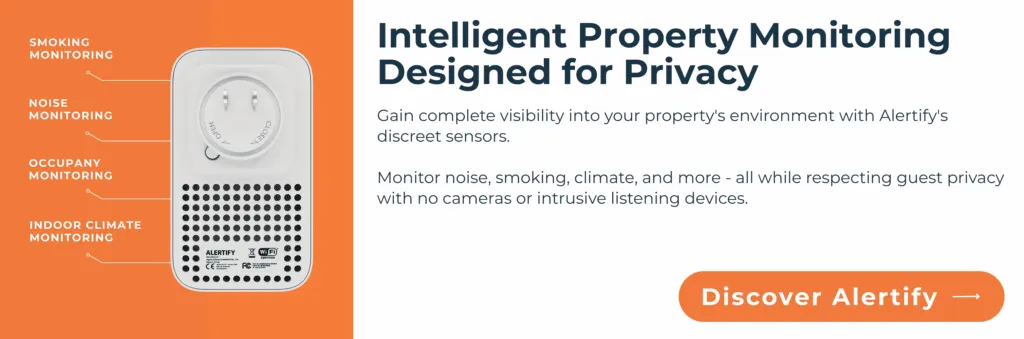
This is where Alertify becomes essential. Alertify is a privacy-safe property monitoring device built specifically for the kind of compliance the new Code expects. It detects noise levels,smoking events and occupancy patterns without ever recording audio or video, making it fully POPIA-compliant and respectful of guest privacy.
When the device detects a noise threshold breach, an unauthorised gathering, or signs of smoking, it sends an instant alert and triggers an automated, non-confrontational message to the guest through Guest Alert. Over 90% of violations resolve within 10 minutes, without any phone call or escalation. Every event is time-stamped and logged for 180+ days as documentary evidence the Code expects you to be able to produce. Alertify installs in 5 minutes, runs on a backup battery, and integrates with WelcomeLink for guest verification at booking.
The Code also requires that hosts ensure a responsible contact person is available to address concerns. Alertify’s real-time alerts make this practical, not theoretical. For hosts navigating evolving body corporate Airbnb rules in South Africa, Alertify also provides the evidence trail needed when disputes go to body corporate hearings or platform appeals.
The Window to Get Ahead Is Open Now
South Africa’s STR sector is at a turning point. Hosts who treat the Code as voluntary noise will be caught flat-footed when binding rules drop. Hosts who treat it as a roadmap, investing in privacy-compliant monitoring and operating as professional businesses, will capture market share from those who don’t.Alertify helps South African hosts and property managers build privacy-compliant monitoring systems aligned with the new Code’s expectations.
Book a free demo to see how Alertify future-proofs your short-term rental ahead of South Africa’s evolving regulatory landscape.