
If you operate an Airbnb in a sectional title scheme, an estate or a complex anywhere in South Africa, you’ve probably seen the trend. Body corporates and HOAs are increasingly hostile to short-term lets. Special resolutions banning STR operations are being tabled across Cape Town, Sandton and Umhlanga. Trustees are issuing fines, demanding removal of properties from platforms, and in some cases pursuing legal action against hosts. Understanding body corporate Airbnb rules in South Africa, and knowing how to defend your operation when challenged, has become essential for any SA host serious about staying in business.
Why Body Corporates Are Cracking Down
The pressure is coming from multiple directions. Permanent residents in sectional title schemes complain about security risks from rotating guests, noise from short stays, wear on common amenities, and the general loss of community feel. Trustees, who are usually permanent residents themselves, are responding by tightening conduct rules and pursuing STR-restrictive amendments to scheme management rules.
The legal framework supports them. Under the Sectional Titles Schemes Management Act 8 of 2011, body corporates can amend conduct rules with the necessary majority. Once amended, those rules bind every owner. Davies Property Group has noted that many sectional title schemes have already banned short-term letting and written this into their conduct rules, leaving sectional title short term rental operators who continue to operate exposed to legal action.
The new short term rental regulations South Africa has introduced through the Draft Code of Good Practice doesn’t override body corporate authority. If anything, it reinforces it. The Code explicitly requires hosts to comply with body corporate rules, inform guests of those rules, and take reasonable steps to ensure compliance.
The Three Most Common Vacation Rental Disputes in South Africa
Hosts in sectional title schemes typically face three categories of body corporate dispute, and they’re now the most common vacation rental disputes in South Africa.
Noise complaints from neighbours: A neighbour reports that guests played music until 02:00. The trustees demand action. Without evidence, you have to either accept the complaint at face value (and the resulting fine) or argue against it without data.
Special resolutions to enforce a body corporate STR ban: Trustees table a resolution at the AGM to amend conduct rules, prohibiting short-term letting altogether. Hosts who can’t demonstrate professional, low-impact operation often lose the vote, and the body corporate STR ban becomes binding on every owner in the scheme.
Conduct rule breach fines: Trustees fine hosts for guest-caused issues like smoking in common areas, overcrowding, or damage. Without proof of what actually happened, the fine usually stands.
In each case, the host who wins is the one who can produce objective, time-stamped evidence of what actually happened on their property.
What Documentary Evidence Wins
“He said, she said” doesn’t work in body corporate hearings. What works is data. Specifically:
Time-stamped noise readings showing decibel levels at specific times, demonstrating either compliance or showing exactly when and how a violation occurred and was addressed. Occupancy logs showing how many people were in the property, supporting your case against false overcrowding allegations. Smoking detection records proving whether smoking did or didn’t occur, and when. Guest message logs showing you took reasonable, immediate action when issues arose. All of this needs to be downloadable, time-stamped and tamper-proof.
This is exactly the type of evidence the new Draft Code of Good Practice expects hosts to maintain. It’s also the only kind of evidence that consistently wins body corporate disputes and platform chargeback appeals.
How Alertify Builds the Evidence Trail Body Corporate Airbnb Rules in South Africa Demand
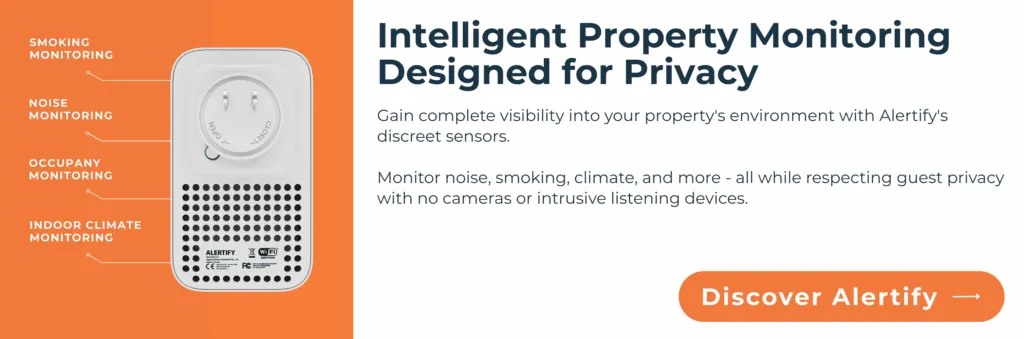
Alertify’s documentary evidence feature is purpose-built for this. Every event the device detects, whether a noise threshold breach, a smoking incident, an occupancy spike is automatically time-stamped and logged. Data is stored for 180+ days, exceeding the timeframe most disputes cover.
Reports are downloadable, formatted for presentation in body corporate hearings, platform appeals or insurance claims. When a trustee accuses your guest of playing music until 02:00, you can produce a report showing the actual decibel levels for every minute of that night. When a neighbour claims you had thirty people in a four-person unit, you can produce occupancy data showing exactly how many people were detected.
Equally important, Alertify documents your interventions. Every automated Guest Alert message sent through the system is logged. So when a body corporate asks “what did you do about the noise complaint?”, you can show that the moment thresholds were breached, your system sent a message to the guest, and the issue resolved within minutes. Over 90% of violations resolve within 10 minutes of an automated alert, which becomes its own form of evidence that you operate professionally and take the “reasonable steps” the Code requires.
For hosts also implementing noise monitoring for short-term rentals in South Africa, smoking detection in a vacation rental in South Africa, or systems to prevent parties at an Airbnb in South Africa, Alertify combines all of this into a single device with a single evidence stream.
Engaging Your Body Corporate Proactively
The smartest SA hosts don’t wait for disputes. They engage their body corporate proactively, presenting their monitoring system as evidence of professional operation. This shifts the dynamic. Instead of being seen as the source of risk, you become the model for how STR operations should work.
Bring your Alertify dashboard to the next AGM. Show the trustees how noise, smoking and occupancy are monitored. Demonstrate the automated guest messaging. Share incident data showing how quickly issues resolve. This positioning often turns trustees from adversaries into supporters, and protects your listing when other hosts in the scheme face restrictions.
Don’t Lose Disputes You Could Have Won
Body corporate disputes, neighbour complaints and platform chargebacks all turn on one question: who can prove what? Hosts with documentary evidence win. Hosts without it lose. With sectional title schemes increasingly hostile to short-term letting and the new Code of Good Practice making host accountability explicit, the cost of operating without proper monitoring has become too high to justify.
Alertify gives South African hosts the privacy-safe, court-defensible evidence platform they need. Installs in 5 minutes, no cameras or microphones, 180+ days of data storage, and downloadable reports that win disputes. Book a free demo to see how Alertify protects your SA short-term rental from body corporate disputes and keeps your listing live.