Airbnb noise complaints in South Africa are the single most common cause of municipal fines, body corporate disputes and bad reviews for STR hosts. With the new Draft Code of Good Practice requiring hosts to inform guests of relevant bylaws covering noise, and to take reasonable steps to ensure guests comply, getting noise monitoring for short-term rentals in South Africa right has shifted from optional to essential. The challenge is that South Africa’s noise framework is layered. National regulations, provincial rules, and municipal by-laws all apply. Hosts who don’t understand the specifics are exposed to fines, complaints and listings under threat.
South Africa’s Layered Noise Framework
At the national level, the National Noise Control Regulations (GNR154 of 1992) define a “noise disturbance” as any sound exceeding the ambient sound level by 7dB or more. These regulations remain in full effect under section 25 of the Environment Conservation Act.
Provincial regulations exist in Gauteng, Western Cape and Free State, with each setting its own enforcement framework. South African law also distinguishes between “disturbing noise” (an objective, scientifically measurable level) and “noise nuisance” (a subjective standard that disturbs the peace). The first requires a decibel reading. The second requires only a complaint, which is why neighbour relations matter so much for SA hosts.
Decibel Limits Cape Town, JHB and Durban Hosts Need to Know
This is where it gets specific. eThekwini noise bylaws cap night-time outdoor noise at 50dB and indoor with open windows at 45dB. Night-time runs from 22:00 to 06:00, daytime from 06:00 to 22:00. These are some of the strictest limits in the country.
The decibel limits Cape Town hosts must observe sit under the Streets, Public Places and Prevention of Noise Nuisances By-law, recently amended in 2025. Authorised officials have powers to inspect premises, issue compliance notices, and impose fines or imprisonment up to six months. With around 70% of CBD accommodation now short-term let, enforcement is active, particularly in areas like Sea Point, Camps Bay and Green Point.
Johannesburg enforces noise through its Public Health By-laws, with similar 22:00 to 06:00 quiet hours. Tshwane operates under its Noise Management Policy with detailed nuisance thresholds.
For STR hosts, the practical implication is simple. A guest playing music at 70dB at 23:30 in any of these metros exposes you to fines of R500 to R5,000+, body corporate complaints, and listing suspension.
Why Generic Noise Monitoring Doesn’t Work in South Africa
Many off-the-shelf noise monitors record audio. In South Africa, this is a serious problem. POPIA (the Protection of Personal Information Act) treats audio recording in private accommodation as personal information processing, exposing hosts to compliance violations and guest privacy complaints. A device that records what’s said, even briefly, is a legal liability.
Hosts also can’t afford monitoring that only triggers when the threshold has already been breached for several minutes. By that point, the neighbour has called, the body corporate is involved, and the damage is done. Effective compliance with the new short term rental regulations South Africa is rolling out demands real-time detection, not retrospective logging.
How Alertify Solves the Noise Monitoring Short Term Rental South Africa Compliance Gap
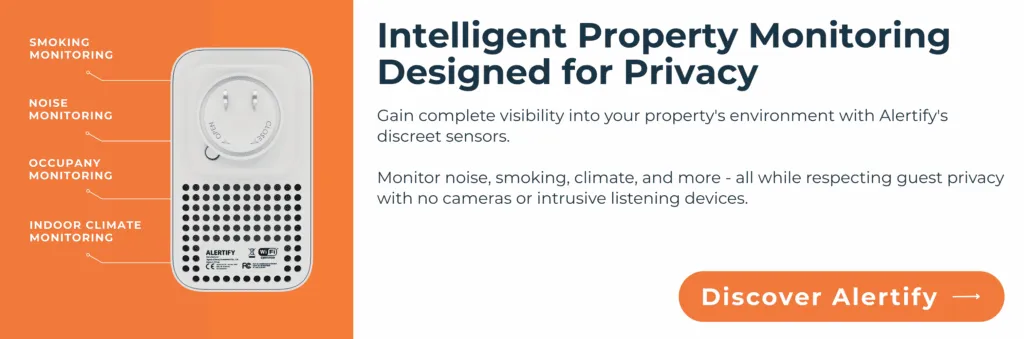
Alertify’s noise monitoring is purpose-built for this. The device monitors decibel levels in real time, never records audio, and is fully POPIA-compliant. Hosts can set custom thresholds, typically 5dB below local ordinance limits, to catch issues before they become violations. The moment a threshold is breached, two things happen simultaneously. The host receives an instant alert, and Alertify’s Guest Alert sends an automated, non-confrontational message to the guest.
Over 90% of noise violations resolve within 10 minutes. No phone call, no confrontation, no escalation. Every event is time-stamped and stored for 180+ days through Alertify’s documentary evidence system, giving hosts downloadable reports for body corporate disputes, platform appeals or municipal proceedings.
For hosts who also need to prevent parties at an Airbnb in South Africa or implement smoking detection in vacation rentals in South Africa, Alertify combines noise monitoring with occupancy detection and smoking detection all in one privacy-safe device. The integrated approach means a single device captures multiple violations and triggers a single intervention.
What Hosts Should Do This Week
Identify the specific by-law for your municipality and the exact decibel limits and quiet hours. Set Alertify’s threshold 5dB below those limits. Enable Guest Alert with messaging customised to your house rules. Engage with your body corporate or HOA, demonstrating that you have monitoring in place.