Short-term rental regulation is one of the fastest-moving areas of local law in the country, and the rules rarely look the same from one city to the next. STR compliance isn’t a single checklist a host completes once. It’s an ongoing responsibility that shifts depending on where a property sits, and enforcement has been getting more aggressive rather than less, with more cities moving from occasional warnings to structured citation programs backed by dedicated enforcement staff.
Why STR Regulations Vary So Much by City
Scottsdale, Arizona is a useful example of where enforcement is headed. Under AirROI’s analysis of 2026 short-term rental enforcement, the city’s ordinance caps occupancy at six adults plus dependent children, bans nuisance parties outright, and allows fines of up to $1,500 per day for unlicensed operation. The city’s short-term rental task force has shifted from issuing warnings to issuing citations, with unlicensed-operation citations rising 26 percent year over year even as total service calls at STR properties fell. Houston introduced a comparable ordinance effective January 2026, with enforcement beginning that April. Neither city is unusual in this respect; both reflect a broader shift toward active enforcement rather than complaint-driven investigation alone.
The pattern across cities is consistent even where the specifics differ: occupancy caps, a required emergency contact, registration or permit requirements, and documented nuisance-party bans, backed by fines that scale with repeat violations. A host operating in one city can’t assume the same rules apply a few miles away in another, and the same property type can face very different obligations depending on whether it sits inside city limits, an unincorporated county area, or a jurisdiction with its own separate short-term rental task force.
Cities That Require Noise Monitoring
A growing number of cities and counties have moved past general noise ordinances and now require hosts to actually install a monitoring device. The specifics vary widely from one jurisdiction to the next, but the direction is the same: regulators want proof, not just a promise, that a property is being kept in check.
Fort Lauderdale, Florida: Under Ordinance No. C-16-25, every vacation rental must be equipped with a noise level detection device, and the resulting data has to be retained for 180 days and made available to the city on request. Noise cannot be plainly audible beyond 25 feet from 10 p.m. to 7 a.m., or beyond 50 feet during the rest of the day.
New Orleans, Louisiana: A noise monitoring device has been required for short-term rentals since July 1, 2023, alongside noise abatement, security, and sanitation plans. The requirement is written directly into the city’s short-term rental code, and violations tied to noise or unpermitted operation can carry fines running into the thousands of dollars.
Clark County and Henderson, Nevada: Clark County requires operators to install noise-monitoring devices at the property lines of their front and back yards, as well as around outdoor pools and spas. Henderson’s ordinance similarly requires noise monitoring devices placed both indoors and outdoors in patio, pool, and gathering areas, with data maintained for at least two months after each booking.
St. Charles, Missouri: Every short-term rental must be affixed with an operable noise monitoring device, which notifies the tenant and property owner of any noise deemed unreasonable, and the device must be documented and inspected before occupancy is issued. The city also enforces quiet hours between 10 p.m. and 10 a.m.
San Bernardino County, California: The county takes an incentive-based approach rather than a strict mandate: it offers a one-time $150 fee credit toward a short-term rental permit when an approved outdoor sound monitoring system is purchased and installed. It’s optional on paper, but the credit, combined with a 24/7 complaint hotline, has pushed adoption up significantly among operators in the mountain and desert regions.
Scottsdale, Arizona: As covered above, Scottsdale’s occupancy caps and nuisance-party bans are backed by active enforcement, and hosts increasingly rely on monitoring devices to document compliance and defend against disputed citations, even where the ordinance itself is occupancy-focused rather than device-specific.
Ocean City, New Jersey: The city’s ordinance doesn’t name a specific device requirement, but it does treat noise as a serious enforcement priority: violations can bring fines up to $3,000 per offense under state guidelines, with each additional day treated as a separate violation. Many hosts install monitoring equipment anyway, since proving compliance after the fact is difficult without one.
Blue Mountains Town, Ontario, Canada: The bylaw requires at least one indoor monitor and one outdoor monitor, or an equivalent noise detection system, to be fully operational and monitored at all times. Operating without a functioning system carries demerit points that count toward license revocation, and the town also sets quiet hours for outdoor amenities like hot tubs and pools.
The Documentation Hosts Need to Stay Protected
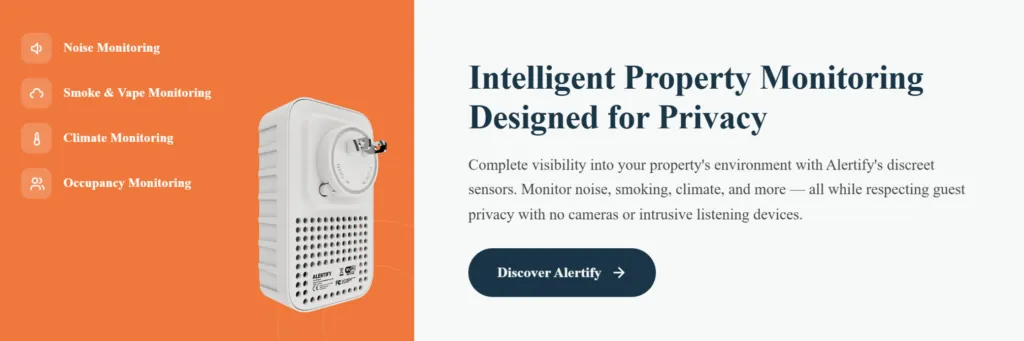
What tends to matter most in an actual enforcement conversation, whether with a city inspector, an HOA board, or a platform’s trust and safety team, isn’t whether a violation occurred. It’s whether the host can show it was caught and addressed. Alertify’s documentary evidence feature timestamps every noise, smoking, and occupancy event and stores it for more than 180 days, giving hosts a record they can produce on request instead of a memory of what they think happened.
For a city-by-city look at registration and permit requirements, Alertify’s compliance resources are a useful starting point before assuming a listing meets every applicable ordinance.
This kind of record matters just as much with an HOA or a homeowner association as it does with a city office. Board disputes over short-term rentals often come down to conflicting accounts of what actually happened, and a host who can produce a timestamped log of every noise or occupancy event tends to resolve those disputes far faster than one relying on memory or a guest’s word against a neighbor’s.
Building Compliance Into Your Daily Operations
Compliance obligations rarely stop at noise and occupancy. Many cities require hosts to register a listing, display a permit number publicly, and collect and remit local lodging taxes, and the specifics vary enough between neighboring cities that assumptions carried over from one property rarely hold up for another. A host expanding from one listing to several is effectively taking on a small compliance program, not just repeating what worked the first time.
Treating compliance as something built into daily operations, rather than something addressed only after a complaint, is what separates hosts who occasionally get fined from hosts who rarely hear from a city office at all. That proactive approach is a core part of vacation rental protection: it’s not just about preventing guest violations, it’s about being able to prove, with dates and data, that a property is run responsibly.
For hosts managing a portfolio across multiple cities, this often means keeping a simple reference sheet per property: permit number, occupancy cap, quiet hours window, and emergency contact requirement, reviewed whenever a local ordinance changes rather than only when a citation arrives. Cities also update these rules more often than most hosts expect, sometimes with only a few months’ notice before enforcement begins, which makes a periodic review far more useful than a one-time setup checklist.
Stay Ahead of Local Regulations
STR compliance will keep evolving as more cities introduce or tighten short-term rental ordinances. Hosts who document conditions consistently, rather than scrambling to reconstruct a timeline after a complaint, are in a far stronger position whenever a question comes up. That habit also tends to pay off in ways beyond avoiding fines: a clean compliance record makes it easier to add new properties, renew a permit without friction, and respond quickly if a city updates its rules mid-year.
If you want a clearer picture of what your property needs to stay compliant, book a free demo and we’ll walk through documentation, alerts, and reporting for your specific market.