
In any school, you’ll hear the daily complaints. “It’s freezing in the library!” “The third-floor classrooms are an oven by the afternoon.” These endless battles with the thermostat are often dismissed as simple comfort issues. But what if these “comfort” problems are actually at the heart of your school’s biggest health and performance challenges?
The “Goldilocks Zone”, a stable range of temperature and humidity, is not a luxury. It is a fundamental component of a healthy building and a prerequisite for learning. An environment that is too hot, too cold, too damp, or too dry creates a cascade of negative outcomes, from decreased test scores to increased absenteeism.
Effective school building humidity control and temperature regulation are a critical, non-negotiable part of managing indoor air quality in schools. This post explores the science behind this delicate balance and why managing it is essential for protecting both student health and your school’s budget.
The “Too Hot, Too Cold” Effect on Learning
Let’s start with temperature. The link between classroom temperature and student performance is one of the most well-documented in educational research.
Our brains and bodies expend a significant amount of metabolic energy simply to maintain our core 98.6°F (37°C) temperature. When a classroom is too cold, a student’s body diverts resources away from complex cognitive tasks (like algebra or reading comprehension) and towards the simple, physical task of staying warm. Students may feel restless, shiver, and be unable to focus on anything but their discomfort.
The opposite is just as bad. In a classroom that is too hot, students become lethargic, irritable, and drowsy. Studies have shown a clear and direct negative correlation: as classroom temperatures rise above the optimal “sweet spot” (typically cited between 68-74°F or 20-23°C), test scores measurably decline.
Maintaining a stable, consistent temperature isn’t “coddling” students; it’s a strategic move to ensure their brains are free to do the one job they’re in school for: learning.
The “Too High” Danger: Humidity and the Threat of Mold
As critical as temperature is, humidity is where the most serious health and financial risks lie. This is why school building humidity control is a top priority for facilities managers.
When indoor relative humidity (RH) climbs above 60% and stays there, it creates the perfect breeding ground for a host of biological contaminants.
- Dust Mites: These microscopic creatures are a major allergen and thrive when humidity is high.
- Bacteria: Many harmful bacteria flourish in damp environments.
- Mold: This is the big one.
The link between high humidity and mold in school buildings is absolute. Mold spores are everywhere, but they are inert until they find two things: moisture and a food source (like drywall, ceiling tiles, or carpet). Persistent high humidity provides all the moisture mold needs to colonize.
Once it takes hold, mold releases spores and mycotoxins into the air, triggering:
- Asthma attacks in sensitive students.
- Severe allergic reactions.
- Respiratory infections and persistent coughs.
- Headaches and fatigue.
For a student with asthma, which is one of the leading causes of school absenteeism, a moldy classroom is a direct threat to their health and their ability to attend school. For the school, a mold outbreak is a financial catastrophe, often costing hundreds of thousands of dollars in remediation and leading to lawsuits and a PR nightmare.
The “Too Low” Danger: Dry Air and the Virus Superhighway
This is the side of the equation we often forget, especially in winter. We crank up the heat, and the air becomes bone-dry, with humidity levels plummeting below 30% or even 20%. This dry air poses its own serious health risk.
Making Students Susceptible
First, dry air compromises our body’s natural defenses. The mucous membranes in our nose and throat are our first line of defense against airborne pathogens. When they dry out, they crack and become less effective, giving viruses an easy entry point into our system.
Creating the “Virus Superhighway”
Second, the physics of dry air helps viruses spread. When an infected person coughs or sneezes, they expel virus-laden droplets.
- In Humid Air (40-60%): These droplets are heavy with moisture. They fall to the ground quickly, usually within a few feet.
- In Dry Air (<40%): The moisture in the droplets evaporates almost instantly. The tiny, dried-out viral particles (aerosols) become light enough to float in the air for hours, traveling across the entire room and being inhaled by others.
An overly dry classroom is, quite literally, a “superhighway” for the flu, the common cold, and other respiratory viruses. This is a major driver of school IAQ and student attendance problems, leading to waves of illness that sweep through classrooms and spike absenteeism for students and teachers alike.
How to Find and Maintain the “Goldilocks Zone”
The science is clear: the optimal “Goldilocks Zone” for health and learning is a relative humidity level between 40% and 60%.
- Above 60%: Risk of mold and mites.
- Below 40%: Risk of virus transmission.
The problem is, without data, you are flying blind. You can’t feel the difference between 35% and 45% humidity. You can’t smell a mold problem until it’s already a massive, expensive crisis.
This is where continuous monitoring becomes essential.
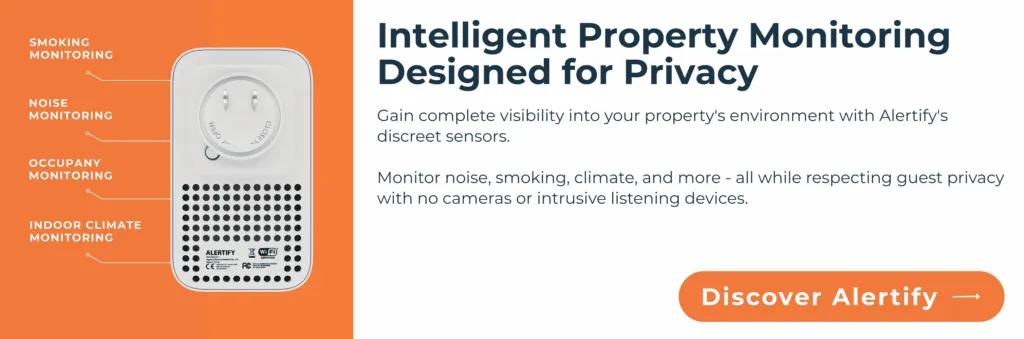
- See the Problem in Real-Time: An Alertify AQ+ monitor tracks temperature and humidity 24/7, displaying it on a simple dashboard.
- Get Proactive Alerts: Don’t wait for a musty smell. Alertify’s platform can send you an immediate alert if humidity in the school kitchen or basement locker room has been above 60% for 48 hours.
- The Alertify Mold Risk Assessment: Our smart algorithm does more than just report the humidity. It actively tracks trends over time to assess and flag high-risk areas for mold before it can grow. This proactive intelligence allows you to deploy a dehumidifier or fix a small leak, saving you from a six-figure remediation bill.
Effective school building humidity control and temperature management are the cornerstone of a healthy learning environment. It’s the key to reducing the risk of mold in school buildings and directly improving classroom temperature and student performance.
Ready to find your school’s “Goldilocks Zone”? Protect your students’ health, boost their performance, and prevent costly disasters. Alertify gives you the 24/7 temperature and humidity data you need to take control of your school’s environment.