Noise is one of the most persistent and least addressed challenges in education. It sits in the background of every classroom, every corridor, and every dormitory, quietly undermining the conditions that learning depends on. Most institutions treat it as an inevitable feature of campus life rather than a manageable variable, and that assumption is costing them more than they realize. Noise monitoring in schools is changing that equation, giving administrators and facility managers the real-time visibility they need to move from reactive complaint-handling to proactive environmental management. This guide covers what the research actually says about noise and learning, where campus noise really comes from, what it costs when left unmanaged, and how modern monitoring technology makes the problem measurably solvable.
The Science Is In: Noise Is Quietly Failing Your Students
The link between acoustic conditions and learning outcomes is not a matter of debate. Decades of research in cognitive psychology and educational acoustics have established clearly that elevated noise levels degrade the mental processes that learning depends on most. Yet in most institutions, acoustic quality receives far less attention than classroom resources, teaching methodology, or student support services, despite the evidence that it underpins all of them.
Working memory is the cognitive system responsible for holding and manipulating information in real time, and it is particularly vulnerable to auditory interference. When background noise competes with a teacher’s voice or a student’s internal processing, the brain must divide its attentional resources, and comprehension suffers. Studies have found that children mishear or fail to process a significant proportion of spoken instruction in classrooms that exceed recommended noise thresholds. For younger students, whose language processing systems are still maturing, the effect is more pronounced. A child who misses one word in every five does not simply have a minor inconvenience. They are losing the connective tissue of instruction, and that gap compounds across a school day, a term, and a year.
The way noise affects student performance extends well beyond individual lessons. Chronic exposure to elevated noise levels has been associated with slower reading acquisition, reduced vocabulary development, and lower standardized test scores, particularly in schools located near high-traffic roads, flight paths, or industrial zones. But internal noise sources are just as damaging, and far more within an institution’s direct control. That distinction matters, because it means the problem is actionable.
The Standards That Define the Problem
The American National Standards Institute, through ANSI/ASA S12.60, establishes the acoustic benchmarks that classrooms should meet. The standard recommends a maximum background noise level of 35 dB(A) in core learning spaces, a threshold that a significant proportion of real-world classrooms routinely exceed, often by 10 to 15 decibels or more. At those elevated levels, speech intelligibility drops substantially, and the gap between what a teacher says and what a student hears widens in ways that compound over time.
For students with hearing impairments or auditory processing differences, the stakes are even higher. When classroom acoustics fall below the recommended standard, the additional cognitive effort required to extract meaning from degraded speech signals creates a disproportionate burden on those students. The ADA requires that institutions make reasonable acoustic accommodations, and documented noise levels are a fundamental part of demonstrating that obligation is being met. Many institutions are carrying a quiet compliance liability in this area that they have not yet formally examined.
It is also worth noting that 40% of students report difficulty understanding their teachers due to background noise, according to data from educational monitoring research. That figure should give any administrator pause. When nearly half a student body is struggling to follow instruction because of the acoustic environment, the problem is systemic, not anecdotal. And systemic problems require systemic solutions, not individual classroom adjustments made on an ad hoc basis.
What Noise Does to Teachers
The effect on educational staff is equally well-documented and frequently underweighted in institutional planning. Teachers in consistently noisy environments raise their voices to maintain audibility, a pattern of sustained vocal effort that leads to fatigue, strain, and in persistent cases, chronic vocal disorders. Studies in occupational health have found that teachers are among the professional groups most affected by work-related voice problems, and acoustic conditions are a primary contributing factor.
Beyond the physical toll, noise-related stress is a meaningful driver of teacher burnout and attrition. When the basic conditions for effective instruction are compromised day after day, the cumulative effect on staff morale and retention is significant. When school noise management is treated as an afterthought, staff carry the cost of that decision in ways that show up in absence rates, performance, and ultimately turnover. The cost of replacing an experienced teacher is substantial by any measure, with recruitment, onboarding, and the productivity gap while a replacement settles into a role estimated at between 50% and 200% of an affected employee’s annual salary depending on seniority and subject specialism.
It’s Not Just the Loud Kids: Where Campus Noise Actually Comes From
Schools tend to frame noise as a behavioral problem: a matter of students being too loud, too disruptive, or insufficiently supervised. That framing is both incomplete and counterproductive, because it obscures the structural and environmental sources of noise that no amount of classroom management will address. Effective noise management requires understanding all of the sources, not just the most visible ones.
Mechanical and Infrastructure Noise
HVAC systems are among the most common sources of elevated background noise in classrooms, and they are often overlooked precisely because they are constant. An air handling unit operating at 45 dB(A) is already 10 decibels above the ANSI/ASA recommended maximum before a single student walks into the room. Aging infrastructure, poorly maintained ductwork, and systems not originally specified for educational acoustics all contribute to a baseline noise floor that forces teachers to project harder and students to work harder to hear.
Building fabric plays a role too. Corridors act as acoustic conduits, channeling sound from hallways, staircases, and adjacent spaces into classrooms. Cafeteria and gymnasium noise, which can reach 80 to 90 dB(A) during peak periods, bleeds into surrounding spaces when acoustic separation is inadequate. These are not behavioral problems. They are facility problems, and they require a facility-level response. The first step toward addressing them is knowing they exist, and knowing that requires measurement rather than assumption.
Event and After-Hours Noise
For institutions with residential facilities, the noise landscape shifts significantly outside of teaching hours. Common areas, shared kitchens, and social spaces generate noise patterns that are irregular, unpredictable, and often concentrated in the late evening and overnight hours when the impact on rest is most acute. Informal gatherings that escalate into unauthorized events are particularly difficult to manage through conventional supervision alone. By the time a complaint reaches a staff member and a response is organized, the disruption has often already run its course, and the opportunity to intervene meaningfully has passed.
Why Complaint-Based Systems Fall Short
Relying on complaints as the primary mechanism for identifying noise problems introduces a structural delay that consistently allows violations to resolve themselves before any intervention can occur, or to persist long enough to cause real harm before anyone acts. Complaints are also inherently subjective, prone to interpersonal dynamics, and difficult to use as the basis for formal policy enforcement. Two people can describe the same event in contradictory ways, and without objective data, institutions are left arbitrating rather than managing.
A classroom noise monitoring system built around real-time decibel data removes that subjectivity entirely. When the evidence is objective, timestamped, and threshold-referenced, the basis for action is clear, the documentation is already done, and the institutional response can be consistent rather than discretionary.
The Bill Nobody Budgets For
The financial consequences of unmanaged campus noise are real, varied, and largely invisible in standard institutional accounting, which is exactly why they tend not to get addressed until they become impossible to ignore. Understanding the ROI of noise monitoring in schools begins with mapping the costs that monitoring prevents.
Staff Costs
Absence is a direct operational expense. Staff sick days linked to stress, vocal strain, or noise-related health complaints add up across a school year, and the cost of cover, whether from supply teachers or internal redistribution of workload, is a line item that facilities and HR teams rarely attribute to acoustic conditions even when the connection is real. When the cause goes unaddressed, the cost recurs, year after year.
Turnover compounds the problem over time. When noise-related stress and vocal health problems are contributing factors to attrition, and the evidence suggests they frequently are, those replacement costs are attributable to an environmental condition that monitoring and management could mitigate. The conversation about noise is rarely framed in budget terms, but the financial case for addressing it is more robust than most administrators realize.
Reputational and Enrollment Risk
The connection between facility quality and enrollment decisions is well established at the university level, where prospective students and their families evaluate the residential and academic environment as part of their selection process. A campus known for noise problems in its dormitories or inconsistent acoustic conditions in its classrooms carries a reputational liability that is difficult to quantify precisely but real in its effect on applications, yield rates, and retention.
At the school level, inspection frameworks in multiple jurisdictions include learning environment quality as an assessment dimension. Documented evidence of active noise management, or the absence of it, can feature in inspection outcomes and shape the institution’s standing with regulators, parents, and governing bodies. The reputational dimension of acoustic quality is an underappreciated institutional risk.
Legal and Compliance Exposure
OSHA noise exposure guidelines set enforceable limits on occupational noise exposure for workers, and teaching staff are not exempt from those protections. Institutions that fail to monitor and manage noise levels in staff working environments carry a compliance liability that most have not formally assessed. The costs of inaction, including reactive complaint-handling, incident mediation, and potential legal proceedings, are consistently higher than the cost of proactive monitoring that identifies and addresses problems before they escalate.
Eyes on the Room, Without a Camera in Sight
Understanding what a modern noise monitoring system actually does, and does not do, is important context for administrators evaluating their options. The technology is often misunderstood, and the privacy concerns that sometimes arise are worth addressing directly and clearly.
What Monitoring Measures
A device-based noise monitoring system measures ambient sound levels continuously, expressed in decibels. It does not record audio, capture speech, or store any content of what is said in a space. The sensor detects whether the volume in a room exceeds a configured threshold, logs the time and intensity of that event, and triggers an alert to the relevant staff member or system. At no point is any conversation, instruction, or personal communication captured or retained.
This distinction matters enormously in an educational context, where student and staff privacy is a non-negotiable baseline. The benefits of noise monitoring for schools depend entirely on the technology being privacy-safe by design, and modern systems built for institutional use meet that standard without compromise. Monitoring ambient decibel levels and recording conversations are categorically different activities, and it is important that staff, students, and parents understand that distinction clearly before deployment.
How Alertify Works in Educational Settings
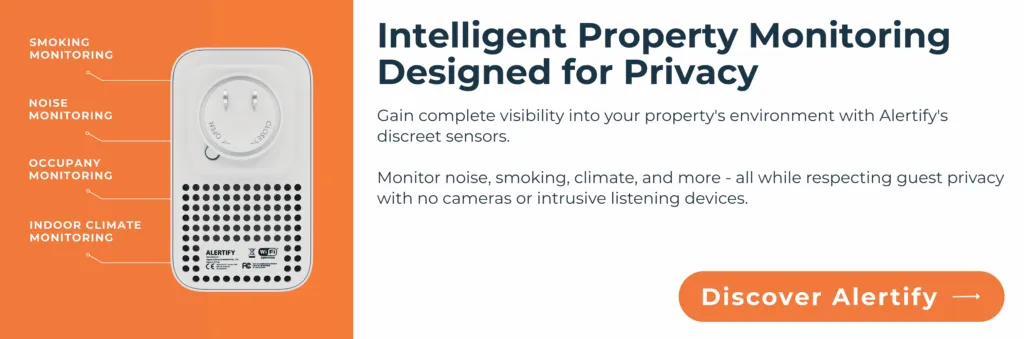
Alertify is a 100% privacy-safe monitoring platform that measures noise decibel levels across classrooms, corridors, dormitories, and common areas in real time. There is no audio recording, no microphone capture, and no video. Only continuous sound level data that gives facility managers and administrators accurate, actionable visibility into what is happening acoustically across their campus.
When noise exceeds a configured threshold, Alertify sends an instant alert via the app or email, allowing staff to respond promptly rather than waiting for a complaint to reach them through the usual channels. Each event is time-stamped and logged automatically, creating a documentary record that can be used in student conduct proceedings, staff wellbeing reviews, or compliance documentation. The Alertify dashboard retains incident history for over 180 days, making it possible to identify patterns, prepare reports, and respond to regulatory queries with accurate data.
Each device covers up to approximately 800 square feet and takes around 15 minutes to set up: plug in, connect to the property WiFi, and configure the unit on the dashboard. For institutions managing multiple buildings, the dashboard provides a consolidated view across all monitored spaces. Alertify’s noise monitoring feature supports configurable day and night thresholds, so the parameters applied during teaching hours can differ from those applied in residential spaces overnight, an important capability for campuses managing very different acoustic environments within the same institution.
Alertify’s data shows that 80% of noise disturbances are reduced with real-time monitoring and alerts in place, and that 75% fewer complaints are generated when accurate noise level tracking enables timely responses. For administrators weighing the investment, those figures represent a meaningful shift in the operational burden that noise currently places on staff every single day.
After Midnight: Why Dorms Are the Hardest Noise Problem to Solve
If classrooms are where noise disrupts learning during the day, dormitories are where it disrupts everything else: sleep, mental health, academic recovery, and the basic quality of residential life that students and their families are paying for.
When Students Don’t Sleep, the Grades Show It
Sleep is not a passive state. It is the period during which memory consolidation occurs, emotional regulation is restored, and the cognitive resources needed for the following day’s work are replenished. When sleep is disrupted, all of those processes are compromised. University students are already a population at elevated risk of sleep insufficiency, driven by academic pressure, social schedules, and the transition to independent living.
Residential noise compounds that risk significantly. Research consistently identifies noise from hallways, neighboring rooms, social events, and late-night gatherings as among the leading causes of sleep disruption in campus dormitory settings. The downstream effects are measurable: poor sleep quality is associated with lower GPA, higher rates of anxiety and depression, and increased likelihood of academic withdrawal. For institutions that invest heavily in student support services, allowing a manageable environmental factor to undermine those investments makes little institutional sense.
The Enforcement Gap No RA Can Fill Alone
Managing residential noise at night presents a structural challenge that supervision alone cannot solve. Resident advisors cannot monitor every floor simultaneously, and the gap between a noise event occurring and a complaint reaching someone empowered to act on it is typically long enough for the disruption to already be done. By the time an RA responds, the noise may have stopped, leaving no basis for formal action and no deterrent against repetition.
This is where dormitory noise monitoring delivers value that no staffing model can replicate. When a configurable overnight threshold is exceeded, whether in a corridor, a common room, or a residential suite, an alert reaches the responsible staff member immediately, enabling a response that is both timely and documented. Each event generates a timestamped, threshold-referenced record stored in the dashboard, providing the objective evidence that student conduct proceedings require. It replaces the contested, subjective complaint dynamic with verified data that can support formal policy enforcement consistently and fairly across the entire residential population.
Where to Start When Every Room Is a Problem
Implementing monitoring across a campus can feel overwhelming when the scale of the challenge is considered all at once. A phased, priority-driven approach makes the process manageable and ensures that the spaces where visibility delivers the most immediate value are covered first.
Conducting a Noise Audit
Before deploying any hardware, the most useful first step is a structured assessment of where noise problems are most acute and most consequential. This does not need to be a technically complex exercise. Facility managers, teaching staff, and residential advisors typically have a well-developed sense of which spaces are most problematic: classrooms adjacent to high-traffic corridors, dormitory floors with a history of complaints, common areas that function as informal late-night gathering spaces.
That qualitative knowledge, combined with any existing complaint logs or incident records, provides a reliable starting point for prioritization. Spaces where noise problems have generated formal complaints, triggered staff concerns, or been flagged in inspection reports should be considered high priority for initial deployment. Starting with two or three high-risk spaces allows an institution to build familiarity with the system and demonstrate value before scaling across the full estate.
Setting Thresholds That Match the Environment
Different spaces require different threshold configurations, and getting this right is important for ensuring that the system generates actionable alerts rather than an unmanageable volume of notifications. Classrooms during teaching hours might be configured to alert at 55 to 60 dB(A), capturing significant disruptions without triggering normal instructional activity. Dormitory corridors overnight might be set considerably lower, reflecting the quieter baseline expected during sleep hours.
Aligning thresholds with ANSI/ASA S12.60 recommendations for core learning spaces provides a defensible, standards-based framework for classroom monitoring. Local ordinances governing residential noise may provide equivalent guidance for dormitory and common area settings. Institutions operating across multiple campuses benefit particularly from the multi-building dashboard view that a noise monitoring system for schools like Alertify provides, making it possible to manage consistent threshold policies across different sites from a single interface without duplicating administrative effort.
Building Staff Buy-In
Monitoring technology is most effective when the people responsible for acting on alerts understand what the system does, why it has been implemented, and how the data it generates will be used. Communication with teaching staff, residential advisors, and facilities teams before deployment, covering the privacy-safe design, the threshold configuration rationale, and the alert workflow, reduces resistance and ensures that alerts are responded to effectively rather than ignored or worked around.
Transparency with students and parents is equally important. Informing the school community that environmental monitoring is in place, and being clear about what is and is not being captured, reinforces institutional accountability and acts as a meaningful deterrent in its own right. The discreet, unobtrusive design of a device like Alertify supports this approach: monitoring without surveillance, and visibility without intrusion.
Using Data to Drive Policy
The incident history generated by a monitoring system over time is a resource that extends well beyond individual event responses. Patterns in the data, including recurring high-noise periods, spaces that consistently exceed thresholds, and times of day or week where noise management is most challenging, provide the evidence base for updating institutional noise policies, targeting acoustic improvement investments, and demonstrating to inspection bodies or governing authorities that the institution is actively and effectively managing its acoustic environment.
The noise monitoring in educational facilities context differs from hospitality or commercial property management primarily in the breadth of stakeholders involved and the compliance dimensions that apply. But the core principle is the same: objective data makes consistent, defensible management possible in a way that subjective complaint systems never can. Institutions that build their noise policies around verified data are in a fundamentally stronger position, operationally, legally, and reputationally, than those that continue to rely on complaint-driven responses.
Quieter Campuses, Better Outcomes
Noise in schools is not an intractable problem. It is a measurable one, which means it is a manageable one. The research on what noise does to learning, staff wellbeing, and residential quality of life is clear. The costs of leaving it unaddressed, in staff turnover, compliance exposure, reputational risk, and lost student potential, are real and quantifiable. And the technology to monitor, alert on, and document noise events across every corner of a campus is available, privacy-safe, and straightforward to deploy.
The shift that monitoring enables is not just operational. It is cultural. When institutions can demonstrate that they take acoustic conditions seriously, that they have the data to back up their noise policies, and that they respond to violations promptly and consistently, the message to students, staff, and parents is clear: this is a place that invests in the conditions that learning requires.
Seventy percent of teachers report that noise disruptions significantly affect classroom learning environments. That is not a statistic that points to individual classroom failures. It is an institutional signal that the current approach to noise management is not working and that a different approach is needed. The infrastructure to support that different approach, real-time decibel monitoring, automated alerts, incident logging, and configurable thresholds across every space, exists today and is more accessible than most administrators assume.
The institutions that move first on this will not just reduce noise complaints. They will build quieter, healthier environments where students can actually learn and staff can actually teach, and they will have the data to prove it.
If you are ready to see what real-time noise monitoring looks like across your campus, book a demo with Alertify and find out how quickly the picture becomes clear.