
If you’re a school facilities manager or director, you are an unsung hero. You’re the first one in during a snowstorm and the last one to leave during a flood. You’re asked to perform magic every day: keep 50-year-old boilers running, patch leaking roofs, and do it all on a budget that seems to shrink every year.
Now, you’re at the center of a new, urgent conversation: indoor air quality in schools. You know it’s important, but you’re stuck. The budget for deferred maintenance in schools is already a mile long. You can’t just find a few million dollars for upgrading school HVAC systems across the district.
So what can you do?
This post is for you. We’re not going to suggest a fantasy solution. We’re going to provide a practical, data-driven roadmap for achieving massive school ventilation improvement without a massive budget. The key is to stop guessing and start using smart, affordable technology to make your existing systems work smarter, not harder.
The Root of the Problem: How We Got Here
Understanding the problem is the first step. Most school facilities issues are a product of their history.
- The 1970s Energy Crisis: This is the “original sin” of modern ventilation. In an effort to save on heating costs, we sealed our buildings tight. We caulked windows, added insulation, and reduced the amount of fresh (and expensive-to-heat) outside air. We saved energy, but we also trapped every indoor pollutant – CO2, VOCs, and viruses – inside with us.
- The “Run-to-Fail” Budget: School funding is tight. Budgets prioritize visible, urgent needs. An HVAC system is “out of sight, out of mind” until it breaks completely. This “run-to-fail” model means that deferred maintenance in schools isn’t a choice; it’s the only option. Filters don’t get changed, dampers get stuck, and sensors fail… and no one knows.
- One-Size-Fits-All Systems: Most old HVAC systems are “dumb.” They are set on a simple timer, treating an empty gym at 8 PM the same as a packed one at 1 PM. This is incredibly inefficient, either over-ventilating and wasting energy or, more likely, under-ventilating and creating a poor learning environment.
A Phased Approach: Beyond the “Rip and Replace” Fantasy
The idea that you can get board approval for upgrading school HVAC systems district-wide is often a non-starter. A more practical approach to school ventilation improvement starts with data.
Phase 1: Audit and Baseline (Stop Guessing) You can’t fix what you can’t measure. Before you spend a dime, you need to know where your actual problems are. Is the IAQ problem in every room, or is it just the 1960s wing? Is the cafeteria’s CO2 level high all day, or just during lunch? A one-time air quality test is a snapshot but you need a video.
Phase 2: Low-Cost Fixes (Optimize What You Have) Once you have data, you can target low-cost fixes:
- Replace clogged filters.
- Test and un-stick fresh air intake dampers.
- Adjust system timers to align better with occupancy schedules.
Phase 3: Smart Augmentation (The Force Multiplier) This is the game-changer. Instead of a multi-million dollar “rip and replace,” you use affordable, modern sensors to make your old system smart. This is where a platform like Alertify comes in.
How Smart Monitoring Makes Old HVAC Smart
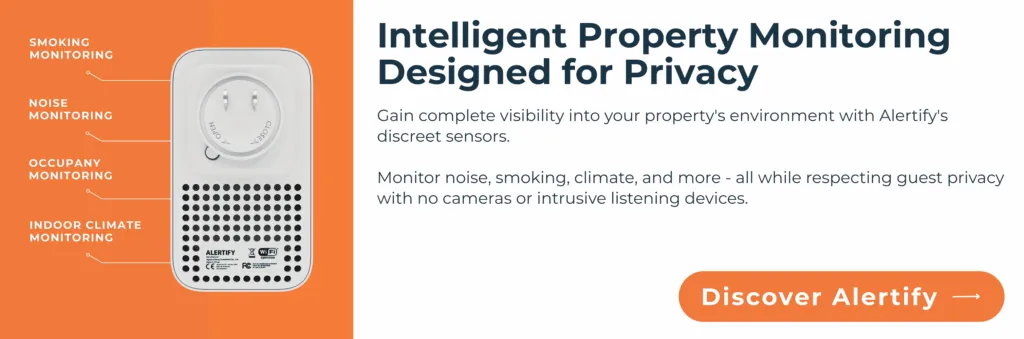
Alertify’s monitoring platform is a facilities manager’s new best friend. By placing simple, all-in-one sensors in key areas, you get a real-time “command center” for your building’s health.
Achieve Data-Driven Ventilation
This is the key. You stop ventilating based on a timer and start ventilating based on need.
- The Scenario: An Alertify sensor in the cafeteria shows CO2 levels are 700 ppm (great!) at 11:00 AM. But at 12:15 PM, it spikes to 2,200 ppm.
- The “Dumb” Solution: Ventilate the cafeteria at 100% all day long, wasting a massive amount of energy.
- The “Smart” Solution: The Alertify sensor sends an alert to boost ventilation to the cafeteria only when CO2 levels are high.
This data-driven approach is the most cost-effective school ventilation improvement you can make. It solves the indoor air quality in schools problem and saves you money on energy by not heating or cooling fresh air for an empty room.
Get Proactive Maintenance Alerts
Alertify does more than CO2. It tracks humidity, temperature, and PM2.5.
- The Scenario: A sensor in the basement locker room shows humidity has been at 75% for three straight days.
- The Old Way: You find out in 6 months when a teacher complains about a musty smell, and you discover a $100,000 mold problem.
- The Alertify Way: You get an automatic “Mold Risk” alert on day 3. You send a technician, who finds a small, slow leak in a pipe. A $200 repair today saves you $100,000 later.
Finally Justify Your Budget
This might be the most powerful tool of all. For years, you’ve been telling the school board you have problems. Now, you can show them.
Instead of saying, “The HVAC in the old wing is failing,” you can present a dashboard: “Every classroom in the 300-wing hits CO2 levels of 3,000 ppm by 11 AM, which research shows is actively harming student learning. Here is the data.”
This hard, objective data transforms you from a cost center into a strategic partner. It’s the ultimate tool for shaking loose the funds for deferred maintenance in schools and targeted, smart upgrading of school HVAC systems.
Ready to become a data-driven facilities leader? Stop fighting fires and start preventing them. Alertify gives you the 24/7 visibility you need to optimize your buildings, save money on energy, and make an undeniable case for your budget. Book a demo today.