Not all noise monitoring technology is created equal. As the market for property monitoring devices has grown, so has the range of options from basic decibel loggers with no alert functionality to sophisticated systems that combine noise monitoring, occupancy detection, smoking detection, and automated messaging in a single plug-and-play device. For landlords who want real protection, understanding what separates a genuinely useful noise monitoring device for landlords from a gadget that looks good on a spec sheet is essential.
If you are managing single family rentals and exploring noise monitoring for single family rentals as a solution to noise violations, HOA compliance issues, or tenant disputes, this guide will help you identify the features that actually make a difference and explain why Alertify has become the go-to choice for landlords who want comprehensive, privacy-safe property monitoring.
Key Features to Evaluate in Any Noise Monitoring Device
The first thing to understand is that decibel measurement alone is not enough. A device that simply logs sound levels without triggering alerts, sending automated messages, or creating downloadable reports does not solve the core problem. Landlords need to know about noise events in real time and have the documentation to act on them. Here is what to evaluate:
Real-time Alerting: The entire value of noise monitoring depends on timely intervention. A device that logs data passively without alerting you when thresholds are exceeded is only useful after the fact and by then, the neighbor has already called the city. Look for a system that sends immediate push notifications or SMS alerts when noise levels exceed your customizable threshold.
Automated Messaging: The most operationally efficient systems go one step further than alerting the landlord they also automatically notify the tenant. Alertify’s Guest Alert feature sends a discreet, pre-configured message to the tenant when noise levels are triggered, without the landlord having to make a single call. This single feature is responsible for the 90% auto-resolution rate within 10 minutes that Alertify customers experience.
Documentary Evidence and Reporting: Any noise monitoring device worth considering should log every event with a timestamp, a decibel reading, and a record of any alerts or automated messages sent in response. This data should be exportable as a downloadable report that can be shared with an HOA, a city enforcement officer, or used in a legal dispute. Alertify’s documentary evidence feature is built specifically for this purpose.
Privacy Compliance: This is non-negotiable. A device that records audio inside a residential rental is legally problematic in most U.S. states and will expose landlords to significant liability. Alertify measures decibel levels without recording audio, no speech, no conversations, no private communications. This is the correct design for a residential monitoring solution, and it is what makes the technology appropriate for use in a tenant-occupied home.
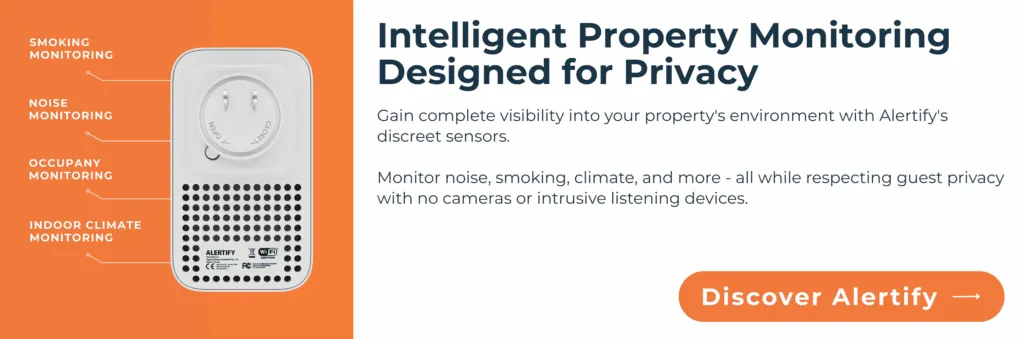
Multi-Sensor Capability: The most valuable monitoring devices do more than measure noise. Alertify also monitors occupancy signals, smoke, CO2 levels, temperature, and humidity giving landlords a complete environmental picture of what is happening in their property, not just a noise log.
Why Alertify Stands Apart as a Noise Monitoring Device for Landlords
Alertify was specifically designed for property managers and landlords managing residential rentals, which means its features reflect the actual workflows and pain points of the industry rather than a generic consumer electronics approach.
The device installs in 15 minutes, no technician required, no hardwiring, no complicated setup process. It plugs directly into a standard wall outlet, connects to the property’s Wi-Fi, and begins monitoring immediately. A built-in backup battery means the device continues functioning even if the power goes out, which is particularly relevant during events where tenants might be motivated to cut power to disable monitoring.
The Alertify dashboard gives landlords a centralized view of all their properties, with real-time data on noise levels, occupancy indicators, smoking detections, and indoor air quality readings. For landlords managing a portfolio of single family rentals, this single-pane-of-glass view eliminates the need to check multiple systems or wait for complaints to learn about problems.
The data retention policy is also a differentiator. Alertify stores incident data for a minimum of 180 days, which means that even if a noise dispute surfaces weeks or months after the fact, the documentation is still available. This is critical for landlords dealing with HOA violations or security deposit disputes where the timeline between incident and formal complaint can be significant.
For landlords committed to serious noise monitoring for single family rentals, Alertify delivers the complete package: real-time alerts, automated messaging, comprehensive sensor coverage, privacy-safe design, and court-admissible documentary evidence all in a device that is up and running in under 20 minutes.
Matching the Device to Your Property’s Needs
Different properties have different monitoring requirements. A single family rental in an HOA community with strict quiet hours has different needs than a rural property where noise complaints from neighbors are unlikely. Understanding your specific risk profile helps you configure the monitoring system for maximum effectiveness.
For HOA-governed properties, set your noise threshold slightly below the HOA’s limit typically 5 to 10 decibels lower to give yourself a buffer for intervention before a formal violation occurs. For properties in urban neighborhoods where noise ordinances are actively enforced, consider using Alertify’s occupancy monitoring alongside noise monitoring to get earlier warning of gatherings before they reach complaint-triggering levels.
For landlords managing rental property noise complaints history at a specific property, Alertify’s data becomes particularly valuable as a baseline record. Establishing what “normal” looks like at the property gives you a clear reference point for identifying anomalies and documenting the contrast between typical behavior and violation events.
Make Noise Monitoring Part of Your Standard Operating Procedure
The most successful landlords treat monitoring technology the way they treat landlord insurance not as a reaction to a problem, but as a standard operational safeguard that is in place from day one of every tenancy. When you deploy a noise monitoring device proactively, disclose it properly in the lease, and configure it to match your property’s specific risk profile, you create a management environment where violations are less frequent and, when they do occur, easily documented and resolved.
Book a free Alertify demo to see the full range of features and understand how other single family rental landlords are using the platform to protect their properties and manage with confidence.