
It starts innocently enough. A tenant mentions they’re having a few friends over for the weekend. By Friday night, there are 40 people on your property, music thumping past midnight, and a neighbor already dialing the city’s noise complaint line. By the time you find out, the damage, financial, relational, and possibly physical is already in motion.
Knowing how to prevent unauthorized parties in a rental property is one of the most important skills a landlord can develop. Unauthorized gatherings are a leading cause of property damage, noise violations, HOA fines, and costly tenant disputes. And in today’s rental market, the tools to prevent them are more accessible than ever. If you’re serious about noise monitoring for single family rentals, preventing unauthorized parties is where that investment pays off fastest.
Why Unauthorized Parties Are Such a Serious Threat to Rental Properties
Unauthorized parties don’t just create noise. They create a cascade of problems that can follow a property for months. The most immediate concern is noise decibel levels that spike well beyond local ordinance limits, triggering neighbor complaints and municipal violations. But the downstream consequences are often worse.
Physical damage is the most financially significant risk. A gathering of 30 or 40 people in a single family home creates a very different wear pattern than a family of four. Furniture gets damaged, walls take hits, flooring is stained, and outdoor areas bear the brunt of foot traffic and spills. Security deposits rarely cover the full cost of remediation, and disputing damage claims with tenants who deny accountability is a time-consuming, emotionally draining process.
There is also the question of liability. If a guest at an unauthorized party is injured on your property, you as the landlord may face exposure depending on the circumstances and your state’s premises liability laws. Insurance policies sometimes exclude coverage for incidents related to undisclosed rental activity. Understanding your exposure and taking active steps to reduce it is part of responsible property ownership.
Finally, there is the reputational cost. In HOA-governed communities, a single high-profile incident can mark your property as a problem rental. Neighbors remember. HOA boards remember. And if you ever want to list the property on a short-term rental platform, a history of noise complaints is reflected in reviews that future guests can read.
Using Occupancy Monitoring to Detect Gatherings in Real Time
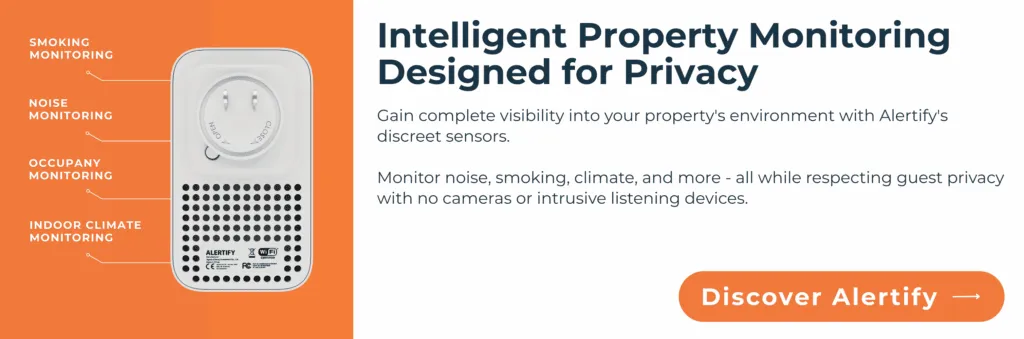
The most effective technological solution for how to prevent unauthorized parties in a rental property is real-time occupancy monitoring. Alertify’s occupancy detection feature measures environmental signals including CO2 levels, temperature, and humidity that reliably indicate when significantly more people are present in a property than is typical.
This matters because noise alone is a lagging indicator. By the time noise levels spike to the point where a neighbor complains, a party is already well underway. Occupancy signals often escalate before the noise does, giving landlords earlier warning and a wider window for intervention.
When Alertify detects occupancy levels that fall outside normal patterns for a given property and those elevated readings coincide with noise levels approaching the threshold the system can trigger an automated alert to both the landlord and the tenant. The tenant receives a message reminding them of the lease’s guest policy and noise rules. The intervention is discreet, immediate, and effective. Alertify data shows that 90% of violations auto-resolve within 10 minutes of an automated alert being sent.
For landlords practicing noise monitoring for single family rentals, this combination of occupancy detection and noise monitoring creates a proactive early-warning system that stops parties before they escalate, rather than managing the aftermath the next morning.
Lease Clauses, Disclosures, and Technology Working Together
Technology is most effective when it is paired with clear lease provisions. Preventing unauthorized parties starts with the lease itself. Your rental agreement should explicitly define the maximum number of guests permitted, the hours during which gatherings are allowed, and the consequences of violations including pass-through provisions for any fines you receive as a result of tenant behavior.
Disclosing your monitoring system in the lease is both a legal requirement in most states and a practical deterrence tool. Tenants who know that occupancy and noise levels are being monitored in real time are significantly less likely to push boundaries. The monitoring system’s deterrence value is partly dependent on tenants knowing it exists.
Pair your lease disclosures with clear communication during move-in. Walk tenants through the monitoring system, explain that it measures environmental conditions and noise levels but does not record audio or video, and reinforce the lease’s guest and noise policies. When expectations are set clearly from day one, violations are less frequent and easier to address when they do occur.
Protect Your Property Before the Next Weekend
Preventing unauthorized parties is not about treating tenants as adversaries. It is about setting clear expectations, using tools that make compliance easy, and protecting an investment that matters. Combining solid lease provisions with Alertify’s real-time occupancy monitoring and noise detection gives you the complete picture you need to intervene early, document accurately, and manage confidently.
The cost of a party that goes unchecked can run into thousands of dollars. The cost of the monitoring system that prevents it is a fraction of that. Book a free Alertify demo and see how landlords across the country are using occupancy and noise monitoring to keep their single family rentals protected.