
You’re a careful landlord. You screened your tenant thoroughly, wrote a solid lease, and set clear expectations about noise and neighbors. Then you get the call that a neighbor is complaining about excessive noise coming from your rental. Your tenant says it wasn’t that loud. The neighbor says it was. And you are stuck in the middle, trying to resolve a dispute you didn’t witness, with no evidence to work with and two people who each believe they are completely in the right.
A neighbor’s noise complaint towards your rental property is one of the most common and most frustrating challenges in residential property management. Without objective data, these disputes are almost impossible to resolve fairly. With objective data, they can be resolved quickly, fairly, and with the documentation needed to prevent them from escalating into fines, legal proceedings, or HOA violations.
This is where noise monitoring for single family rentals transforms the equation entirely.
Why Noise Complaints Without Evidence Are So Difficult to Resolve
The core problem with noise complaint disputes is that they come down to competing testimonies. The neighbor claims the noise was excessive and disruptive. The tenant claims it was a normal evening. You, as the landlord, have no way to know who is telling the truth and neither does the HOA board or the city housing officer who receives the formal complaint.
In this environment, the party who pursues the dispute most aggressively tends to win, not the party who is most accurate. Neighbors who are willing to file formal complaints, escalate to the HOA, or pursue a city noise violation have a structural advantage over landlords who are simply trying to manage a situation they did not observe.
There is also a pattern problem. A single isolated noise complaint is one thing. But if a neighbor is filing repeated complaints about a property, and the landlord cannot determine whether those complaints are legitimate or exaggerated, managing the situation becomes genuinely difficult. You risk either ignoring real violations or alienating a good tenant based on potentially inflated accusations.
Objective sensor data cuts through both of these problems. When you have a timestamped log of decibel readings for every evening in question, the dispute changes character entirely. Either the data confirms that noise levels were elevated in which case you have the evidence to take action against the tenant or it confirms that noise levels were within normal limits, in which case you can respond to the complaint with confidence and documentation.
Using Alertify Data to Respond to a Neighbor Noise Complaint Rental Property Dispute
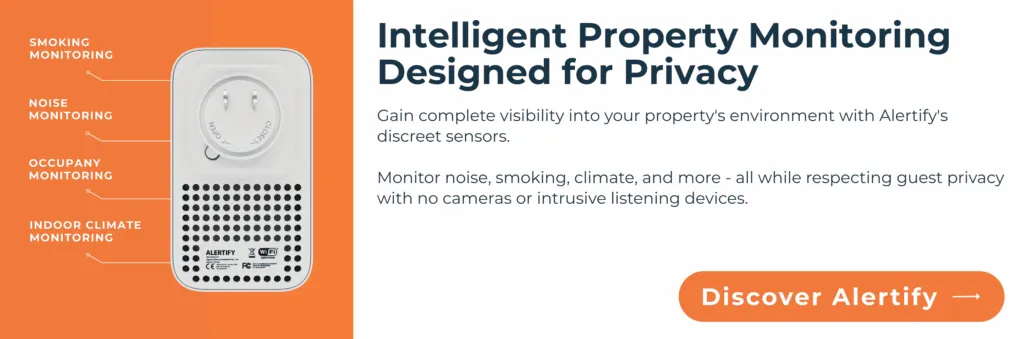
Alertify’s noise monitoring device logs every detected noise event with a timestamp, a decibel reading, the duration of the event, and a record of any alerts or automated messages triggered in response. This data is stored for a minimum of 180 days and is accessible as a downloadable documentary evidence report at any time.
When a noise dispute arises, you can pull the sensor data for the specific dates and times in question and review exactly what happened. If noise levels exceeded your threshold, the data will show it along with documentation that you were alerted and that an automated message was sent to the tenant. This demonstrates to the HOA, the city, or any other party reviewing the complaint that you are managing the property actively and responsibly.
If the data shows that noise levels were within normal limits on the dates of the complaint, you have an equally powerful tool. You can respond to the neighbor, the HOA, or the city with objective evidence that contradicts the complaint not defensively, but factually. A clean noise log for the relevant dates is a far stronger defense than a landlord’s assertion that their tenant is well-behaved.
This is the core value proposition of documentary evidence in property management: it removes subjective judgment from situations that should be resolved on facts. Alertify’s incident reports are specifically designed to meet the evidentiary standards of formal dispute resolution processes, including small claims court and HOA violation hearings.
Proactive Monitoring Prevents Most Complaints Before They’re Filed
The most effective way to handle a noise complaint is to prevent it from happening in the first place. Alertify’s real-time alerting and Guest Alert automated messaging system means that in the majority of cases, noise violations are identified and addressed before they reach a level that prompts a neighbor complaint.
When a tenant receives an automated notification that noise levels have exceeded the threshold before the neighbor picks up the phone the vast majority of incidents resolve themselves within 10 minutes. The party is turned down, the television is lowered, the gathering wraps up early. No formal complaint is filed, no violation is recorded, and the neighbor’s evening returns to normal without anyone having to make an awkward phone call.
This proactive approach benefits everyone involved. Tenants avoid formal lease violations. Neighbors get a quieter evening. Landlords avoid fines, HOA notices, and the time cost of managing disputes. And the relationship between all parties remains functional rather than adversarial.
For landlords who manage properties in communities where noise complaints have been a recurring issue, demonstrating to the HOA that active monitoring is in place and providing incident logs that show a pattern of proactive intervention can meaningfully improve standing with the association and reduce the risk of escalating enforcement action.
Turn Disputes Into Documentation-Backed Decisions
A neighbor’s noise complaint dispute does not have to be a management nightmare. With the right monitoring system in place, you have the data to respond to every complaint legitimate or otherwise from a position of knowledge and confidence. Alertify gives you real-time visibility, automated intervention, and court-admissible documentary evidence, all without recording a single word spoken inside your property.
Book a free Alertify demo today and discover how landlords across the country are using objective noise data to manage disputes fairly, protect tenant relationships, and keep their properties compliant.