
Smoking is the single most expensive guest violation most hosts will ever deal with, and it’s rarely obvious until the next guest checks in and mentions the smell. Vacation rental smoking detection exists to close that gap, catching a violation the moment it happens instead of discovering it during a cleaning turnover or, worse, in a review. This post covers what indoor smoking actually costs, why house rules alone don’t stop it, and how detection technology fits into a broader approach to protecting a property.
The Real Cost of Indoor Smoking Damage
Smoke doesn’t stay where it starts. It settles into fabric, drywall, and HVAC ductwork, which is why a single indoor smoking incident can affect a unit’s condition for far longer than the stay itself. According to Angi’s cost data on smoke damage remediation, professional smoke cleanup averages around $3,000 per job, with costs ranging from as little as $200 for a lightly affected room to $12,000 for extensive, whole-home remediation. HVAC duct cleaning alone, often necessary after repeated indoor smoking, can add another $150 to $800 on top of that.
For a host running one or two properties, a single incident like this can wipe out weeks of booking revenue, and that’s before factoring in the near-certain negative review from the next guest who checks into a unit that still smells like the last one. Odor is also one of the hardest forms of damage to fully eliminate. Even after professional remediation, lingering smoke smell in soft furnishings or ductwork can resurface in humid weather, meaning the true cost of a single incident sometimes extends well beyond the initial cleaning invoice.
Why ‘No Smoking’ Policies Alone Fail
A no-smoking clause in the listing description sets an expectation, but it does nothing to stop a guest from lighting up once they’re inside with the door closed. Enforcement, not policy, is where most hosts run into trouble. By the time a cleaner discovers burn marks, ash, or lingering odor, the guest has already checked out and is difficult to hold accountable for anything beyond a disputed cleaning fee.
This is the core problem with relying on the honor system: a policy only works on guests who were already planning to follow it. The guests who cause the actual damage are, by definition, the ones a written rule never reached. Some hosts try to compensate with a large refundable smoking deposit, but that only works if the smoking is ever proven, and proving it after the fact usually comes down to a lingering smell that a guest can simply deny caused it, leaving the host with little real recourse.
How Smoke Detection Technology Closes the Gap
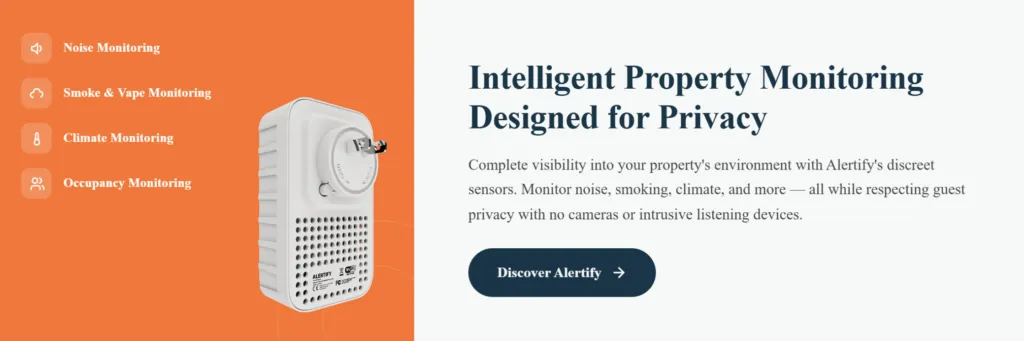
Alertify’s smoking detection identifies a smoking event the moment it happens and sends an alert to the host in real time, whether it involves a cigarette, vape, or cannabis. The device flags that a smoking event occurred; the specific substance is then logged manually by the host in the violation dashboard, giving an accurate, time-stamped record rather than relying on guesswork.
That timing difference is what makes an indoor smoking monitor useful beyond simply confirming what already happened. A real-time alert lets a host send an automated warning while the guest is still on-site, often stopping the behavior before serious damage accumulates. If damage does occur anyway, a time-stamped incident report makes it far easier to recover cleaning costs through a security deposit claim rather than absorbing the loss outright. This is exactly the kind of documented, catch-it-early approach that makes up real vacation rental protection, rather than a policy that only looks good in the listing description.
It also removes the guesswork that normally follows a smoking dispute. Guests who are confronted with a vague accusation often deny it outright, and without evidence a host is left choosing between an uncomfortable standoff and simply eating the cost. A time-stamped alert changes that conversation from “we think someone smoked in here” to a documented event with a specific date and time attached to it.
Protect Your Property From Smoking Damage
Preventing smoking damage isn’t about assuming the worst of every guest. It’s about having a system that catches the small percentage who ignore the rules before their stay becomes a five-figure repair bill. A clear house policy sets expectations, and real-time detection backs it up when a guest decides not to follow them. Together, they shift the entire conversation from cleanup after the fact to prevention while a stay is still underway, which tends to save far more in avoided damage than it costs in device setup.
If indoor smoking has cost your property before, book a free demo and we’ll show you how real-time detection and automated alerts work on a property like yours.