Most short-term rental hosts who lose smoking damage claims do not lose because their damage was not real. They lose because their documentation was not strong enough to survive the dispute resolution process. Platform resolution teams do not visit your property. They cannot smell the smoke or see the staining on your ceiling. What they can evaluate is the evidence you submit, and in the vast majority of contested Airbnb smoking damage claims, the host who wins is simply the host who prepared better.
Hosts who win smoking damage disputes consistently are not necessarily the ones with the most damage, they are the ones with the strongest evidence package. Building that evidence package starts with smoking monitoring for your vacation rental, and this is how to do it right.
How to Build Your Airbnb Smoking Damage Claim Foundation: Before, During, and After Every Stay
The single most important thing you can do to win a future smoking damage dispute is build a systematic documentation practice that generates evidence at every turnover, not just after an incident occurs.
Pre-stay documentation is the baseline. Before every new booking, conduct a brief walkthrough of the property and capture timestamped photographs of walls, ceilings, soft furnishings, and any surfaces that would show smoke damage or discoloration. This establishes the condition of the property at the start of the guest’s stay and is the reference point against which post-stay damage will be compared. Without it, a guest can credibly argue that the damage pre-existed their stay, and without photographic evidence to the contrary, platform resolution teams frequently give guests the benefit of the doubt.
Post-stay documentation should be captured as quickly as possible after checkout, ideally within hours, before any cleaning has taken place. Photograph everything that shows signs of smoking: discoloration on walls or ceilings, ash or cigarette debris, burn marks, residue on surfaces. Include wide shots that establish context and close-ups that show detail. Timestamps are essential, they demonstrate that the damage was documented contemporaneously, not assembled days later.
Professional remediation invoices are the third pillar of your evidence package. When you submit a damage claim, the remediation cost should be supported by an itemized invoice from a professional service rather than a self-assessed estimate. Platform resolution teams are significantly more likely to approve claims supported by third-party documentation of both the damage and its cost. This is the foundation of any successful vacation rental damage dispute evidence package, and it applies whether you are filing through Airbnb, VRBO, or any other platform.
How Monitoring Data Transforms Your Airbnb Smoking Damage Claim
Photographs and invoices establish that damage occurred. Monitoring data establishes that it occurred during this guest’s stay, which is the specific evidentiary gap that causes many otherwise well-documented claims to fail.
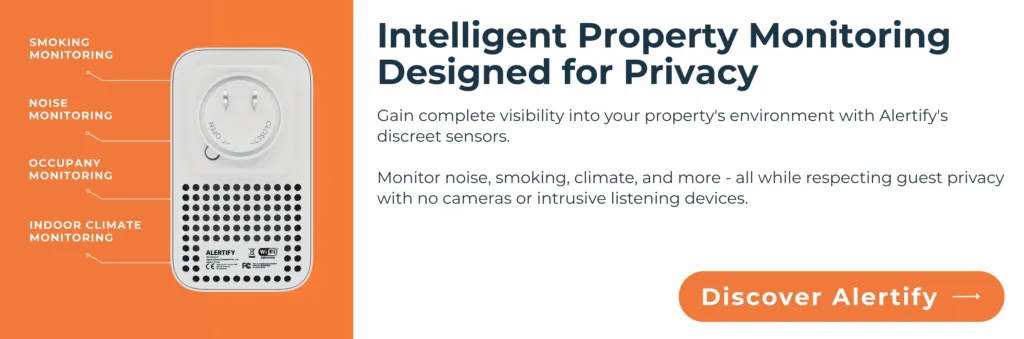
Alertify’s indoor smoking monitor logs every detection event with a precise timestamp, the duration of the event, and the type of smoking detected. When a guest disputes a damage claim by arguing that the damage pre-existed their stay or was caused by someone else, a monitoring report showing a smoking detection event on night two of their booking at 11:17pm is not easily dismissed. It is contemporaneous, objective, third-party data that corroborates your claim in exactly the way that a cleaner’s subjective report cannot.
This documentary evidence is downloadable directly from the Alertify platform and is formatted for use in platform dispute submissions. Hosts who have used Alertify monitoring data in Airbnb and VRBO damage claim disputes report significantly higher success rates than those relying on photographic evidence and cleaner reports alone. The monitoring report does not replace those elements, it completes the evidence package by filling the temporal gap between the start of the stay and the discovery of the damage.
There is also a prevention dimension worth noting. When guests know that the property uses real-time smoking monitoring, disclosed in your house rules and pre-arrival communication, the likelihood of a smoking violation occurring in the first place decreases substantially. Fewer violations means fewer claims, fewer disputes, and fewer difficult guest conversations.
Submitting Your Claim — What the Platforms Actually Need for a VRBO Smoking Chargeback or Airbnb Dispute
Understanding how platform resolution processes work gives you a meaningful advantage in preparing your submission. Both Airbnb’s AirCover for Hosts and VRBO’s damage protection programs operate on a documentation review model, a resolution team member evaluates your submitted evidence against the guest’s response and makes a determination based on the comparative strength of both sides’ documentation.
Submit your claim promptly. Both platforms have time windows within which damage claims must be filed. Airbnb requires claims to be initiated before the next guest checks in or within 14 days of checkout, whichever comes first. Missing this window forfeits your claim regardless of the strength of your evidence.
In your claim submission, be specific. Reference the exact policy clause that was violated, cite the monitoring data timestamp if available, include your pre-stay and post-stay photographs in chronological order, and attach the remediation invoice. A clear, organized, evidence-based submission is processed faster and approved more frequently than a narrative complaint unsupported by documentation. When dealing with a VRBO smoking chargeback, the same principles apply: objective evidence, precise timestamps, and third-party remediation costs are the three elements that platform resolution teams consistently respond to.
WelcomeLink: Your First Line of Defence Before Smoking Damage Happens
The most effective smoking damage strategy does not begin after checkout, it begins before the guest ever arrives. Alertify’s WelcomeLink service gives hosts a structured, documented pre-arrival workflow that creates legally defensible accountability from the moment a booking is confirmed, closing the enforcement gap that most hosts leave open.
Through WelcomeLink, every guest is required to digitally sign your house rules and guest agreement before receiving check-in instructions. This is not a checkbox on a booking platform, it is a standalone, timestamped document that records the guest’s explicit acknowledgement of your no-smoking policy. If a smoking incident occurs and the guest disputes the charge, that signed agreement is your first piece of documentary evidence. They cannot claim they were unaware of the rule. They cannot argue the policy was buried in fine print. The signature is on record.
WelcomeLink also collects a government-issued ID and a real-time selfie from the guest, matched and stored against the booking. This matters more than most hosts realise. In platform disputes, chargebacks, and even small claims proceedings, one of the most common guest defences is denial, claiming the damage was pre-existing, or that someone else in the party was responsible. A verified ID matched to a selfie, linked to the signed agreement, directly counters that defence. You can demonstrate precisely who made the booking, who agreed to the rules, and who was verified as present at check-in.
On the financial side, WelcomeLink enables you to collect a damage deposit directly from guests as part of the pre-arrival flow. Unlike the security deposit mechanisms built into Airbnb or VRBO, which are controlled by the platform and subject to their own approval processes, a WelcomeLink deposit is held by you. When smoking damage is confirmed at checkout, you have the option to retain the deposit rather than automatically releasing the funds, supported by an evidence trail that is difficult to dispute.
When a claim does need to go to Airbnb AirCover, VRBO’s resolution centre, or Stripe for a fraudulent chargeback, the WelcomeLink documentation bundle gives you everything platform and payment reviewers are looking for: the signed guest agreement confirming policy acknowledgement, the verified ID and selfie establishing the identity of the responsible party, Alertify’s timestamped smoking detection data, pre- and post-stay photographs, and the remediation invoice. A guest who files a fraudulent dispute claiming they never agreed to the charge, or that the damage was pre-existing, is directly contradicted by all of the above. Each document in isolation is useful. Together, they form a case that is exceptionally difficult to reverse. For hosts managing multiple properties or higher-value listings, WelcomeLink quietly transforms the pre-arrival process from a hospitality formality into a robust risk management system, one that builds the evidentiary foundation you need long before a problem ever arises.
If your initial claim is declined or partially approved, you have the right to escalate to a formal dispute review. At this stage, monitoring data from Alertify’s Guest Alert system is particularly valuable, a timestamped detection report is objective evidence that a human reviewer’s judgment cannot easily override.
Book a demo with Alertify to see how the platform’s incident reporting works and how it integrates with your damage claim process.