In the high-stakes world of hospitality management, financial planning usually revolves around marketing spend, renovation budgets, and staffing costs. However, there is a “silent line item” that many General Managers and Asset Directors fail to account for until it is too late: the catastrophic cost of unmitigated moisture. While investing in monitoring technology is often viewed as an operational expense, the reality is that mold prevention is, first and foremost, a revenue protection strategy.
When a hotelier views mold remediation as merely a housekeeping issue, they are underestimating the financial threat. The cost of addressing a mold outbreak goes far beyond a bucket of bleach and a fresh coat of paint. It involves a complex web of direct remediation costs, operational downtime, and potential legal settlements that can cripple a property’s annual profit margin.
The Anatomy of a Remediation Bill
To understand the Return on Investment (ROI) of prevention, one must first dissect the cost of the alternative. When mold becomes visible to the naked eye or detectable by smell, the damage is rarely superficial. It is typically the “tip of the iceberg,” signaling that the fungal root system has penetrated porous materials.
The Construction Project You Didn’t Plan For
Treating a mold-infested guest room is not a simple cleaning task; it is a hazardous material construction project. The moment a spore outbreak is confirmed, the room must be taken offline. The process requires a Certified Industrial Hygienist to conduct testing, followed by the establishment of negative-pressure containment zones to protect the rest of the hotel.
Once containment is set, the demolition begins. Drywall, insulation, expensive millwork, and carpets often need to be ripped out and discarded. Since porous materials cannot be 100% sanitized, soft goods like mattresses, drapes, and upholstered furniture are frequently written off as total losses. The bill for materials and specialized labor alone can run into the tens of thousands for a single suite. If the issue is systemic – such as a central HVAC failure affecting a whole floor – the costs can escalate into the millions.
The Hidden Killer: RevPAR and Business Interruption
While the direct costs of construction are painful, the indirect costs of downtime are often the true killer of profitability. In the hotel industry, inventory is perishable. You cannot sell last night’s empty room today.
Calculating the Loss of Inventory
Consider a scenario where a premium suite commanding $350 per night requires three weeks for full remediation and restoration. That equates to over $7,300 in immediate lost room revenue. However, the impact ripples further. If the hotel is at high occupancy, you may be forced to “walk” guests to competitor properties, paying for their stays and eroding their loyalty to your brand.
Taking inventory offline directly impacts your Revenue Per Available Room (RevPAR), the primary metric by which investors and owners judge performance. A lower RevPAR devalues the asset and can complicate refinancing or sales discussions. Prevention is not just about keeping walls clean; it is about keeping inventory live and sellable.
Legal Liability and the Power of Data
We live in a litigious era. “Toxic Mold” lawsuits are a rising threat to hoteliers. If a guest claims that exposure to mold in your property caused respiratory distress or long-term health issues, the burden of proof lands squarely on the hotel operator.
Defending Your Asset with Historical Data
In a legal battle, a logbook of manual inspections is often insufficient. It is your word against the plaintiff’s. This is where the specific features of Alertify become a financial shield. Alertify does not just monitor real-time conditions; it provides a comprehensive, unalterable log of historical data.
If a guest sues, claiming the room was damp and dangerous, Alertify allows you to pull the records for that specific timeframe. You can demonstrate, with data precision, that the temperature and humidity levels were maintained within safe, comfortable, and compliant standards. This ability to prove diligence can save hundreds of thousands of dollars in settlements and legal fees.
Investing in Intelligence with Alertify
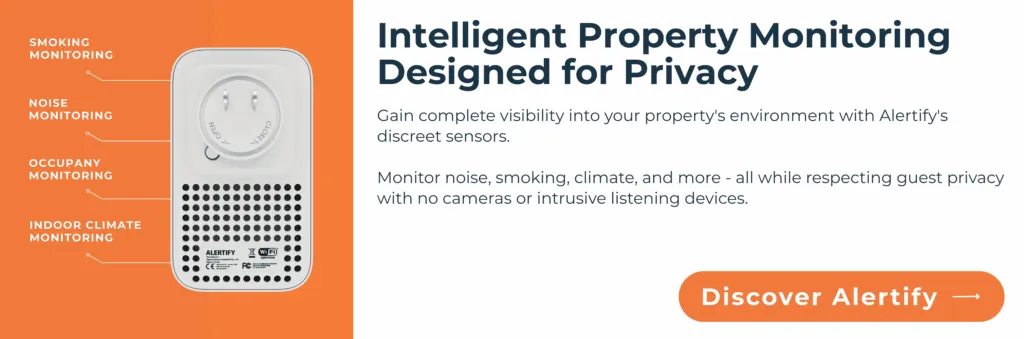
The financial argument is clear: the cost of a monitoring solution is a fraction of the cost of a single remediation event. Alertify offers a sophisticated defense against financial loss by combining humidity and temperature monitoring to detect mold risks before they become capital expenditure disasters.
Effective mold detection in hotels is not just about spotting a problem; it is about preventing the financial hemorrhage that follows. By utilizing Alertify’s smart detection features, you aren’t just buying a sensor; you are buying an insurance policy for your bottom line. It allows engineering teams to intervene when moisture is a minor maintenance task, rather than a major renovation project. Protect your revenue, defend your asset, and secure your profitability by making the invisible visible.
Don’t let hidden moisture drain your bank account. Protect your asset and your revenue stream today. Book a Demo with Alertify.