
Table of contents
- The Business Case for Mold Prevention in a Changing Market
- The Economic Impact: Why Prevention is Profit
- Understanding the Enemy – The Science of Mold
- Where Mold Hides in Your Hotel
- The Failure of Manual Inspections
- The Solution: Alertify’s Risk Monitoring
- Health Implications for Guests and Staff
- Operational Best Practices to Pair with Alertify
- Legal and Financial Consequences
- A Breath of Fresh Air
The hospitality industry is built on a specific, sacred promise. That promise is one of comfort, safety, and escape. When a guest swipes their keycard and steps into a room – whether it is a luxury suite in the Maldives, a boutique room in the French Quarter of New Orleans, or a high-traffic business hotel in downtown Chicago – they expect a pristine environment. They expect fresh sheets, spotless surfaces, and, most importantly, clean, breathable air.
However, there is a silent, invisible, and insidious threat that can shatter this experience in moments. It is a biological hazard that can destroy a property’s reputation, drain its bank accounts, and lead to catastrophic legal battles. That threat is mold.
For hotel owners, General Managers (GMs), and Asset Directors, mold detection is not merely a housekeeping item or a task on a preventative maintenance checklist. It is a critical operational strategy. It is about safeguarding the health of your guests and ensuring the longevity of your real estate asset. In a post-pandemic world, travelers are hyper-aware of Indoor Air Quality (IAQ) and hygiene. Meeting rigorous hotel air quality standards is no longer optional; it is a baseline expectation. A single musty smell, a sense of dampness in the bed linens, or a visible spore patch on a bathroom ceiling can trigger a cascade of negative consequences: bad reviews, chargebacks, refund demands, and lawsuits.
This complete guide explores the depths of mold management in the hospitality sector. We will cover the science of mold growth, the hidden dangers lurking behind high-end wallpapers and HVAC vents, and the financial implications of negligence. Most importantly, we will discuss how cutting-edge technology – specifically Alertify – is revolutionizing how hoteliers approach hotel mold prevention, empowering teams to detect risks and intervene before a crisis emerges.
The Business Case for Mold Prevention in a Changing Market
The Evolution of Guest Expectations: The Rise of “Sleep Tourism”
The modern traveler is sophisticated, skeptical, and connected. Twenty years ago, a guest might have tolerated a slightly damp room in a tropical resort as “part of the charm.” Today, that tolerance has evaporated. We are living in the age of the “Wellness Traveler” and the booming trend of “Sleep Tourism” – a market projected to grow by 8% annually.
Hotels are fundamentally in the business of selling sleep. Guests are no longer just looking for a place to crash; they are looking for restorative environments. The 2024 Hilton Trends Report noted that the number one reason people travel now is to “rest and recharge,” with huge demand for “Sleep Suites” equipped with smart beds and circadian lighting. However, the most critical component of sleep hygiene is often overlooked: Air Quality.
Sleep science tells us that air quality, temperature, and humidity are the three pillars of deep REM sleep.
- The Humidity Factor: According to the Sleep Foundation, high humidity increases wakefulness and reduces the time spent in both REM and slow-wave sleep. If a guest feels “sticky” or “clammy,” they will toss and turn.
- The Allergen Factor: Airborne mold spores irritate the respiratory tract, causing snoring, coughing, and congestion. If a guest wakes up with a “hotel headache” or a stuffed nose, they attribute it to the room.
If a hotel cannot guarantee safe, dry, and clean air, it is failing at its core product offering. Guests who wake up congested or groggy due to poor air quality will not return, and they will tell their network why.
The Reputation Economy: One Tweet Can Cost Millions
The digital amplification of guest experiences means that a single negative encounter is no longer isolated. Platforms like TripAdvisor, Google Reviews, and TikTok allow guests to broadcast their experiences to millions instantly.
A review that mentions “damp sheets,” “musty odors,” “smell of wet dog,” or “black spots in the shower” acts as a radioactive warning sign for future bookings.
- The Algorithm Penalty: Search algorithms on booking sites (OTAs) often suppress hotels with recurring keywords like “dirty” or “smell.”
- The Corporate Impact: High-value corporate clients and event planners often vet hotels for safety and hygiene. A reputation for moisture issues can cost a hotel lucrative conference contracts.
- The Revenue Impact: Cornell University’s Center for Hospitality Research demonstrated that a hotel’s online reputation is directly linked to its pricing power. Their study showed that if a hotel increases its review score by just 1 point (on a 5-point scale), it can increase its price by 11.2% while maintaining the same occupancy. Conversely, a drop in reputation forces you to lower rates to attract guests.
The Economic Impact: Why Prevention is Profit
Many hoteliers view mold prevention tools and maintenance as a “cost center” – a line item on the P&L statement that eats into profits. This is a dangerous and expensive misconception. Mold prevention is revenue protection.
When you analyze the skyrocketing hotel mold remediation cost versus the minimal cost of investing in a monitoring solution like Alertify, the ROI becomes undeniably clear.
1. The Hidden Magnitude of Mold Remediation
Visible mold acts as the “tip of the iceberg.” By the time it is detected by sight or smell, the fungal root system (mycelium) has often already penetrated deep into the building’s substrate, making surface cleaning with bleach ineffective. Addressing a single event in a hotel room triggers a strict, industrial-grade remediation cycle:
- Professional Investigation: The process begins with hiring a Certified Industrial Hygienist to conduct air quality testing and identify the moisture source, a necessary legal step before work begins.
- Containment: To prevent cross-contamination, the room must be sealed in a negative-pressure chamber with plastic barriers, isolating spores from hallways and adjacent guest rooms.
- Demolition: Contaminated infrastructure – including drywall, insulation, and millwork – is physically removed and discarded.
- Asset Loss: Porous materials cannot be effectively sanitized. This typically results in the total loss of carpets, padding, mattresses, drapery, and upholstered furniture.
- HVAC Remediation: If the system is compromised, ductwork requires specialized chemical cleaning or complete replacement to ensure the air supply is safe.
- Restoration: Finally, the room requires full reconstruction, including new fixtures, wall coverings, and paint.
Financial Implication: This is not a housekeeping task; it is a hazardous material construction project. Consequently, the cost per room is substantial. If the infestation is systemic – such as a central HVAC failure affecting a wing – the financial exposure can escalate into the millions.
2. Business Interruption and RevPAR Impact
The hidden killer of profitability is downtime. You cannot sell a room that is being treated for mold.
- The Math of Loss: If a room commands a rate of $300 a night, and remediation takes three weeks (21 days), that is $6,300 in direct lost revenue.
- Displacement: If you are fully booked, you may have to walk guests to other hotels, paying for their stay and damaging your loyalty standing.
- RevPAR Decline: Taking inventory offline directly lowers your Revenue Per Available Room (RevPAR), the key metric for hotel performance.
3. Legal Liability and Settlements
We operate in a litigious society. “Toxic Mold” lawsuits are a massive risk for hoteliers. Guests who claim exposure to mycotoxins can sue for personal injury, medical bills, pain and suffering, and lost wages.
The Burden of Proof: If you are sued, do you have data to prove your rooms were safe? Without historical climate data, it is your word against theirs. Settlements in these cases are substantial, and legal fees alone can cripple a small to mid-sized operation.
4. Asset Devaluation and FF&E Lifespan
For hotel owners looking to sell or refinance, mold is a deal-killer. During due diligence, inspectors will check for moisture damage. A history of mold issues devalues the property significantly. Furthermore, high humidity destroys your Furniture, Fixtures, and Equipment (FF&E) faster. It causes wood veneer to peel, metal fixtures to rust, and electronics to fail prematurely. Keeping humidity in check extends the life of your physical assets.
Understanding the Enemy – The Science of Mold
To effectively protect your asset, you must understand the biology of the threat. Mold is a fungus. It plays a vital role in the outdoor ecosystem by breaking down organic matter. However, when it moves indoors, it becomes a pathogen.
The Mold Triangle
Mold requires three specific conditions to thrive, often referred to as the “Mold Triangle”:
- Spores: These are microscopic and omnipresent. You cannot eliminate spores; they enter on guests’ luggage, through open doors, and on the wind.
- Food Source: Mold eats carbon-based organic material. Hotels are built of mold food: drywall paper (cellulose), wood studs, wallpaper glue, cotton fabrics, wool carpets, and dust.
- Moisture: This is the trigger. Without moisture, spores remain dormant. They cannot grow.
Key Takeaway: You cannot remove the spores (entirely). You cannot remove the food sources (unless you build a concrete bunker). Therefore, the only controllable variable in a hotel environment is moisture. Mold detection is, fundamentally, moisture management.
Deep Dive: Relative Humidity vs. Dew Point
Effective hotel humidity control requires understanding the physics of air. Most hoteliers track temperature. Some track Relative Humidity (RH). Very few track the most important metric: Dew Point. This distinction is vital for engineering teams.
- Relative Humidity (RH): This measures how much water is in the air relative to how much it can hold at that temperature. Warm air holds more water than cold air.
- The Trap: You can have 50% humidity at 85°F. That sounds safe. But if you cool that air down to 70°F (which guests do with the AC), that same air mass can no longer hold the water. The humidity spikes to 90%, or the water condenses into liquid.
- Dew Point is the absolute measure of water in the air – specifically, the temperature at which the water vapor in the air turns into liquid water.
If the dew point in a room is 72°F, and your AC vent is blowing air at 65°F, condensation will form on the vent. This condensation is the water source for mold. Alertify’s algorithms monitor these complex relationships. It doesn’t just tell you it’s “humid.” It tells you that the conditions are ripe for condensation and microbial growth. It calculates the risk based on the intersection of temperature and moisture.
Where Mold Hides in Your Hotel
Mold is an opportunist. While your housekeeping team focuses on visible cleanliness – polishing mirrors and vacuuming floors – mold thrives in the dark, undisturbed micro-climates of a hotel room.
1. The “Vinyl Trap” (Wallpaper Nightmares)
Vinyl wallpaper is a staple in hospitality design because it is durable, scrubbable, and looks high-end. However, in humid climates, it is a disaster waiting to happen. Vinyl acts as a vapor barrier. It does not breathe.
- The Mechanism: Humid outdoor air infiltrates the wall cavity (through cracks in the exterior stucco, electrical outlets, or window seals).
- The Condensation: When this warm, humid air hits the back of the cool, air-conditioned drywall inside the room, it condenses into liquid water.
- The Trap: That water is trapped between the drywall and the vinyl wallpaper. It cannot evaporate into the room because the vinyl blocks it.
- The Result: A perfect, dark, wet incubator. Mold eats the paper backing of the drywall and the starch in the wallpaper glue. You won’t see it for months until the wallpaper starts to bubble, peel, or turn pink. By then, the drywall is mush, and the studs may be rotting.
2. The HVAC System: The Super-Spreader
Your HVAC system is the lungs of your hotel. If the lungs are sick, the whole body suffers.
- Condensate Pans: These pans catch water dripping from cooling coils. If the drain line clogs with algae or “slime,” water sits stagnant. This is a breeding ground for mold and Legionella bacteria.
- Ductwork: If the air in the ducts is too humid, mold grows on the dust lining the ducts. When the fan turns on, it blows millions of spores directly into the guest’s breathing zone. This is a primary cause of “Sick Building Syndrome”, a condition where occupants experience acute health effects linked to time spent in the building.
- PTAC Units: In many mid-scale hotels, PTACs (Packaged Terminal Air Conditioners) are under the window. These units are notoriously difficult to clean and often harbor black mold deep inside the blower wheel.
3. Carpet Over Concrete
In ground-floor units or basements, carpeting is often laid over concrete slabs. Concrete is porous and wicks moisture from the ground (capillary action). If the carpet backing gets damp, it acts as insulation, preventing the concrete from drying. This creates a fungal garden under the guests’ feet. The room will smell musty, but no mold will be visible.
4. Bathroom Ceilings and Grout
If exhaust fans are underpowered or tied to a light switch that guests turn off, steam settles on ceilings, feeding mold on the paint. Furthermore, porous grout in showers allows water to seep behind tiles. That orange or pink slime often seen in hotel showers is usually Serratia marcescens, a bacterium often accompanied by mold.
The Failure of Manual Inspections
Traditionally, hotels have relied on manual inspections to catch these issues. This usually involves a Chief Engineer walking the floor once a quarter with a clipboard. The flaws in this approach are fatal:
- Snapshot in Time: An inspection checks a room for 5 minutes. It misses the other 129,595 minutes of the quarter. A leak can happen 10 minutes after the engineer leaves.
- Intrusiveness: You cannot inspect occupied rooms. If a guest stays for two weeks, that is two weeks of unmonitored risk.
- Subjectivity: One engineer’s “musty smell” is another’s “just cleaned.” It is not data-driven.
- Invisibility: Manual inspections cannot see behind headboards, inside locked owner closets, or detect humidity spikes at 3:00 AM.
To protect a multi-million dollar asset, relying on a human nose is not a strategy. It is a gamble.
The Solution: Alertify’s Risk Monitoring
In the modern hospitality landscape, you need precision, automation of data collection, and 24/7 vigilance. This is where smart hotel sensors – specifically Alertify – enter the picture as an essential partner in property protection and indoor climate monitoring.
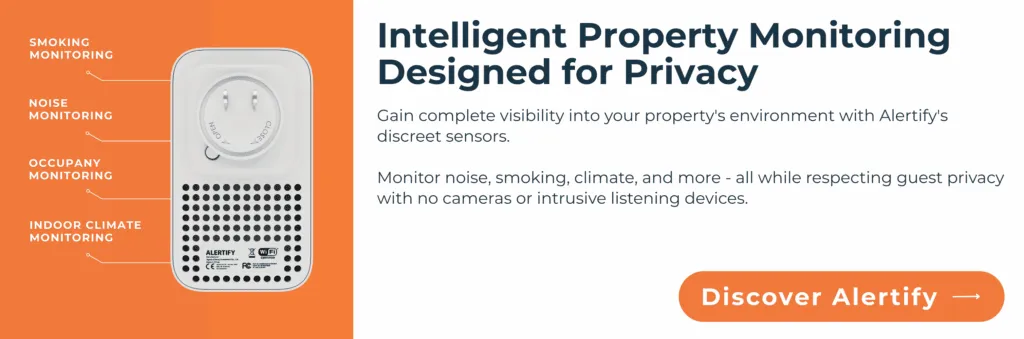
Alertify is a comprehensive property monitoring device designed specifically for hotels and short-term rentals. Alertify sits in the living space, measuring exactly what the guest experiences and what the building structure is exposed to. It provides unbiased, third-party verification of your climate health.
How Alertify Helps to Mitigate The Risk of Mold Growth
The Alertify device continuously monitors ambient temperature and humidity levels within a room. It doesn’t just give you a number. It analyzes the data to calculate mold risk.
The device uses advanced algorithms to track the persistence of humidity. It understands that a 10-minute spike in humidity from a hot shower is normal. It also understands that 75% humidity for 12 hours is a crisis.
1. The Notification Workflow: Empowering Staff
Alertify uses the most valuable asset you have: your staff. It empowers them with “X-Ray Vision” into the room’s climate, making indoor air quality monitoring for hospitality an actionable process rather than just data collection.
- The Trigger: Alertify detects that Room 302 has been at 70% humidity for 12 hours.
- The Notification: A real-time alert (via SMS, email, or mobile notification) is sent to the Duty Manager or Chief Engineer.
- The Action: The staff member receives the notification. They now know exactly where to go. They enter Room 302. They find that the guest has left the balcony door wide open while the AC is running (a common cause of massive condensation).
- The Resolution: The staff member closes the door and adjusts the AC. The problem is solved in minutes. Without the notification, that door might have stayed open for 8 hours, soaking the drywall and starting the mold cycle.
2. Historical Data: The “Black Box” of Your Room
The Alertify dashboard provides a history of the room’s climate. You can identify trends.
- Trend Analysis: You might see that Room 302 consistently runs 10% more humid than Room 304, even when both are unoccupied. This data indicates a structural issue – perhaps a gap in the window seal, a missing vapor barrier, or a slow leak in the plumbing behind the wall.
- Maintenance Efficiency: Instead of having your team inspect 100 healthy rooms randomly, you send them to the 3 rooms that Alertify flagged as “High Risk.” This is data-driven, predictive maintenance.
3. Documentation and Liability
In the event of a guest complaint or a dispute regarding room conditions, you have hard data.
- Proof of Quality: If a guest demands a refund claiming the air was “unhealthy” or “damp,” you can pull the Alertify log. You can prove that the temperature and humidity were within safe, comfortable EPA standards for the entire duration of their stay. This saves thousands in unjustified refunds and protects your reputation.
4. Privacy-Safe Monitoring
Hoteliers are rightly concerned about guest privacy. Alertify is designed with this in mind. It is camera-free and does not record audio conversations. It monitors decibel levels (for noise control) and air particles (for smoke and mold risk). It provides safety without surveillance.
By installing Alertify, you are not just buying a sensor. You are investing in a preventive maintenance system.
Health Implications for Guests and Staff
The presence of mold is not just a structural issue. It is a human health crisis. The health risks of mold in hotels are well documented and severe.
- Allergic Reactions and “Hotel Hay Fever”: For many people, mold is a potent allergen. Exposure triggers an immune response. Symptoms include sneezing, runny nose, red eyes, and skin rashes. A guest might think they have caught a cold or flu during their trip. In reality, they are reacting to your building. This ruins their vacation and ensures they never return.
- Asthma Triggers: For guests with asthma, mold is dangerous. It can trigger severe asthma attacks, leading to emergency room visits. Hotels have a duty of care to provide a safe environment for all guests, including those with respiratory conditions.
- Toxic Mold Syndrome: Certain molds produce mycotoxins. The most famous is Stachybotrys chartarum, or “black mold.” Exposure to these toxins can cause serious neurological and respiratory issues. Symptoms include chronic fatigue, headaches, difficulty concentrating, and immune suppression.
Staff Safety, Retention, and “Sick Building Syndrome”
Staff are at even greater risk than guests. Housekeepers and maintenance staff spend 40 hours a week in the hotel. Long-term exposure to low levels of mold can lead to significant health issues.
- The Symptoms: Staff complaining of headaches, fatigue, and dry coughs only when they are at work.
- The Cost: This leads to high absenteeism, low morale, and workers’ compensation claims.
- The HR Crisis: In an industry currently facing a massive labor shortage, protecting the health of your staff is a competitive advantage. If your hotel makes your maids sick, they will leave to work for a competitor with cleaner air.
Operational Best Practices to Pair with Alertify
Because Alertify is a monitoring tool, its value is unlocked by the protocols you build around it. Here is how to integrate Alertify into your hotel’s Standard Operating Procedures (SOPs).
1. The “Red Alert” Protocol
When the Alertify dashboard flashes red for high humidity, your team needs a script.
- Step 1: The Front Desk checks if the room is occupied.
- Step 2: If occupied, they call the guest. “Mr. Smith, our systems show a climate anomaly in your room. Is your AC working correctly? Is a window perhaps open?” This is a courtesy call that doubles as an investigation.
- Step 3: If unoccupied, Engineering is dispatched immediately looking for the “Silent Leaks” – a pinhole leak in a pipe, a dripping toilet supply line, or condensation on a vent.
2. Housekeeping as the “Boots on the Ground”
Train housekeepers to be the physical verifiers of the digital data.
- Don’t Over-wet: When cleaning carpets, extract as much water as possible. Use fans to dry the carpet quickly.
- Ventilation: Housekeepers should keep the bathroom fan on while they clean to remove the humidity from the previous guest’s shower.
- Reporting: Create a simple system for housekeepers to report leaks. A dripping faucet or a running toilet adds gallons of water to the environment over time.
3. HVAC Maintenance Strategy
Your HVAC system is the most important tool for prevention.
- Positive Pressurization: Hotels should be positively pressurized. This means the air pressure inside the hotel is slightly higher than outside. This pushes air out of the building. This prevents hot, humid outdoor air from being sucked into the walls.
- Filter Changes: Change filters monthly or quarterly. Use high-quality filters (MERV 8 or higher) that trap spores.
- Coil Cleaning: Clean the cooling coils regularly. Dirty coils cannot remove humidity effectively.
4. Renovation and Construction
Many mold problems start during construction or renovation. If new drywall is installed before the building is watertight, it gets wet. If carpet is laid on damp concrete, it molds.
- Use Alertify During Construction: Place devices in rooms under renovation to monitor drying times.
- Contractor Accountability: Use the data to ensure contractors are using dehumidifiers and keeping the site dry. This prevents “legacy mold” that appears years after the hotel opens.
Legal and Financial Consequences
The legal landscape regarding mold is treacherous. Ignorance is not a defense. If a guest sues your hotel for mold exposure, the burden of proof shifts to you. You must prove that you maintained the property diligently.
If your only defense is “the room looked clean,” you will likely lose. Juries are sympathetic to victims of health hazards. Settlements for toxic mold exposure can reach millions of dollars.
However, if you have Alertify, the conversation changes. You can walk into court with a data log. You can show that the room was monitored 24/7. You can show that humidity levels were within safe EPA standards. This proves you were not negligent. It proves you took proactive measures.
The Insurance Angle
Insurance carriers are increasingly wary of insuring hotels in coastal or humid regions. “Water damage” is one of the highest causes of loss in the hospitality sector. By demonstrating that you have installed a proactive monitoring system like Alertify, you can often negotiate better premiums or higher coverage limits. You are demonstrating to the underwriter that you are a lower risk than the hotel down the street because you have a digital watchdog on site.
The ROI of Clean Air: Guest Preferences and Profitability
Beyond legal protection and insurance savings, investing in air quality monitoring offers a direct path to increased revenue and a stronger brand reputation.
The modern traveler is more health-conscious than ever before. In a post-pandemic world, “cleanliness” isn’t just about fresh sheets; it is about the invisible environment.
- The “Wellness Premium”: Studies consistently show that travelers, particularly millennials and business professionals, are willing to pay a premium for “wellness” features. A hotel that actively monitors and certifies its air quality can command higher nightly rates.
- Visible Trust: Marketing your use of Alertify isn’t just a technical detail – it’s a selling point. Listing “24/7 Air Quality Monitoring” on your OTA profiles or website signals to guests that you prioritize their health, differentiating you from competitors who offer standard, unmonitored rooms.
When calculating ROI, the math is simple: the cost of prevention is a fraction of the cost of remediation.
- Preventing the Revenue Block: A mold infestation doesn’t just cost money to fix; it takes a room out of inventory for days or weeks. If a room is down for remediation during peak season, you lose thousands in revenue. Alertify catches the humidity spike before the mold grows, keeping your inventory active.
- Asset Longevity: High humidity destroys FF&E (Furniture, Fixtures, and Equipment) faster than almost anything else. Wallpaper peels, wood warps, and electronics degrade. By keeping humidity in check through smart monitoring, you extend the lifecycle of your physical assets, reducing capital expenditure over time.
A Breath of Fresh Air
Mold detection in hotels is a battle. It is a battle against nature. It is a battle against the elements. But it is a battle you can win.
The cost of a monitoring system is a fraction of the cost of a single mold remediation project. By prioritizing air quality, you tell your guests that you care about their well-being. You tell your investors that you are protecting the asset. You tell your staff that you value their health.
Do not wait for the first bad review. Do not wait for the first smell of mildew. Take control of your indoor climate today. Use technology to make the invisible visible.
Ready to protect your hotel from the invisible threat? Book a Demo with Alertify today and see how our mold detection and property monitoring solutions can secure your revenue, your reputation, and your guests’ comfort.