
It’s 1:30 PM. Lunch is over, and your students are back at their desks. You’re trying to introduce a new math concept, but you’re met with a sea of blank stares, droopy eyelids, and barely-stifled yawns. It’s the classic “post-lunch slump,” a daily struggle for teachers everywhere. We blame it on heavy lunches, lack of sleep, or simple post-recess fatigue. But what if the culprit isn’t the students or the food, but the very air they’re breathing?
In the crucial conversation about indoor air quality in schools, one of the most significant and measurable factors is carbon dioxide (CO2). This isn’t a toxic pollutant in the traditional sense, but it is a powerful indicator of a much bigger problem: poor ventilation. And as research increasingly shows, it has a direct, negative impact on how CO2 in classrooms affects learning.
This post will explore the science behind CO2 in schools, its direct link to cognitive function, and how modern monitoring provides a clear path to boosting student focus and achievement.
What Are High CO2 Levels in a Classroom?
It’s Not a Pollutant, It’s a Proxy
First, let’s be clear: CO2 is not a poison at the levels found in schools. We exhale it with every breath. The problem is what it represents. In a crowded room like a classroom, 30 people are constantly exhaling CO2. If that room is sealed (as most modern, energy-efficient rooms are), that CO2 has nowhere to go. Its concentration builds up rapidly.
High CO2 levels are a direct proxy for two things:
- High Occupancy: The room is full of people.
- Poor Ventilation: Not enough fresh, outside air is being introduced to dilute the indoor air.
This “stale” air is not just high in CO2, it’s also high in all the other things humans exhale – bioaerosols, odors, and airborne pathogens. The CO2 level is simply the easiest one to measure, acting as a “canary in the coal mine” for poor indoor air quality in schools.
Understanding the “PPM” Numbers
We measure CO2 concentration in parts per million (ppm). Here’s a simple breakdown of what those numbers mean for a classroom:
- 400-600 ppm: Fresh outdoor air. This is the ideal.
- 600-1,000 ppm: Acceptable indoor air. Minimal impact on a person’s focus.
- 1,000-2,000 ppm: Complaints of drowsiness and poor air (“stuffiness”) begin. Cognitive function and student concentration levels start to decline.
- Above 2,000 ppm: Significant, measurable drops in cognitive performance. Headaches, fatigue, and sleepiness are common.
- Above 5,000 ppm: This is the legal occupational limit for an 8-hour workday.
Shockingly, it is not uncommon for under-ventilated classrooms to reach 2,500 ppm or even 3,000 ppm by late morning, precisely when students are expected to perform their most challenging mental tasks.
The Science: The Direct Link Between CO2 and Cognitive Decline
The connection between high CO2 and feeling drowsy is not just a feeling but rather it’s a documented physiological and cognitive event. Groundbreaking studies, including those from the Harvard T.H. Chan School of Public Health, have put this to the test.
In these “COGfx” (Cognitive Function) studies, researchers exposed participants to different indoor air quality scenarios. The results were staggering. On days with poor ventilation and high CO2 levels, participants showed significant drops in key cognitive areas:
- Strategic Thinking: The ability to plan and think ahead.
- Information Usage: How effectively they could use the information given to them.
- Problem-Solving: Their speed and accuracy in solving complex problems.
When CO2 levels were doubled, cognitive performance scores dropped by as much as 23%.
For a student, this isn’t just a number. A 23% drop in cognitive function is the difference between understanding a new algebra equation and giving up. It’s the difference between focusing on a reading passage and re-reading the same sentence three times. This is the tangible evidence of how CO2 in classrooms affects learning. It directly impacts student concentration levels, hindering their ability to absorb, process, and apply new information.
Why Aren’t We Fixing This? The Classroom Ventilation Standards Gap
If the science is so clear, why is this still a problem? The answer lies in a gap between standards, reality, and measurement.
The Standards Exist (But Aren’t Met)
Organizations like ASHRAE (American Society of Heating, Refrigerating and Air-Conditioning Engineers) set the classroom ventilation standards. These standards dictate how much fresh outdoor air (measured in cubic feet per minute, or CFM, per person) must be supplied to a room.
The problem is threefold:
- Aging Buildings: Many schools were built decades before these standards were in place and have HVAC systems that simply can’t keep up.
- Energy Efficiency: In an effort to save on heating and cooling costs, buildings are often sealed as tightly as possible, and ventilation rates are turned down.
- Deferred Maintenance: Even in schools with modern HVAC, a broken damper, a clogged filter, or a faulty sensor can halt fresh air intake, and no one would ever know.
You Can’t Fix What You Can’t See
This is the core of the problem. A principal can see a broken window. A teacher can hear a loud radiator. But no one can see a CO2 level of 2,500 ppm. We operate on “run-to-fail” or “fix-when-complained-about.” But by the time a room feels “stuffy,” students’ cognitive performance has already been suffering for hours.
This is where we must move from subjective guessing to objective, real-time data.
The Solution: Real-Time Monitoring with Alertify
You don’t need to guess about your classroom’s air. You can know.
The solution to high CO2 is continuous, 24/7 monitoring. This is where a platform like Alertify transforms the learning environment.
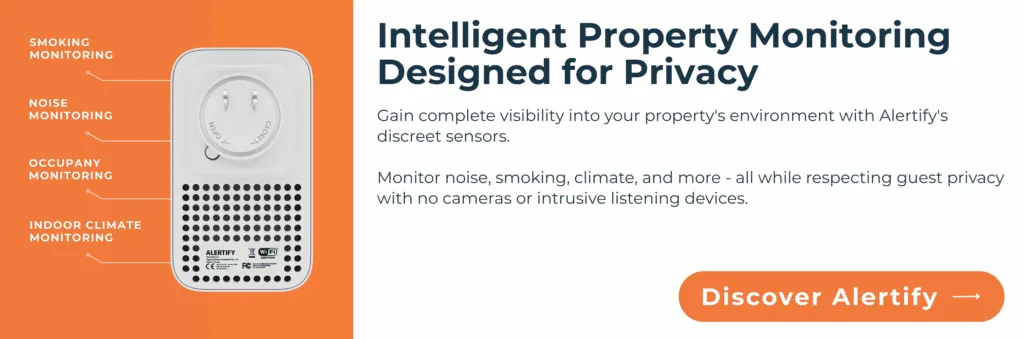
- Real-Time Data: An Alertify AQ+ monitor sits in the classroom, tracking CO2, humidity, and temperature levels every minute of the day.
- Actionable Alerts: When CO2 levels rise, the teacher or facilities manager gets an instant, automatic notification on their phone or dashboard.
- Data-Driven Solutions: The alert triggers a simple, immediate action. It could be as simple as “Open windows for 10 minutes between classes” or a notification to the Building Management System to boost the HVAC’s fresh air intake for that specific zone.
- Identify Problem Zones: The dashboard shows you exactly which classrooms are the worst offenders, allowing you to prioritize maintenance and resources effectively.
This data-driven approach finally closes the loop. It ensures classroom ventilation standards are actually being met. It provides immediate, positive feedback on student concentration levels. And most importantly, it offers a cost-effective, high-impact solution to one of the biggest unseen problems in education.
The connection between how CO2 in classrooms affects learning is too strong to ignore. To truly improve indoor air quality in schools, we must first make the invisible visible.
Ready to stop guessing and start knowing? Your students’ focus is too important to leave to chance. Alertify provides the real-time CO2 and air quality data you need to create the optimal learning environment. Schedule a demo today to see how our platform can turn your classrooms into zones of high focus and achievement.