
Table of contents
- The Hidden Threat: Why Mold is a Vacation Rental Nightmare
- Understanding Mold: Know Your Enemy
- Proactive Detection: How to Find Mold Before Your Guests Do
- The Ultimate Solution: Automated 24/7 Indoor Climate Monitoring
- Prevention is the Best Medicine: Creating a Mold-Resistant Property
- What to Do If You Find Mold: A Step-by-Step Action Plan
- Protect Your Investment and Reputation with Proactive Monitoring
Imagine this: a guest checks into your pristine vacation rental on a Friday. By Sunday, they’re calling to complain about a strange, musty smell in the master bathroom. They leave a two-star review mentioning “dampness and potential mold,” and the next booking, a lucrative week-long stay, cancels immediately. This scenario is a nightmare for any property owner, and it happens more often than you think. Effective mold detection in vacation rentals is no longer a simple maintenance task but rather it is a critical component of protecting your investment, your reputation, and your revenue. This guide is your ultimate resource for understanding, identifying, and eliminating mold. We will cover the science behind its growth, a comprehensive plan for detection, and the modern technological solutions that offer true peace of mind, ensuring your property remains a safe, clean, and profitable haven for every guest.
The Hidden Threat: Why Mold is a Vacation Rental Nightmare
Mold isn’t just an unsightly nuisance but rather it’s a silent threat that can systematically dismantle your vacation rental business from the inside out. For hosts and property managers, ignoring the potential for mold is a gamble with stakes that are simply too high. It attacks on four primary fronts: guest health, your finances, your brand reputation, and the physical structure of your property.
The Serious Health Risks for Guests
Your primary responsibility as a host is to provide a safe environment. Mold directly compromises this responsibility. Mold spores are microscopic allergens that can become airborne and easily inhaled, triggering a range of health issues. For many people, exposure can lead to symptoms like:
- Persistent coughing and wheezing
- Nasal congestion and sinus problems
- Skin irritation and rashes
- Itchy, watery eyes
- Sore throat
For guests with pre-existing conditions like asthma, young children, the elderly, or anyone with a compromised immune system, the risks are far more severe. An allergic reaction or an asthma attack triggered by mold in your property can lead to a medical emergency. This brings up the critical topic of host liability for mold exposure, which can include covering medical costs, refunding stays, and facing potential legal action if negligence is proven. In an age where guest wellness is paramount, providing a clean and healthy environment is non-negotiable.
The Crippling Financial Cost of Remediation
If you think a bad review is costly, wait until you see the bill for professional mold remediation. The financial fallout from a mold infestation is steep and multi-faceted.
First, there’s the cost of removal itself. Professional remediation isn’t a simple cleaning job. It involves containment of the affected area, specialized air filtration, removal of contaminated materials like drywall and insulation, and treatment of the remaining structures. This process can easily cost thousands, or even tens of thousands, of dollars, depending on the scale of the infestation.
Second, most standard property insurance policies have limitations or outright exclusions for mold damage, especially if it’s deemed to have resulted from a gradual leak or poor maintenance. This often leaves property owners to cover the entire cost out of pocket.
Finally, there’s the lost revenue. Your property will need to be vacant during the entire remediation process, which can take weeks. That means canceling existing bookings, losing potential new ones, and having zero income from your asset while the expenses pile up.
The Irreversible Damage to Your Reputation
In the vacation rental industry, reputation is currency. A single mention of the word “mold” in a public review can be catastrophic. Potential guests scrolling through listings on Airbnb, Vrbo, or Booking.com are highly sensitive to any suggestion of uncleanliness or health hazards.
A review detailing a musty smell, visible mold spots, or damp conditions can:
- Plummet Your Listing’s Ranking: Booking platform algorithms penalize properties with low ratings and negative reviews, making your listing less visible to potential guests.
- Destroy Booker Confidence: Over 90% of travelers read reviews before booking. A review mentioning mold acts as a giant red flag, causing them to immediately look elsewhere.
- Lead to De-listing: In severe cases, or after multiple complaints, platforms like Airbnb can suspend or permanently remove a listing for failing to meet health and safety standards.
Rebuilding a damaged reputation is a slow, arduous process. Preventing the damage in the first place is infinitely easier and more cost-effective.
The Silent Destroyer: Structural Damage to Your Property
Beyond the immediate health and financial risks, mold actively destroys your property. Mold is a living organism whose purpose is to break down organic material. Unfortunately, the materials used to build your property – wood studs, drywall, insulation, subflooring, and even paint – are all excellent food sources.
When mold takes hold, it secretes enzymes that digest these materials, causing them to rot and decay. An unchecked infestation can weaken wooden support beams, crumble drywall, and compromise the structural integrity of your entire property. What starts as a small, hidden leak can eventually lead to major, expensive structural repairs that go far beyond simple remediation. Mold doesn’t just live in your house, it eats it.
Understanding Mold: Know Your Enemy
To effectively fight mold, you first need to understand what it is, how it thrives, and where it comes from. Knowledge is your first line of defense, allowing you to shift from a reactive to a proactive mindset. Mold isn’t a mysterious force, it operates on predictable scientific principles that you can control.
What Exactly is Mold and How Does it Grow?
Mold is a type of fungus that is present almost everywhere, both indoors and outdoors. Its spores are microscopic and travel through the air. They are generally harmless until they land on a surface with the right conditions to grow. For mold to grow and colonize, it needs three key things, often referred to as the “mold triangle”:
- A Food Source: Mold is not picky. It can feast on a wide variety of organic materials common in any home, including wood, paper (drywall), cotton, carpet, and even dust and dirt.
- The Right Temperature: Mold thrives in temperatures that humans also find comfortable, typically between 15°C and 27°C (60°F and 80°F). This means that if your rental is at a comfortable temperature for guests, it’s also at a comfortable temperature for mold.
- Moisture: This is the single most important ingredient. Without moisture, mold cannot grow, period. While you can’t eliminate food sources or control the temperature to inhabitable levels, you can control moisture. This is the key to mold prevention.
Moisture can come from obvious sources like a plumbing leak or a flood, but it more commonly comes from less obvious, persistent sources like high humidity, condensation on windows, or steam from showers and cooking.
Common Types of Mold Found in Properties
While there are thousands of species of mold, vacation rental owners are most likely to encounter a few common culprits. You don’t need to be a mycologist, but knowing the basics can help you assess a situation.
- Aspergillus: This is a very common indoor mold. It can be many different colors (green, white, yellow, brown) and often appears as long, flask-shaped spores. It’s frequently found in areas with high humidity or on water-damaged materials and is a known allergen.
- Cladosporium: This mold can be olive-green to brown or black. It often grows in a suede-like texture and can thrive in both warm and cool conditions. It’s commonly found on fabrics, carpets, and wood surfaces, and is a frequent trigger for asthma attacks.
- Stachybotrys chartarum (Black Mold): This is the infamous “black mold.” It is a greenish-black, slimy mold that requires constant, significant moisture to grow, which is why it’s often a sign of a serious water leak or water damage. It is known for producing mycotoxins that can cause more severe health reactions in some individuals. It’s important to understand the difference between black mold vs mildew in rental properties. While mildew is also a type of mold, it typically refers to the powdery, surface-level growth you might see on shower grout. Stachybotrys, on the other hand, often indicates a more serious, underlying water problem and always requires professional attention.
The Perfect Storm: Ideal Conditions for Mold Growth in a Rental
Vacation rentals can be unintentional but perfect incubators for mold. The combination of property characteristics and guest behavior can create the ideal conditions for a “perfect storm” of mold growth.
- High Humidity: This is the number one cause. Areas with naturally humid climates are at high risk. However, any property can develop high indoor humidity, often caused by poor ventilation. A relative humidity level consistently above 60% is an open invitation for mold.
- Poor Ventilation: Guests often keep windows closed for security or air conditioning, trapping moisture inside. Bathrooms without powerful exhaust fans, kitchens where steam isn’t vented, and stuffy closets are prime breeding grounds.
- Intermittent Occupancy: Properties that sit vacant between bookings can have stagnant air, allowing humidity to build up without anyone noticing or airing out the space.
- Hidden Leaks: A slow drip from a pipe under a sink, a small crack in a shower tile’s grout, or a minor roof leak can provide a steady source of moisture that goes unnoticed for weeks or months, creating a hidden mold colony behind a wall or under a floor.
- Guest Behavior: Long, steamy showers without turning on the fan, spills that aren’t properly cleaned up, or leaving wet towels on the floor can all introduce excess moisture that contributes to a mold-friendly environment.
Proactive Detection: How to Find Mold Before Your Guests Do
The difference between a minor issue and a full-blown catastrophe is early detection. Finding mold before it becomes visible or before a guest smells it is the ultimate goal. This requires a proactive, systematic approach that combines regular manual inspections with the power of modern technology. Relying on your cleaning crew to spot a problem is not a strategy; it’s a gamble.
The Power of Your Senses: Conducting Manual Checks
Regular, thorough inspections are the foundation of any good property maintenance plan. Train yourself or your property manager to use your senses to hunt for the early signs of a moisture problem.
- Visual Inspections: Look for more than just obvious, fuzzy mold growth. The earliest signs are often subtle.
- Water Stains & Discoloration: Yellow, brown, or dark stains on ceilings, walls, or floors are a tell-tale sign of a past or present leak.
- Peeling, Bubbling, or Cracking: Paint or wallpaper that is bubbling or peeling is often caused by moisture trapped behind it.
- Warped Surfaces: Check wood floors, baseboards, and cabinet bases for any signs of warping, which indicates they have absorbed moisture.
- Condensation: Look for persistent condensation on windows, metal pipes, or toilet tanks. While some condensation is normal, excessive amounts signal high humidity.
- The Smell Test: Your nose is one of your best mold-detection tools. Mold gives off microbial volatile organic compounds (MVOCs), which have a distinct odor.
- Musty & Earthy Odors: A persistent smell often described as “musty,” “damp,” or “like wet socks” is a major red flag, even if you can’t see any mold.
- Follow the Scent: If you notice a smell, try to pinpoint its source. It’s often strongest near a hidden moisture problem, like inside a cabinet, a closet, or near an appliance.
A Property Manager’s Checklist: Key Hotspots for Mold
To know exactly where to check for mold in a property, you must be vigilant in the common hotspots where mold loves to grow – dark, damp places with poor air circulation.
- Bathrooms:
- Around the base of the toilet and under the sink.
- On shower curtains, tile grout, and caulking around the tub.
- Inside the exhaust fan cover and on the ceiling directly above the shower.
- Kitchens:
- Under the kitchen sink (check pipes for slow drips).
- Behind and under the refrigerator (check the drip pan and ice maker line).
- Around the dishwasher seals and under the unit itself.
- Inside garbage disposals and trash cans.
- Basements and Crawl Spaces:
- These areas are naturally prone to dampness. Check for leaks in foundation walls, around pipes, and look for efflorescence (a white, powdery substance) on concrete, which indicates moisture penetration.
- HVAC Systems and Window Sills:
- Check the HVAC drain pans and ductwork for any signs of moisture or microbial growth.
- Inspect window sills and frames, where condensation often collects.
- Laundry Areas:
- Behind and under the washing machine (check hoses for leaks).
- Inside the seal of a front-loading washer.
- Check the dryer vent to ensure it’s clean and venting properly to the outside.
The Limitations of Seasonal Inspections
Even the most thorough manual inspection has a fundamental flaw: it’s only a snapshot in time. You can inspect a property on Monday and declare it perfectly dry, but a problem can begin on Tuesday and grow for weeks or months before your next visit.
This is especially true in the vacation rental industry. A guest could cause a minor overflow in the bathtub, fail to report it, and the water could seep into the subfloor. A humid spell could coincide with a period of high occupancy where multiple guests are taking long showers. You simply cannot be there 24/7 to monitor the conditions inside your property. This gap between inspections is where mold finds its opportunity to thrive.
The Role of Technology in Mold Detection in Vacation Rentals
To close the gap left by manual inspections, property managers must turn to technology. The most advanced approach to mold management isn’t about finding existing mold; it’s about continuously monitoring the conditions that allow it to grow in the first place. This is where the practice of indoor air quality monitoring becomes a game-changer. By using smart sensors to track key environmental metrics in real-time, you can be alerted to a potential problem the moment it begins. This shifts your strategy from reactive cleanup to proactive prevention, saving you time, money, and the stress of dealing with a full-blown infestation. It’s about using data to predict and prevent problems before they ever start.
The Ultimate Solution: Automated 24/7 Indoor Climate Monitoring
The modern vacation rental manager needs a modern solution. Relying solely on your senses and periodic check-ins is an outdated strategy that leaves your valuable asset exposed. Automated, 24/7 monitoring is the definitive answer to proactively protecting your property from mold, ensuring you are always in control, even when you’re hundreds of miles away.
Why Manual Checks Will Always Fall Short
Let’s be realistic. You can’t be at your property every day. Your cleaning crew is focused on a quick turnover, not conducting a deep forensic analysis of humidity levels. Manual checks are inherently reactive. By the time you can see or smell mold, the colonization has already happened, and the damage has begun. You are already behind.
Furthermore, manual checks can’t detect the invisible threat: rising humidity. A property can feel fine one day, but a change in weather or guest behavior can cause indoor humidity to spike into the danger zone (above 60%) for days on end, creating the perfect breeding ground. You would have no way of knowing until it’s too late.
Measuring What Matters: How Humidity and Temperature Predict Mold Risk
The science is clear: mold needs water to live. In the indoor environment, that water most often comes from elevated relative humidity. Relative humidity (RH) is the measure of water vapor in the air, expressed as a percentage. When RH is consistently high, moisture can condense on surfaces or be absorbed by materials like drywall and wood.
- The 60% RH Danger Zone: Most mold species begin to grow when relative humidity surpasses 60%.
- The Time Factor: It’s not just about a temporary spike. It’s about sustained high humidity. If RH stays in the danger zone for 24-48 hours, mold growth can begin.
By tracking humidity and temperature, you are tracking your property’s real-time mold risk. This data is the key to prevention. If you can be alerted the moment conditions become favorable for mold, you can take corrective action, like asking a local contact to check for a leak or turn on a dehumidifier, before a single spore has a chance to grow.
Introducing Alertify: Your 24/7 Mold Risk Detective
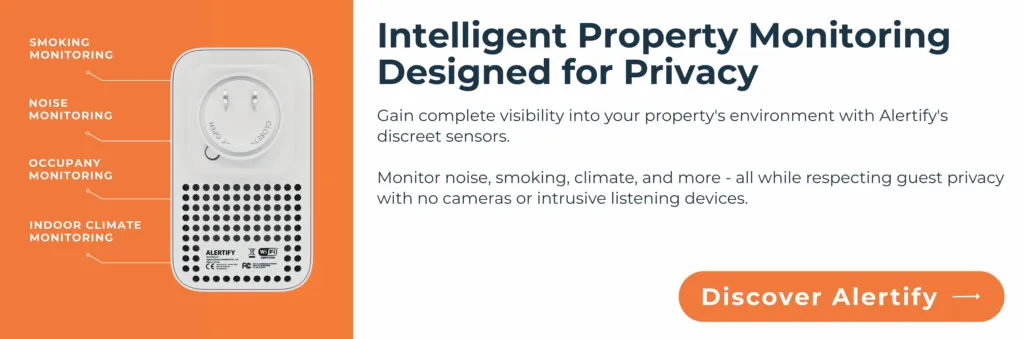
This is where smart technology provides the ultimate peace of mind. Alertify’s Indoor Climate monitoring feature is designed specifically for proactive property managers who understand that prevention is better than remediation. It acts as your 24/7 watchdog, constantly monitoring the environmental conditions inside your rental.
Here’s how it works: A small, discreet Alertify sensor is placed inside your property. This device measures the ambient temperature and relative humidity in real-time. Through the Alertify app, you set your own custom thresholds. For instance, you can set an alert to be triggered if the humidity level exceeds 60% for more than a few hours.
The moment that threshold is crossed, you receive an instant notification directly to your smartphone. This alert gives you the crucial head start you need to prevent a disaster.
Real-World Scenarios Where Alertify Saves the Day
Imagine these common vacation rental situations:
- Scenario 1: The Humid Summer Week. Your property is booked solid during a hot, humid month. Multiple groups of guests are in and out, taking showers and running the AC, but the indoor humidity is slowly creeping up. Alertify sends you an alert that the RH has been at 65% for 12 hours. You can remotely adjust your smart thermostat or call your local contact to air out the property, completely averting a potential mold outbreak.
- Scenario 2: The Hidden Leak. A connector on the toilet supply line develops a very slow, almost imperceptible drip behind the wall. You wouldn’t see it for months. But the slow leak gradually raises the humidity in the bathroom. Alertify detects this abnormal, sustained rise in humidity and alerts you. You can now send a plumber to investigate, catching a leak that would have otherwise led to thousands in water and mold damage.
In both cases, you were able to act proactively because you had the data.
Stop reacting to costly mold damage. Start preventing it with 24/7 monitoring. Learn more about Alertify’s Indoor Climate solution and protect your property today.
Prevention is the Best Medicine: Creating a Mold-Resistant Property
While technology provides critical alerts, the physical management of your property plays a huge role in mold prevention. Creating a mold-resistant environment involves controlling moisture at its source and ensuring your property is designed to stay dry. A comprehensive strategy for preventing moisture problems in properties is the best long-term investment you can make in the health of your rental.
A Guide to Controlling Humidity and Improving Ventilation
Moisture-laden, stagnant air is mold’s best friend. If you want to know how to reduce humidity in a vacation rental, the answer lies in two key areas: improving ventilation and actively removing moisture from the air.
- Upgrade Bathroom Exhaust Fans: A small, noisy fan is often not enough. Install a high-capacity, quiet exhaust fan in every bathroom. Even better, install one with a humidity sensor (a humidistat) that automatically turns on when it detects excess moisture and runs until the air is dry.
- Ensure Proper Kitchen Ventilation: Your range hood should vent to the outside, not just recirculate air. Encourage guests to use it when cooking to remove steam.
- Use Dehumidifiers: In naturally damp areas like basements, laundry rooms, or in properties located in humid climates, a dehumidifier is an essential appliance. Choose a model that can be set to a specific humidity level (e.g., 50%) and has a continuous drain option so you don’t have to rely on guests emptying a bucket.
- Promote Air Circulation: Avoid overcrowding rooms with furniture. In closets, use slatted shelves instead of solid ones to allow air to move. In between guests, open windows and let the property air out thoroughly.
Quick Fixes and Long-Term Upgrades
Water intrusion is the other half of the moisture equation. Regularly inspect your property’s defenses against water from the outside and from its own plumbing.
- Inspect and Seal Leaks Immediately: Routinely check for leaks in all the key hotspots: under sinks, around toilets and showers, and from appliance hoses. Fix any drip, no matter how small, as soon as it’s discovered.
- Maintain Your Roof and Gutters: Clean your gutters every spring and fall to ensure water is being channeled away from your property’s foundation. Regularly inspect the roof for missing or damaged shingles that could allow water intrusion.
- Check Exterior Grading: The ground around your property should slope away from the foundation. If it slopes inward, rainwater will pool against your foundation walls and can eventually seep into your basement or crawlspace.
- Choose Mold-Resistant Materials: When renovating, especially in high-moisture areas like bathrooms, opt for mold-resistant products. This includes mold-resistant drywall (often called “green board” or “purple board”), mold-resistant paint and primers, and inorganic flooring materials like tile or luxury vinyl plank instead of carpet.
Educating Your Cleaning Staff and Guests
Your team and your guests can be your allies in the fight against mold if you give them the right tools and information.
- Create a “Moisture Checklist” for Cleaners: Add a few simple items to your standard cleaning checklist. For example: “Check under all sinks for any signs of dampness,” “Report any musty smells immediately,” and “Ensure bathroom fans are working.” This empowers your cleaners to be your eyes and ears.
- Provide Gentle Guidance for Guests: You don’t want to alarm your guests, but a little information goes a long way. Include a small, friendly note in your welcome book or house manual. For example: “To keep our home fresh and comfortable, please use the exhaust fan during and for 15 minutes after your shower. Thank you!”
What to Do If You Find Mold: A Step-by-Step Action Plan
Despite your best efforts at prevention, you may one day discover a mold problem. How you handle this situation, especially if a guest is involved, can make all the difference. Acting quickly, professionally, and transparently is key to mitigating the damage to your property and your reputation.
Step 1: Don’t Panic. Assess and Document.
The moment you or a guest identifies suspected mold, your first step is to assess the situation calmly.
- Safety First: If you are inspecting it yourself, wear protective gear, including an N95 mask, gloves, and safety glasses to avoid inhaling spores or getting them on your skin.
- Assess the Scope: Is it a small patch of surface mildew on the shower grout, or a large, dark stain on a wall? The rule of thumb from the EPA is that if the affected area is less than 10 square feet, you may be able to handle it yourself. If it’s larger, or if you suspect it’s inside a wall, it’s time to call a professional.
- Document Everything: Take clear, well-lit photos and videos of the affected area from multiple angles. Document the date and time you discovered it and any related issues, like a nearby leak. This documentation will be crucial for insurance claims or discussions with remediation companies.
Step 2: Communicating with Guests and Handling Relocations
This is the moment every host dreads: a guest complains about mold in their Airbnb. If a guest is currently staying at the property, their safety and satisfaction are your top priority.
- Communicate Immediately and Honestly: Contact the guest right away. Acknowledge their concern with empathy. Say something like, “Thank you so much for bringing this to my attention. Your comfort and safety are my top priority, and I am looking into this immediately.”
- Offer a Solution, Not an Excuse: Do not downplay their concern. If the issue is significant or they are uncomfortable, you must offer to relocate them to a comparable property or provide a full refund. Work with your booking platform’s support team if needed. Handling this generously and professionally can often salvage a review.
Step 3: DIY Remediation vs. Calling the Professionals
Deciding whether to tackle mold removal yourself or hire a pro is a critical decision.
- When to DIY: For small, non-porous surfaces (like tile or glass) or very minor patches of surface mold on drywall, a DIY approach may be feasible. This typically involves scrubbing the area with a detergent solution and ensuring it is dried completely. Never use bleach, as it can be hazardous and doesn’t address the underlying issue.
- When to Call a Professional: You should always call a certified mold remediation specialist if:
- The mold patch is larger than 10 square feet.
- You smell mold, but you cannot see the source (it’s likely behind a wall).
- The mold was caused by contaminated water (like sewage or floodwater).
- Someone in your family or a guest has a severe allergy or compromised immune system.
- The HVAC system is contaminated.
If you’ve determined you need a professional, knowing how to hire a mold remediation company is the next crucial step. Look for certified and insured professionals. Ask for references, check their credentials (like IICRC certification), and get a detailed, written scope of work before signing any contracts. A reputable company will focus on identifying and fixing the moisture source, not just cleaning the visible mold.
Step 4: The Remediation and Post-Cleaning Process
Once the mold is removed (either by you or a professional), your job isn’t done.
- Fix the Moisture Source: This is the most important step. If you simply clean the mold but don’t fix the leak, high humidity, or ventilation issue that caused it, the mold will return.
- Post-Remediation Verification: After a professional job, consider hiring an independent third-party inspector to conduct a post-remediation air quality test. This verifies that the job was done correctly and the spore count in the air has returned to normal levels. This is a key step in ensuring proper indoor air quality monitoring and safety.
- Repair and Restore: Replace any removed drywall, insulation, or flooring. Repaint with a high-quality, mold-resistant primer and paint.
Protect Your Investment and Reputation with Proactive Monitoring
For the modern vacation rental owner, mold is more than a maintenance issue, it’s a significant business risk. It threatens the health of your guests, the integrity of your property, and the reputation you have worked so hard to build.
As we have seen, the key to winning the battle against mold is to shift your strategy from reactive cleanup to proactive prevention. While regular manual inspections, proper ventilation, and swift leak repairs are essential components of property management, they leave a dangerous gap: you cannot see or feel rising humidity levels when you’re not there. This is where problems begin.
The only way to gain true peace of mind and complete control is to know what’s happening inside your property 24/7. Technology provides the solution. By leveraging smart sensors to constantly monitor the indoor climate, you can be instantly alerted to the very conditions that allow mold to grow. This allows you to act before a problem ever begins, saving you thousands in remediation costs and protecting your five-star reviews.
Stop worrying about what’s happening in your property when you’re not there. Invest in proactive protection and safeguard your rental business today.
Discover how Alertify can provide 24/7 peace of mind for your property. Book a demo today.