
For affordable housing providers, the financial pressure is constant. Operating within tight budget constraints, managing ageing building stock, and navigating an increasingly demanding regulatory environment — all while delivering the quality of housing management that residents deserve and regulators expect — leaves very little margin for the avoidable costs that poorly managed noise disputes generate. And those costs are more significant than most providers realise.
Noise disputes are not just a management headache. They are a measurable drain on affordable housing property management costs — consuming officer time, generating legal exposure, driving tenant turnover, and creating the conditions for maintenance damage and community breakdown that are expensive to reverse. Investing in noise monitoring technology is therefore not just a resident welfare decision or a compliance decision. It is a financial one — with a return on investment that compounds across multiple cost centres simultaneously.
The True Cost of Unmanaged Noise Disputes
Before examining the financial case for monitoring technology, it is worth quantifying the costs of the status quo. The direct costs of noise dispute management in affordable housing are substantial but frequently invisible because they are distributed across multiple budget lines rather than attributed to a single cost centre.
Housing officer time is the most significant direct cost. A complex noise dispute — involving multiple reports, investigations, mediation attempts, formal warnings, and potentially legal proceedings — can consume dozens of hours of officer time spread over months. Research from the Chartered Institute of Housing has consistently identified antisocial behaviour management, of which noise is the most common category, as one of the highest consumers of housing management resources in the social housing sector. When this time is costed at the fully loaded rate of an experienced housing officer, the per-dispute cost is substantial.
Legal costs add further to this total. Pursuing a formal noise enforcement action — through lease violation proceedings, an application for a noise abatement order, or in the most serious cases possession proceedings — requires legal support, court time, and documented evidence. In the absence of objective monitoring data, building the evidentiary case for legal action is time-consuming and uncertain in outcome. Cases that would be straightforward with monitoring data become protracted and expensive without it.
Affordable Housing Property Management Costs: The Turnover Dimension
The most significant but least visible financial consequence of poorly managed noise disputes in affordable housing is tenant turnover. When noise complaints are unresolved — when residents feel their landlord has failed to protect their right to quiet enjoyment of their home — good tenants leave. They leave for private rentals where they believe they will have more control over their environment, they leave for other social housing providers with better reputations for complaint management, or they simply leave because the stress of living in a chronically noisy environment has become unsustainable.
Research from the Chartered Institute of Housing and the Housing Ombudsman’s own complaint data confirm that dissatisfaction with noise and antisocial behaviour management is one of the leading drivers of voluntary departure from social housing tenancies. Every departure generates a vacancy period during which rental income is lost, a re-letting process that consumes officer time and administrative resource, and the cost of any remedial works required to return the unit to lettable condition.
Noise monitoring for affordable housing directly addresses the primary driver of this turnover by resolving noise disputes faster, more fairly, and more consistently — giving residents the confidence that their complaints will be acted upon and that their home will be protected. Ninety percent of noise incidents managed through Alertify’s automated system resolve within ten minutes, removing the sustained noise exposure that drives dissatisfaction and departure before it reaches that point.
How Monitoring Technology Reduces Operating Costs
The financial benefits of noise monitoring technology in affordable housing operate across three distinct dimensions: cost reduction, cost avoidance, and revenue protection.
Cost reduction is achieved through the efficiency gains that automated monitoring and alert systems deliver. Providers using Alertify report a 70% reduction in unwanted behaviour and a 75% reduction in formal dispute incidents following deployment — reductions that translate directly into fewer investigation hours, fewer formal enforcement proceedings, and lower legal costs.
Cost avoidance is delivered through the documentary evidence feature, which generates the objective, timestamped incident records that make formal enforcement action faster, cheaper, and more likely to succeed. Cases that previously required months of evidence gathering and uncertain legal proceedings are resolved more quickly and with greater certainty when objective monitoring data is available. The regulatory compliance value of this documentation also avoids the costs — financial and reputational — of adverse Housing Ombudsman determinations or regulatory findings.
Revenue protection comes from the tenant retention benefits of effective noise management. When residents trust that their landlord will act on noise complaints promptly and effectively — because the technology to detect and document those complaints is in place — satisfaction increases, turnover decreases, and vacancy rates fall. Each percentage point reduction in vacancy rate represents real rental income that would otherwise have been lost during re-letting periods.
Beyond Noise: Additional Financial Value From Monitoring Technology
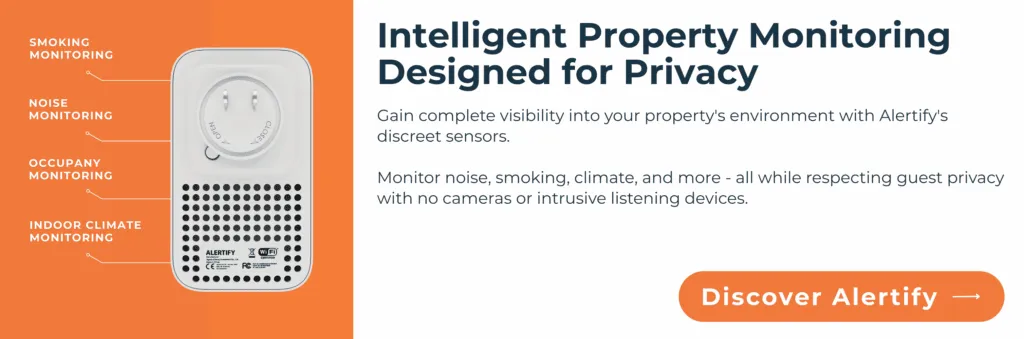
Alertify’s monitoring system delivers financial value beyond noise management through its indoor climate monitoring capability. Continuous tracking of temperature, humidity, and indoor air quality enables early detection of the conditions that lead to mold and damp — one of the most costly maintenance challenges in affordable housing stock. Early detection and intervention prevents the remediation costs, habitability complaints, and legal exposure that arise when mold problems are allowed to develop undetected — adding a further dimension to the financial return on monitoring technology investment.
The Cost of Doing Nothing Compounds Every Quarter
The financial case for noise monitoring in affordable housing is not theoretical. It is grounded in measurable reductions in officer time, legal costs, vacancy rates, and maintenance expenditure — all delivered by a system that installs in 15 minutes, requires no specialist infrastructure, and begins generating value from day one. Every quarter without systematic noise monitoring is a quarter of avoidable costs accumulating across budget lines that affordable housing providers can least afford.
Book a free demo with Alertify and receive a personalized cost analysis for your portfolio — find out exactly what noise dispute management is currently costing your organisation and what the return on monitoring technology investment looks like for your specific context.