
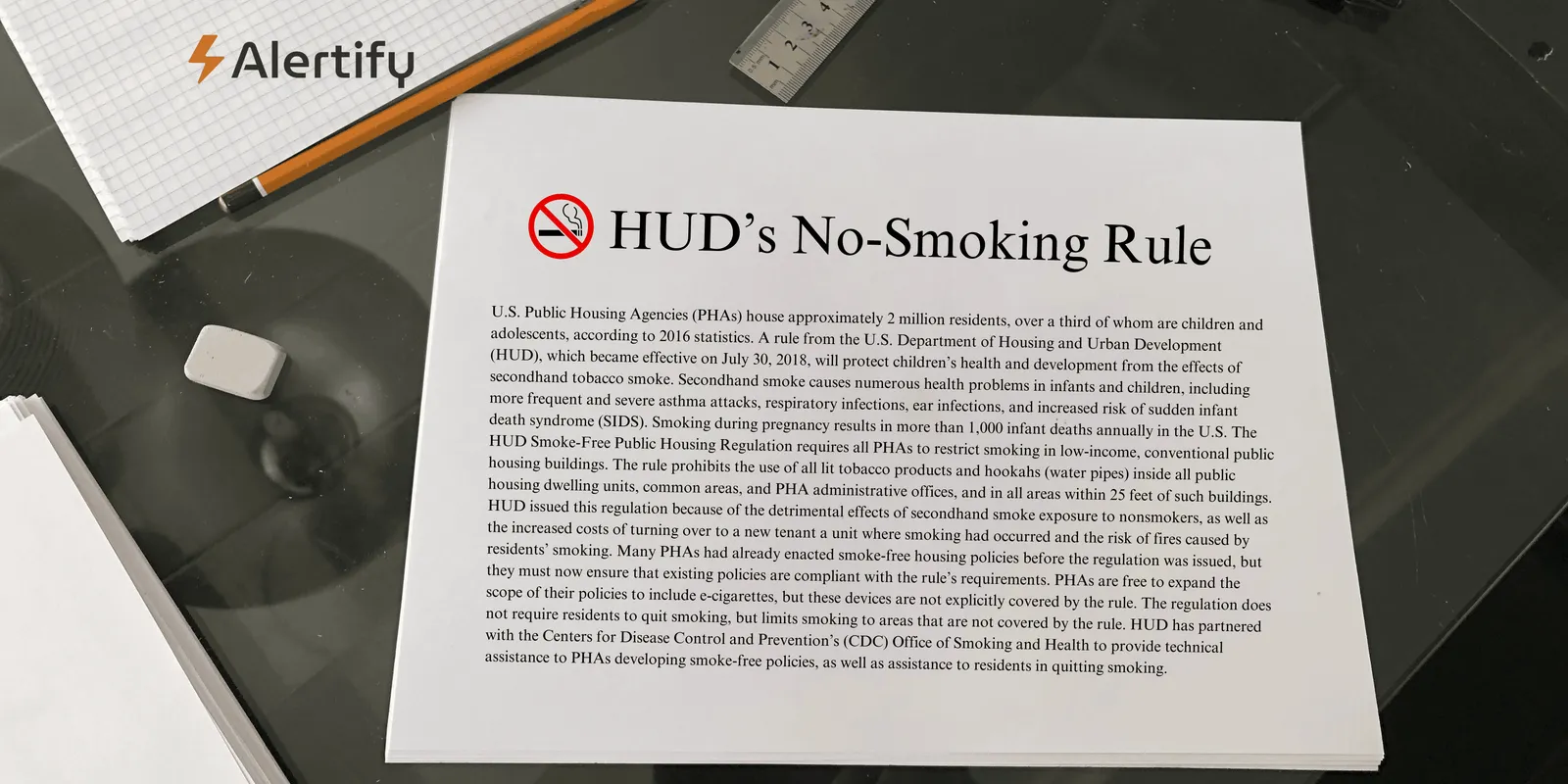
When the U.S. Department of Housing and Urban Development (HUD) implemented its no-smoking rule in 2018, it marked a historic shift in public housing policy. For the first time, federally subsidized housing smoking bans has been implemented which include public housing units, administrative offices, and shared spaces.
While the intent behind the policy is clear—to protect the health of residents and reduce the cost of smoking-related damage—many affordable housing property managers are still grappling with the complexities of enforcing it. In this post, we explore how HUD’s no-smoking rule affects both properties and tenants, the compliance challenges housing providers face, and how technology like Alertify is helping close the enforcement gap.
What Does HUD’s No-Smoking Rule Actually Require?
The HUD no-smoking rule for public housing bans the use of lit tobacco products in all indoor areas and within 25 feet of buildings. This includes:
Cigarettes
Cigars
Pipes
Hookahs
The rule does not apply to e-cigarettes or vaping devices (though PHAs may choose to include them in their own policies).
Importantly, this rule is mandatory for all Public Housing Authorities (PHAs) and affects over 1.2 million households across the United States, according to HUD’s own data. While Section 8 (Housing Choice Voucher) units are not included under the federal rule, many landlords and housing authorities have adopted similar policies under Section 8 smoking policy updates and local housing regulations.
Why the Rule Was Created: Health and Economic Impacts
HUD’s ban was driven by two primary concerns: health risks and property maintenance costs.
Protecting Resident Health
According to the CDC, secondhand smoke causes nearly 41,000 deaths each year among non-smoking adults in the U.S. alone. In dense housing environments like public housing, smoke doesn’t stay contained—it seeps through walls, vents, and shared HVAC systems, putting neighbors at risk, especially children, seniors, and people with chronic health conditions.
Reducing Smoking-Related Property Damage
The cost of turning over a unit where smoking occurred is significantly higher than a non-smoking unit. In affordable housing, where budgets are already tight, these costs are unsustainable. According to the American Lung Association, smoking-related damages in rental housing can cost landlords $1,000 to $8,000 per unit, depending on the severity.
This includes:
Repainting walls and ceilings
Replacing carpets and window treatments
Deep cleaning HVAC systems
Odor removal treatments
Addressing nicotine stains and burns
Challenges in Enforcing the Policy
Despite its benefits, enforcing the HUD no-smoking rule for public housing has been difficult for many housing providers.
Lack of Evidence
The most common complaint from property managers? It’s hard to prove someone smoked inside. Without hard evidence, pursuing smoking fees for tenants or lease violations can be legally risky or lead to disputes.
Tenant Pushback
Some tenants feel the policy is intrusive or discriminatory, especially if they’ve been long-term residents. Others simply ignore the rules, knowing enforcement is inconsistent.
Resource Constraints
Public housing staff often have limited time and budget to inspect units, respond to complaints, or monitor violations. With high turnover, managing and documenting repeat offenses becomes even harder.
How Alertify Supports Compliance
To meet these challenges, housing providers are turning to smoking detection technology like Alertify. These devices provide the real-time data and objective evidence needed to support enforcement efforts—without recording audio or invading privacy.
Continuous Monitoring with Clear Data
Alertify monitors for particulate levels and chemical compounds associated with tobacco and marijuana smoke. When levels exceed a set threshold, property managers receive a time-stamped alert, making it easier to document and investigate suspected violations.
Enforcing Smoking Fines Fairly
Armed with verified data, property managers can issue smoking fees for tenants fairly and consistently—reducing bias, protecting non-smoking residents, and defending their policies with confidence.
Educating Tenants
Alertify’s WelcomeLink guest journey tool also allows PHAs and landlords to educate residents at lease signing. Tenants can review the smoking policy, acknowledge the rules, and understand the consequences—all tracked digitally to support compliance and transparency.
Looking Ahead: Should Vaping Be Included?
Although vaping in hotels and private rentals is often banned, many PHAs have yet to include e-cigarettes in their policies. However, the Section 8 smoking policy landscape is evolving. Some states and municipalities are moving toward broader definitions of “smoking” that include all forms of nicotine and cannabis consumption, especially near vulnerable populations or oxygen tanks.
Alertify’s sensors are capable of detecting e-cigarette aerosol as well, offering future-proof compliance as more housing providers update their policies.
In Summary
The HUD no-smoking rule for public housing is a necessary step to protect health and reduce costs—but enforcement remains a challenge. For property managers, relying on tenant reports and periodic inspections is no longer enough. Proactive tools like Alertify make enforcement fair, consistent, and legally defensible—while helping housing authorities comply with federal mandates and maintain safer, cleaner homes for all residents.
Looking for a better way to prevent smoking violations in your affordable housing properties? Explore the full guide to affordable housing smoking detection.
Prevent smoking violations in your affordable housing properties
Want more Alertify? Follow us on: