If you own a rental property in a community governed by a homeowners’ association, you operate under a set of rules that most landlords significantly underestimate. HOA noise rules are not simply guidelines for polite behavior but rather they are enforceable contractual obligations that carry real financial penalties, and those penalties fall on you as the property owner, regardless of whether your tenant was the one causing the problem.
Understanding HOA noise rules for landlords is not optional. It is a baseline requirement for responsible rental operation in HOA-governed communities, and failing to manage it proactively can put your rental income, your property’s standing with the association, and in extreme cases, your ability to continue renting the property at all.
The good news is that proactive noise monitoring for single family rentals makes HOA compliance significantly more manageable, turning a reactive headache into a documented, systematic part of your property management process.
What HOA Noise Rules Actually Cover
HOA noise rules for landlords vary by association, but most CC&Rs (covenants, conditions, and restrictions) address noise in several consistent ways. Understanding these categories helps landlords set monitoring thresholds and tenant expectations correctly.
Quiet hours: Most HOAs designate specific quiet hours during which noise must be kept below a certain level. On weekdays, these typically run from 10 p.m. to 8 a.m and on weekends, from 11 p.m. to 9 a.m. Some associations extend quiet hours on public holidays. Violating quiet hours even once can result in a formal notice and a fine assessed against the property owner.
Decibel limits: Some HOAs specify a maximum decibel level rather than (or in addition to) quiet hours. These limits may apply 24 hours a day or only during designated periods. Knowing your specific HOA’s decibel thresholds and setting your monitoring system accordingly is the first step toward proactive compliance.
Gathering and event restrictions: Many HOAs regulate the size and frequency of gatherings at residential properties. There may be limits on the number of guests, the use of amplified music, outdoor events, and the times during which gatherings can be held. These rules are particularly relevant for landlords managing properties that tenants may use for events or social gatherings.
Repeat violation escalation: Most HOAs operate a tiered penalty system. A first violation may result in a warning or a modest fine, with repeat violations escalating significantly both financially and procedurally. Landlords with properties that accumulate multiple violations within a short period can face hearings before the HOA board, restrictions on rental activity, and in serious cases, legal action.
Why the Fine Falls on You, Not Your Tenant
This is the point that many landlords misunderstand until they receive their first HOA violation notice. HOA fines are assessed against the property owner, the legal member of the association, not the tenant. Your tenant is bound by your lease, not by the HOA’s rules (unless you have specifically incorporated HOA rules into the lease). This means that if your tenant violates HOA noise rules, you receive the fine.
You can include lease provisions that allow you to pass HOA fines through to the tenant and you absolutely should but collecting that money is a separate legal process with its own costs and complications. The administrative burden of the violation response, the potential impact on your HOA standing, and the risk of escalating penalties all remain with you regardless of your success in recovering costs from the tenant.
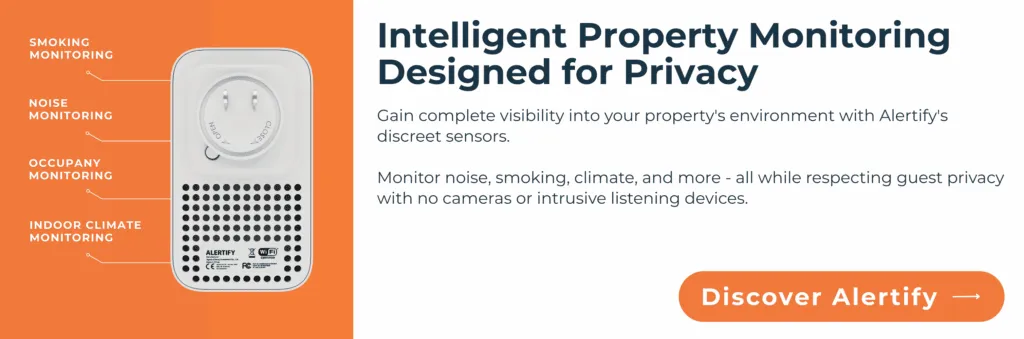
This structural reality is exactly why proactive monitoring makes so much financial sense. When Alertify detects noise approaching your HOA’s threshold during quiet hours and automatically sends an alert to the tenant via the Guest Alert feature, the intervention often prevents the violation from escalating to the point where a neighbor files a formal HOA complaint. The fine is avoided entirely which is a far better outcome than recovering it from the tenant after the fact.
Using Noise Monitoring to Document HOA Compliance
There is a proactive benefit to noise monitoring that goes beyond just preventing violations it creates, it is a documented record of your compliance management that can be shared with the HOA when disputes arise.
If a neighbor files an HOA complaint about your property on a specific date, Alertify’s documentary evidence sensor data allows you to respond with a factual account of what the monitoring system recorded at that time. If the data shows noise levels were within the HOA’s limits, you have objective evidence to present at a board hearing. If the data confirms elevated levels, you have documentation showing that you were alerted and responded demonstrating the kind of active management that HOA boards generally respond to more favorably than they do to landlords who appear indifferent to compliance.
Some HOA communities are beginning to look favorably on landlords who voluntarily deploy monitoring systems. Demonstrating that your property has a noise management system in place and providing incident logs as evidence of active oversight positions you as a responsible owner within the community and can provide protection in cases where complaints are subjective or exaggerated.
For landlords managing properties in HOA communities where rental property noise complaints have been an issue historically, Alertify’s combination of real-time alerting, automated messaging, and 180-day data retention creates the kind of documented compliance posture that makes a material difference in your relationship with the association.
Know Your Rules. Monitor Proactively. Stay Compliant.
HOA noise rules for landlords are a fixed feature of the regulatory landscape for single family rental operators in community associations. Understanding them, incorporating them into your lease provisions, setting your monitoring thresholds accordingly, and using real-time data to manage proactively is the most effective strategy available.
Alertify makes that strategy operationally simple: a 15-minute installation, customizable thresholds, real-time alerts, automated messaging, and downloadable incident reports that serve as both compliance documentation and dispute protection.
Book a free Alertify demo and take the guesswork out of HOA noise compliance at your rental property.