
Ask most landlords what a noise disturbance costs them, and they’ll mention the fine. Maybe $200, maybe $500 an unpleasant but manageable expense. What they rarely calculate is everything that comes after: the lost rental income, the property damage, the time spent managing the dispute, the hit to their rental’s reputation, and the potential insurance implications that compound over months and years.
The hidden costs of noise disturbances in rental properties are significantly larger than the headline fine, and understanding the full financial picture is essential for any landlord who wants to make informed decisions about how and how much to invest in prevention. Proactive noise monitoring for single family rentals is not just about avoiding noise fines. It is about protecting the total economic value of your rental investment.
The Full Cost Breakdown That Most Landlords Overlook
Direct fines and HOA penalties: The most visible cost, but rarely the largest. Municipal noise ordinance violations typically start at $250 for a first offense, rising to $500 for a second and $1,000 or more for repeat violations. HOA penalties have their own fee structures and can escalate on a daily basis for repeat or unresolved violations. In some cities, short-term rental operators face tiered enforcement systems where a third violation results in license suspension, a cost that far exceeds the fine itself.
Property damage from noise-generating events: The gatherings that produce noise violations also tend to produce physical damage. Broken furniture, stained flooring, damaged walls, and outdoor area wear are the physical legacy of unauthorized parties. Security deposits rarely cover the full cost of remediation particularly when damage is disputed and the time and effort required to document, claim, and recover these costs is its own significant burden.
Vacancy and turnover costs: A noise-related eviction or early lease termination creates a vacancy period. For a single family rental generating $2,000 per month, even two weeks of additional vacancy represents $1,000 in lost income. Add the cost of cleaning, maintenance, and re-listing, and a single tenancy disruption can cost $3,000 to $5,000 before the next tenant moves in.
Administrative and legal costs: Responding to a noise violation, contesting an HOA fine, managing a tenant dispute, or pursuing a security deposit claim all require time and if the situation escalates to formal legal proceedings, attorney fees add up quickly. Many landlords significantly underestimate the value of their own time when calculating these costs.
Insurance implications: Repeated noise complaints and associated property damage can affect your landlord insurance premiums at renewal, or in some cases lead to policy non-renewal. Insurers assess risk based on documented claim history, and a property with a pattern of disturbance-related incidents represents elevated risk.
Reputation damage: For landlords who use their single family rental as a short-term rental during vacancy periods, noise complaints translate directly into negative reviews. A single noise-related complaint on Airbnb or VRBO can lower your listing’s ranking, reduce booking rates, and create a reputational problem that takes months of five-star reviews to repair.
Calculating the Real Cost of One Noise Incident
To make the hidden costs of noise disturbances in rental properties face concrete, consider a realistic scenario. A tenant hosts an unauthorized party on a Saturday night. The noise reaches 85 decibels at 1 a.m. A neighbor files a complaint. The following week, the landlord receives a $500 municipal fine and a $250 HOA violation notice. During the party, a piece of rented furniture was damaged and requires $400 in replacement costs. The tenant disputes the damage charge, requiring three hours of administrative follow-up and a formal deposit dispute process.
In this scenario, the direct measurable costs are approximately $1,150. But if the tenant ultimately leaves early due to the dispute, and the property sits vacant for an additional three weeks, the total economic impact including lost rent, turnover cleaning, and re-listing climbs to roughly $3,000 to $4,000. One incident.
Now multiply that risk across a full year of tenancy at a property without any monitoring system in place, and the expected value of unmanaged noise risk becomes substantial. Against this backdrop, the annual cost of an Alertify monitoring subscription looks like exactly what it is: insurance that pays for itself.
How Alertify Reduces Hidden Costs at Every Level
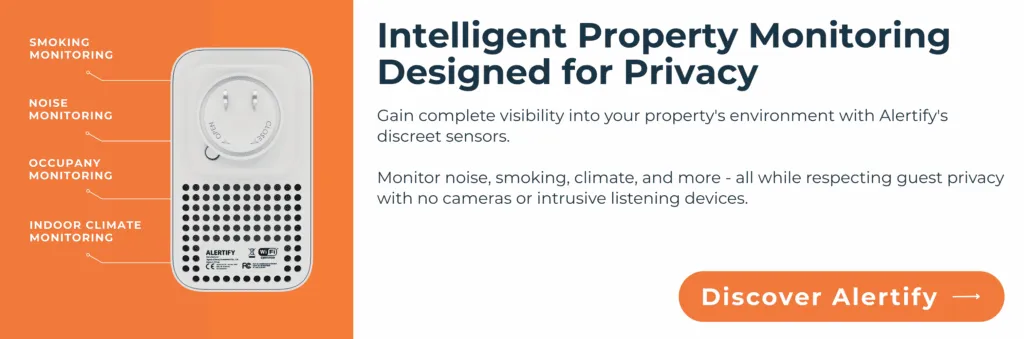
Alertify addresses the hidden costs rental properties face at multiple points in the cost chain. Real-time noise monitoring and Guest Alert automated messaging prevent the majority of violations before they escalate to the point of a neighbor complaint or city fine Alertify data shows that 90% of noise violations auto-resolve within 10 minutes of an automated alert being sent.
For violations that do occur, Alertify’s documentary evidence feature provides timestamped incident reports that support security deposit claims, HOA dispute responses, and formal legal proceedings. Landlords with objective documentation recover damages more reliably than those relying on subjective accounts, reducing the administrative burden and improving outcomes in dispute resolution.
The occupancy monitoring and indoor smoking detection features address the two major sources of physical property damage which is unauthorized gatherings and indoor smoking with the same combination of real-time alerting and documentary evidence. Landlords who deploy a full property monitoring system report significantly fewer incidents of serious property damage, which directly reduces vacancy costs, turnover costs, and insurance exposure.
For landlords who take noise monitoring for single family rentals seriously, the investment calculus is clear. The cost of prevention is far lower than the cost of the damage, disputes, and administrative burden that noise disturbances generate when left unmanaged.
Protect Your Investment from the Costs You Don’t See Coming
The hidden costs of noise disturbances are real, significant, and preventable. Understanding the full financial picture beyond the headline fine is the first step toward making an informed decision about property monitoring. Alertify gives landlords the tools to prevent violations, document incidents, and resolve disputes with objective data, all in a device that takes 15 minutes to set up.
Book a free Alertify demo and discover what proactive monitoring can do for the economics of your rental portfolio.