
You understand the “why.” You know that indoor air quality in schools is a critical, measurable factor in student health, attendance, and academic performance. You’re ready to move beyond guessing and start managing your school’s environment.
But what’s the first step? The task of implementing school air quality monitoring can seem daunting. Do you hire an expensive consultant? Do you buy a few random sensors off the internet?
Don’t worry. Starting your IAQ journey is easier and more affordable than you think. This 5-step action plan will walk you through the process, transforming you from a concerned administrator into a data-driven, proactive leader.
Step 1: Ditch the “Snapshot” Mindset
The first, most critical step is a mental one. You must move beyond the old model of school IAQ testing.
The old way involved hiring a consultant to come in for one day. They would take a few air samples, give you a 50-page report (that no one read) six weeks later, and charge you $10,000. This is a “snapshot.” It tells you what the air was like on one Tuesday afternoon in October.
It doesn’t tell you:
- What happens when 30 students pile into a room after recess?
- What the CO2 levels are during a packed school assembly?
- If the humidity in the basement spikes every night?
- If wildfire smoke is seeping in right now?
Air quality is dynamic. It changes minute-by-minute. You don’t need a snapshot but rather you need a 24/7 video. The goal of implementing school air quality monitoring is to get continuous, real-time data that you can actually act on.
Step 2: Assemble Your IAQ Team
This isn’t a one-person job, and it shouldn’t be siloed in the facilities department. Your IAQ team should include key stakeholders who can provide insight and help champion the solution.
- The Facilities Manager: Your technical expert. They will manage the HVAC response.
- The School Nurse: Your health expert. They have the data on asthma attacks and mysterious headaches. They will be your biggest advocate.
- A Lead Teacher or Principal: Your on-the-ground expert. They know which rooms “feel stuffy” and can help implement in-classroom solutions (like opening windows).
- A District Administrator: Your budget expert. They need to see the data to understand the ROI and approve the investment.
Step 3: Audit Your Buildings and Prioritize
You don’t need to put a sensor in every single room on day one. Be strategic. Start by implementing school air quality monitoring in your known “red flag” zones.
- High-Density Areas: Cafeteria, gymnasium, auditorium, band room (where lots of people are breathing heavily).
- Vulnerable Populations: The nurse’s office, special education rooms, and kindergarten classrooms.
- Known “Problem” Areas: The basement library that “always smells musty,” the classrooms in the 1950s wing, the art room (with VOCs), or any room near the bus pickup line (PM2.5).
This “phased” approach allows you to gather powerful data and demonstrate the value of monitoring quickly, making it easier to expand the program later.
Step 4: Choose the Right Technology (A Platform, Not Just a Sensor)
This is the most important decision you’ll make. Don’t just buy a $50 CO2 sensor from an online marketplace. You’ll have 20 different devices with 20 different apps, and no way to see the big picture.
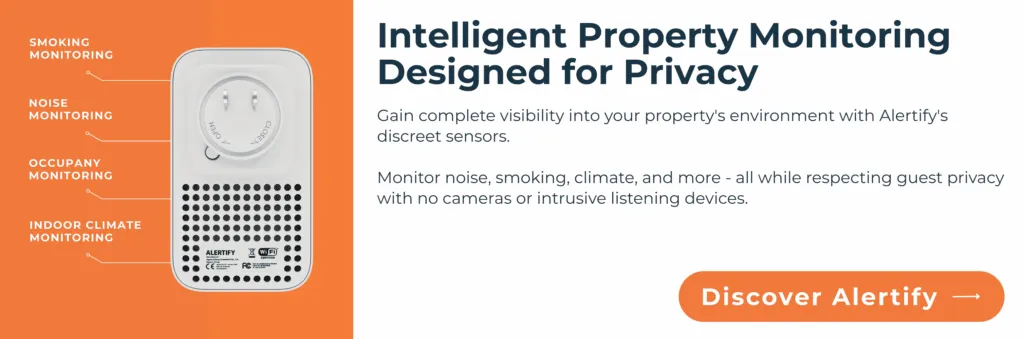
You need a platform, like Alertify with its indoor air quality monitoring system. Here’s what to look for:
- All-in-One Sensors: You need a device that tracks all the key metrics in one: CO2, Humidity, Temperature, and PM2.5.
- A Central Dashboard: This is non-negotiable. You must be able to see the status of all your buildings and rooms from one simple, web-based dashboard on your phone or computer.
- Easy, “Plug-and-Play” Installation: You don’t have time for a complex IT project. Alertify’s sensors are designed to be set up in minutes. Just plug them in, connect to Wi-Fi, and they start working.
- Actionable Alerts: The platform must be able to send you instant, automatic email or text alerts when a threshold is breached. Data is useless if you don’t see it until it’s too late.
Step 5: Create Your Action Plan and Communicate
The data from your new monitoring platform will immediately show you where your problems are. Now, you can create a data-driven action plan.
This is a great time to create a Healthy School Environment Checklist for your staff. This checklist is no longer based on “guesses” but on your school’s actual data.
- IF: The Alertify sensor in your room shows CO2 is high…
- THEN: Open windows for 10 minutes between classes to “flush” the air.
- IF: The dashboard shows high PM2.5 from outside smoke…
- THEN: An all-school announcement is made to keep windows closed and turn on portable HEPA filters.
- IF: The dashboard shows high VOCs in the art room…
- THEN: The teacher is reminded to run the exhaust fan during and after class.
- IF: The platform sends a “High Mold Risk” alert for the locker room…
- THEN: A maintenance ticket is automatically created for facilities to investigate for a leak.
Finally, share your commitment. Be transparent with parents and staff. Let them know you are one of a few leading-edge school districts that is proactively monitoring and managing indoor air quality in schools. This builds immense trust and shows you are dedicated to their children’s health and safety.
You don’t have to do it alone. Alertify is more than a sensor; we’re a partner in your school’s health. Our team can help you identify your red-flag zones and set up your action plan. Schedule a demo today to start your journey to a healthier, smarter school.