The late-night phone call is a universal sound of dread for any property manager, landlord, or short-term rental host. The moment your phone vibrates on the nightstand after hours, your heart sinks, anticipating the inevitable: a noise complaint. It’s the call that signals a disruption, a potential conflict, and a threat to your property’s peaceful reputation. Noise, unauthorized parties, and smoking are not just minor annoyances but rather they are major threats to a property’s profitability and standing in the community. The key is to shift your strategy from reactive problem-solving to proactive protection. This guide will show you how to implement a powerful, two-part solution,combining physical soundproofing with Alertify’s smart noise monitoring system, to effectively prevent noise complaints for good.
The True Cost of a Single Incident: Why You Need a Strategy
Ignoring the potential for a single disruptive event is a gamble most property owners can’t afford to take. A single out-of-control party or a tenant with a habit of playing loud music can trigger a cascade of negative consequences that go far beyond a single sleepless night for a neighbour. To truly understand the importance of a proactive strategy, you must first appreciate the tangible costs of unmanaged noise and guest behaviour.
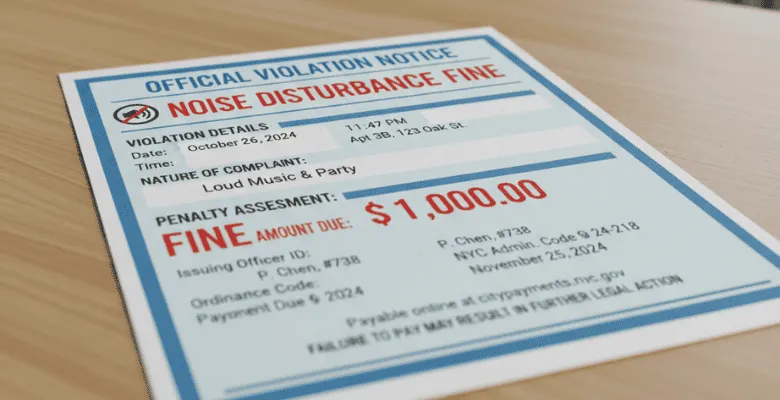
The financial penalties alone can be staggering. Many municipalities and Homeowners’ Associations (HOAs) have strict noise ordinances with little tolerance for violators. These aren’t just small warnings – noise violation fines can be as high as $1,000 for a single incident in areas such as North Carolina, Florida, New York, and more. This is a direct hit to your bottom line, instantly turning a profitable booking into a significant loss.
Beyond direct fines, the damage to your reputation can be even more costly. Once a property is labelled as “that noisy house”, it’s incredibly difficult to shake. This leads to strained relationships with neighbors and the community, inviting constant scrutiny and future complaints, even for minor infractions. In the digital age, this community sentiment quickly translates online. For short-term rental hosts, a review mentioning a “loud party” or “thin walls” can be a death sentence for future bookings. With studies showing that 90% of consumers read online reviews before making a purchasing decision, a single negative review about noise can deter hundreds of potential guests.

For long-term rentals, the consequences are just as severe. Persistent noise from a neighbouring unit is a leading cause of tenant dissatisfaction and, crucially, tenant turnover. The cost of re-tenanting is substantial. When you factor in advertising for a new tenant, the time spent on showings and vetting, cleaning and repair costs, and the lost rental income during the vacancy, the total cost can easily exceed thousands of dollars per vacancy. In extreme cases, repeated complaints can escalate to legal action, costing you thousands in legal fees and immense stress, not to mention the difficulty of resolving deposit disputes without concrete evidence.
The Foundational Layer: Practical Ways to Soundproof Your Property
Before you can manage noise, you need to control how it travels. Sound waves are like water and they will find and move through any crack or weak point. The first line of defense in your strategy to prevent noise complaints is to make it physically harder for sound to escape or enter your property. To effectively soundproof your property, you can implement a range of solutions, from low-cost DIY fixes to more significant structural investments.
Low-Cost, High-Impact DIY Soundproofing
You don’t need a complete renovation to make a noticeable difference. These high-impact solutions are affordable, easy to implement, and can significantly reduce ambient noise.
- Soften the Surfaces: Hard surfaces like hardwood floors, tile, and bare walls are a major cause of noise amplification. They reflect sound waves, creating echo and making every sound seem louder. The solution is absorption. By introducing soft, porous materials, you can soak up that sound energy. Lay down thick area rugs with dense pads underneath. Hang heavy, insulated curtains over windows, which not only block light but can also absorb sound. Place fabric tapestries or even stylish acoustic art panels on large, empty walls. Opt for upholstered furniture like fabric sofas and armchairs over hard wood or leather where possible.
- Seal the Gaps: The most common way for airborne noise to travel between rooms or from the outside is through air gaps. Sealing these gaps is one of the most cost-effective ways to soundproof your property. Apply self-adhesive foam weatherstripping around window frames and door jambs to create a tight seal. Install a solid door sweep at the bottom of exterior doors and any interior doors leading to hallways or shared walls. For a more permanent fix, use acoustical caulk, a flexible sealant designed for soundproofing, to fill any visible cracks around window sills, baseboards, and electrical outlets.
- Strategic Furnishing: You can use your furniture as a sound barrier. Large, dense objects are excellent at absorbing and blocking sound energy. The best example is a large, fully-stocked bookshelf. Placing one against a shared wall with a neighbour adds significant mass, making it much harder for conversations or TV noise to pass through.
Structural Investments for Serious Soundproofing
If you’re dealing with significant noise issues, are located in a busy urban area, or are planning a renovation, it’s the perfect time to make more substantial upgrades to truly soundproof your property.
- Windows and Doors: Your property’s weakest points for sound are often its windows and doors. A standard hollow-core door offers minimal sound resistance. Upgrading to a solid-core wood door can make a world of difference. For windows, investing in double or even triple-pane units is highly effective. Look for the Sound Transmission Class (STC) rating; the higher the number, the better the sound insulation. A standard single-pane window might have an STC of 27, while a high-quality, double-pane window can achieve an STC of 45-50+, effectively blocking out most traffic and loud conversations. Even simple upgrades like adding heavy, insulated curtains can reduce perceived noise by 10-20 decibels.
- Walls and Ceilings: To stop low-frequency sounds like bass music or heavy footsteps, you need to address the structure itself. During construction or renovation, installing a layer of Mass Loaded Vinyl (MLV) takes everything to a new level. This is a thin, heavy, flexible material that is attached to studs before the drywall goes on, acting as a powerful sound barrier. Another technique is decoupling, which creates a separation to stop vibrations. This is done by installing drywall on resilient channels or sound isolation clips, which break the physical path sound uses to travel through a structure. Finally, filling wall and ceiling cavities with dense materials like Rockwool or fiberglass insulation absorbs sound energy and significantly reduces transmission.
- Floors: Impact noise from footsteps or dropped items is a common complaint in multi-story buildings. When installing new hard flooring, use a thick, high-quality acoustic underlayment designed to absorb impact. For the best possible solution, a “floating floor” can be constructed, which involves building a new subfloor on top of rubber isolators, completely separating it from the main structure.
From Complaint Crisis to a Quiet Home: Solving High-Rise Noise with Acoustic Underlayment
A compelling case study from a luxury high-rise in Atlanta, Georgia, highlights a successful resolution to pervasive noise issues in a multi-family building. The condominium association was facing a crisis of constant resident complaints due to significant impact noise, such as footsteps, and airborne noise, like conversations and televisions, traveling between floors. To address this, acoustic specialists were brought in to implement a targeted solution. They installed a high-performance, dense rubber acoustic underlayment directly onto the subfloors of the upper units before the final flooring was laid. This created a “floating floor” system, effectively decoupling the residents’ floor from the building’s main structure. The resilient mat absorbed the vibrational energy from daily activity, preventing it from passing through to the apartments below. The project resulted in a dramatic reduction in noise complaints, leading to a significant increase in resident satisfaction and ultimately protecting the property’s luxury-level value by restoring a peaceful living environment.
Why Soundproofing Alone Isn’t a Complete Solution
While taking steps to soundproof your property is a critical and foundational step, it has its limits. You could have the most perfectly insulated apartment in the world, but it won’t stop a group of twenty people from gathering for an unauthorized party at one in the morning. Soundproofing raises the threshold for what can be heard, but it cannot control the source of the noise.
Think of it this way: soundproofing is a passive defense. It mitigates the symptoms of noise transmission but does not address the cause – excessive noise being generated by occupants in the first place. You can’t control guest or tenant behaviour with insulation alone. To truly prevent noise complaints, you need to pair your passive defenses with a proactive solution that alerts you to problems in real-time.
The Proactive Solution: Smart Monitoring with Alertify
This is where modern technology provides the missing piece of the puzzle. A smart noise monitoring system gives you the insight and control you need to get ahead of potential issues without ever infringing on guest or tenant privacy.
What is Alertify (and What It Isn’t)?
Let’s clear up the most important point first: a noise monitoring system like Alertify is not a recording device. It is 100% privacy-compliant. It cannot listen to, record, or transmit conversations or any identifiable sounds. It detects a potential problem (excessive decibels) without knowing the specifics.
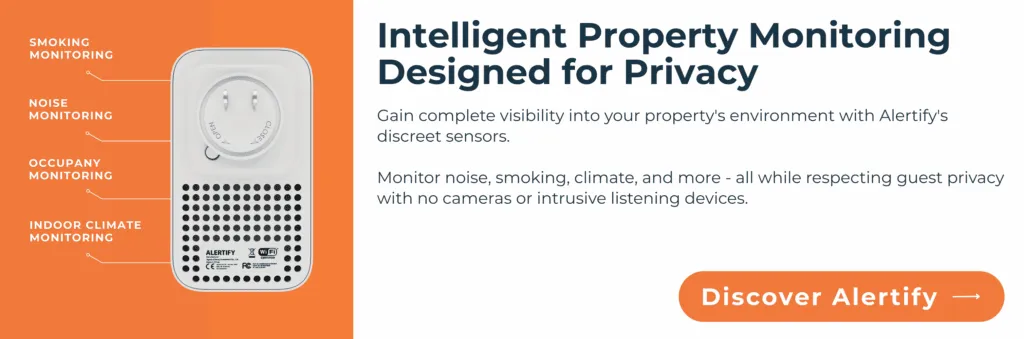
Alertify is an all-in-one system that monitors noise levels, cigarette and marijuana smoke, occupancy, and indoor climate like temperature and humidity. It’s a simple, discreet, plug-and-play Wi-Fi sensor. You plug it into an outlet in a common area, connect it to your dashboard, and it immediately starts monitoring the environment against the thresholds you’ve set. It’s a silent guardian for your property.
How Alertify Helps You Prevent Noise Complaints & More
A smart noise monitoring system like Alertify transforms your management style from reactive to proactive, giving you the tools to solve problems before they even become complaints.
- Instant, Real-Time Alerts: The moment noise levels exceed your pre-set threshold for a specific duration, you receive a notification on your phone via SMS, email, or push notification. You are the first to know, not the last.
- Automated Guest Messaging: This is perhaps the most powerful feature. When noise is detected, the system can automatically send a polite, pre-written text message to the guest, gently reminding them of the quiet hours. This single feature de-escalates situations immediately and discreetly. Alertify’s automated system resolves 90% of noise issues within 5-10 minutes, all without you needing to lift a finger.
- Occupancy Monitoring: Unauthorized parties are a property manager’s worst nightmare. Alertify’s noise monitoring system can also detect the number of people in a unit, preventing parties before they get out of hand. If your rental is for four people and the sensor detects fifteen, you’ll know immediately.
- Incident Reports for Evidence: When a complaint does arise, you’re no longer in a “he said, she said” situation. Alertify provides objective, timestamped proof of noise events, smoking, or over-occupancy. This data is invaluable for resolving disputes, fighting false claims, or providing evidence for deposit claims or to an HOA board.
- Full Customization: Every property is different. You can easily set custom thresholds for daytime and quiet hours, complying with your local ordinances and building rules, ensuring the system is perfectly tailored to your needs.
Your Complete 4-Step Noise Management Strategy
By combining the physical defense of soundproofing with the smart technology of a noise monitoring system, you create a comprehensive, layered strategy. Here’s your action plan:
- Step 1: Communicate Clearly: Proactive and clear communication is the foundation of a successful guest or tenant relationship. Your house rules, lease agreement, or booking description should explicitly state your policy on noise, parties, and quiet hours. To streamline and professionalize this process, use a tool like Alertify’s WelcomeLink. This allows you to create a customized digital guidebook where you can present all essential information in one place. You can require guests to review and sign off on your house rules, collect verified IDs and guest emails, and even upsell services. By using WelcomeLink to present your policies, you ensure guests have read and acknowledged the rules before they even check in. Informing them through this platform that a system is in place to prevent noise complaints also acts as a powerful, transparent deterrent.
- Step 2: Implement Soundproofing: Use the techniques above to soundproof your property. Start with the low-cost DIY solutions and, based on your budget and specific needs, consider the more structural investments for long-term peace.
- Step 3: Install Alertify: Place your Alertify device in a central common area like the living room or kitchen, where noise is most likely to originate. The simple plug-and-play setup takes only minutes.
- Step 4: Automate Your Response: Configure the automated guest messaging feature in your Alertify dashboard. Create a polite, friendly message that will be sent automatically if noise levels are breached. This handles the vast majority of issues for you.
Invest in Protection and Peace of Mind
In the world of property management, peace and quiet isn’t a luxury but rather it’s a valuable asset. Every noise complaint you avoid is a negative review you don’t receive, a fine you don’t pay, and a neighbourly relationship you don’t damage. The most effective way to prevent noise complaints is to stop seeing them as inevitable and start treating them as preventable.
By adopting a dual approach, fortifying your space by taking steps to soundproof your property and actively managing it with a privacy-safe noise monitoring system like Alertify, you create a robust shield for your investment. This strategy protects your property’s reputation, maintains good community relations, reduces your stress, and ultimately secures your profitability. It’s time to turn noise anxiety into peace of mind.