
As an STR host, your noise monitor throws numbers at you like 65 dB, 72 dB, 85 dB. But what do those numbers actually mean? Here’s the plain-English guide, backed by real data, to understanding what’s normal, what’s a problem, and when you need to act.
The Decibel Scale: What You Need to Know First
Decibels are logarithmic, not linear. That’s the single most important thing to understand. A 10 dB increase doesn’t mean “a bit louder”, it means 10 times more acoustic energy, and roughly double the perceived loudness to the human ear. So the jump from 60 dB to 80 dB isn’t a 33% increase, it’s 100 times the intensity.
That’s why noise ordinances are written with precision, and why a monitor alerting you at 75 dB versus 85 dB is a meaningfully different situation.
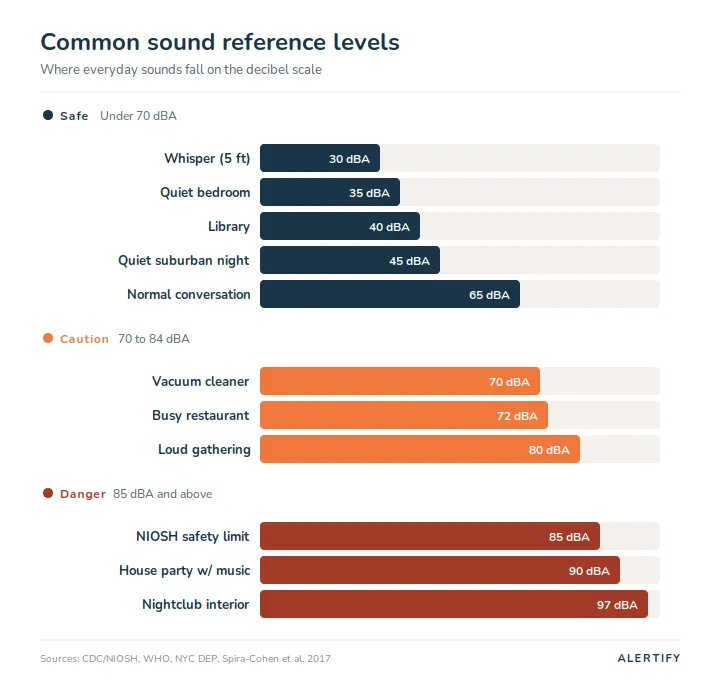
The key thresholds to memorise: The CDC states that sounds at or below 70 dBA are generally considered safe. NIOSH sets its recommended occupational exposure limit at 85 dBA over 8 hours, and OSHA’s legal workplace ceiling is 90 dBA. Once your property monitor is reading above 80 dB and sustaining it, you have a problem.
What ‘Normal’ Looks Like in a Short-Term Rental
Noise monitoring data from industry research helps build a realistic picture of everyday STR noise. A NoiseAware study monitoring 2.9 million minutes across 34 short-term rentals in Charleston found that STR properties were actually quieter than long-term occupied homes four out of seven days per week – Sunday through Wednesday. The strongest predictor of noise wasn’t whether a property was a short-term or long-term rental. It was sleeping capacity.
So what does a normal night look like on the dB scale?
| Situation | Typical Indoor Level | Concern? |
|---|---|---|
| Guests watching TV (normal volume) | 50–60 dBA | None |
| Small group chatting, background music | 60–68 dBA | None (daytime) |
| Kids running around, active household | 65–72 dBA | Low |
| 🔹 Raised voices, loud music, 6+ people | 🔹 72–82 dBA | 🔹 Moderate – watch closely |
| 🔹 Party with amplified music | 🔹 85–95 dBA | 🔹 High – act immediately |
| 🔹 Nightclub-level event (measured) | 🔹 92–97 dBA | 🔹 Extreme |
The peer-reviewed baseline for loud venues: a 2017 study published in the Journal of Occupational and Environmental Hygiene measured NYC bars, restaurants, and clubs, finding a median indoor level of 92 dBA, with 80% of venues exceeding the NIOSH 85 dBA safety threshold. If your STR is hitting those readings, you don’t just have a noise complaint risk, you have a health and safety event.
What Your Local Noise Ordinance Actually Enforces
Every host needs to know the specific rules for their market. The table below covers the major STR markets in the US and the numbers are tighter than most hosts realise, especially at night.
| City | Day Limit | Night Limit | Quiet Hours |
|---|---|---|---|
| New Orleans, LA | 60 dBA | 55 dBA | 10 pm – 7 am |
| Nashville, TN | Plainly audible standard | 50–55 dBA (commercial equip.) | 10 pm – 7 am |
| Austin, TX | 75 dBA amplified | Inaudible beyond property line | 10:30 pm – 7 am |
| Phoenix, AZ | Unreasonably loud standard | No shouting/amplified sound | 10 pm – 7 am |
| Scottsdale, AZ | 68 dBA (entertainment venues) | 68 dBA / 70 dBC | 10 pm – 9 am |
| Fort Lauderdale, FL | Per Table I, Code Ch. 17 | 40 dBA HVAC; bass limits | 10 pm – 7 am |
| New York City | 7 dBA above ambient | 42 dBA inside neighbor’s unit | 10 pm – 7 am |
⚠️ Important: Some jurisdictions, such as Phoenix, Austin (nighttime), Nashville residential, use a ‘plainly audible’ standard, not a dBA cap. This means a complaint can be issued without a sound-level meter. Even if your sensor reads below the dB threshold, a neighbor who can hear music through a wall at midnight may have a valid complaint.
Fines escalate fast. Fort Lauderdale can reach $15,000 through magistrate hearings. Scottsdale goes from $500 to $2,500. Austin issues Class C misdemeanours up to $500 per violation. And in markets like La Quinta and Cathedral City in California, where STR-related noise complaints drove a 267% spike and ultimately led to a full STR phase-out, a pattern of noise issues can cost you your licence entirely.
The Real Data on Noise Incidents in STRs
The good news: serious noise incidents are rare. The bad news: the ones that happen tend to have outsized consequences.
Airbnb (2024 Newsroom): Fewer than 0.035% of global stays resulted in an allegation of a party, a decrease from 2023, and over 50% lower than 2020 since the platform-wide party ban.
The pattern is clear: most guests self-correct when they know they’ve been detected. The problem is hosts who only find out hours later, or after the neighbour has already called the police.
What Thresholds Should You Actually Set?
Based on EPA indoor residential guidelines, WHO sleep-health data, and the ordinance table above, here’s a practical starting framework:
| Time | Recommended Alert Threshold | Why |
|---|---|---|
| Daytime (8am–10pm) | 70 dBA sustained 10 mins | Aligns with EPA indoor residential goal; below NIOSH safety line |
| Nighttime (10pm–8am) | 55 dBA sustained 5 mins | Matches stricter ordinances (New Orleans, Nashville); WHO sleep protection |
| Any time – escalate | 85 dBA sustained 5 mins | At NIOSH hazard threshold; consistent with full-party activity |
One more practical tip: set your monitor to track sustained averages, not peaks. A door slamming at 90 dB is not a noise violation. Music thumping at 78 dB for 45 minutes almost certainly is and it’s the kind of reading that will hold up in a dispute.
How Alertify Turns These Numbers Into Action
Understanding decibel levels is the foundation but knowing them in real time, at the right property, the moment something crosses a threshold, is what actually protects your investment.
Alertify monitors noise 24/7 across your portfolio. When levels exceed your set thresholds, you’re notified within 5 minutes – not after the neighbour calls, not after checkout, not when the damage is already done. Here’s what that looks like in practice:
- Which property: For multi-property operators, Alertify’s dashboard shows exactly which unit is triggering – no guessing.
- How long it’s been going on: Trend data shows whether noise has been building for 8 minutes or 80 minutes, a meaningful difference when deciding how to respond.
- Automated guest messaging: Set up automated notifications that alert guests when they’ve crossed a threshold, giving them a chance to self-correct before you need to intervene.
- Instant incident reports: Every violation auto-generates a timestamped PDF report, downloadable immediately from your dashboard, with peak dB, average dB, duration, and guest details if connected to your PMS.
That last point matters more than most hosts realise. When a guest disputes a damage charge or claims “there was no party,” a timestamped noise report showing 89 dBA sustained for 2 hours starting at 11:47 pm is not a conversation. It’s a case closed.