
An unauthorized gathering can turn a routine weekend booking into property damage, a furious neighbor, and a platform strike against the listing, and it usually happens with almost no warning. Learning how to prevent parties in your vacation rental properties starts with understanding that outright parties are actually rare. The bigger, quieter risk is overcrowding that never gets loud enough to draw attention until the damage is already done, which is exactly the pattern most worth watching for.
Why Party Guests Slip Through Screening
Since introducing its global party ban in 2020, Airbnb reports that reported parties have dropped by more than 50 percent, and in 2024, fewer than roughly 0.06 percent of US reservations resulted in a party report at all. That’s a meaningful drop, but it doesn’t mean the risk has disappeared for any individual host. The bookings most associated with unauthorized gatherings tend to share a pattern: a same-week reservation, a single weekend night, a small stated guest count for a property that could comfortably hold far more, and little to no review history on the account making the booking.
Platform-level screening catches some of this, but not all of it, and a host relying entirely on booking details has no way to confirm what’s actually happening at the property once a guest checks in. A booking made under one name, for one or two guests, can just as easily become the venue for a gathering organized entirely through a group chat the host never sees.
How Occupancy Monitoring Catches Overcrowding in Real Time
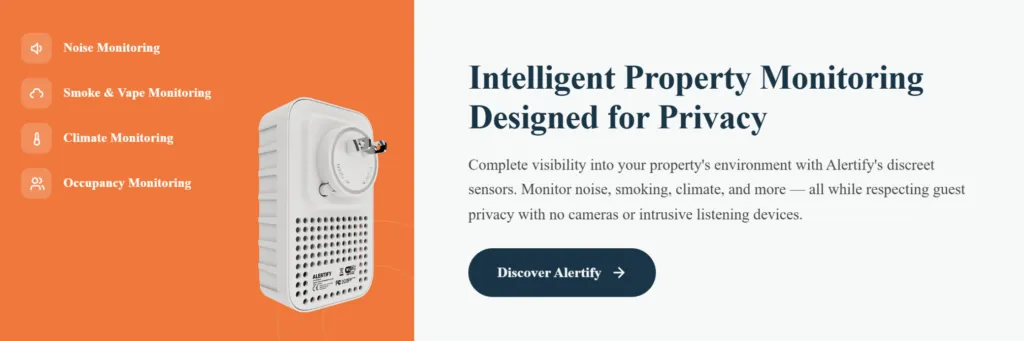
The more common problem isn’t a loud party. It’s quiet overcrowding: a two-guest booking that turns into twenty people for the weekend, none of them disruptive enough to trigger a neighbor’s call, but all of them adding wear, water use, and liability the booking never accounted for. It’s also the kind of overcrowding that runs headlong into local rules hosts often overlook: city occupancy limits per house, noise ordinances that kick in after certain hours in residential zones, parking restrictions that can’t absorb a dozen extra cars, and in some municipalities, specific trash and waste disposal rules for large groups. Alertify’s occupancy monitoring notifies hosts when there’s a large spike in occupancy in a short period of time in a unit relative to a threshold the host sets, without cameras or facial recognition, and flags the property the moment it goes over capacity.
Paired with Guest Alert, an automated message is sent through the hosts’ PMS as soon as a violation is detected. This gives the host a chance to address the issue while it’s still forming rather than finding out from a neighbor the next morning.
The threshold itself matters as much as the alert. Alertify’s occupancy feature doesn’t work off a simple headcount trigger. Instead, the device pings nearby sensors, and when occupancy spikes to reflect a large group, hosts get an alert. That signal is often paired with other telling signs of a gathering, like consistently elevated noise levels or smoking detection. This combination gives hosts a fuller picture than a single guest count would, so they’re not left guessing whether a small overage is a real problem or just a normal afternoon barbecue running a couple of guests over.
Protecting Your Property and Neighbors Without Being On-Site
Most short-term rental insurance and liability coverage is written around a specific occupancy limit, and a property that regularly hosts far more guests than it’s insured for can find that coverage doesn’t apply cleanly if a claim comes up. Real-time occupancy data closes that gap before it becomes a dispute with an insurer rather than during one, and it gives a host a factual record to reference rather than relying on a guest’s word about how many people were actually there.
This kind of monitoring also does the opposite of what many hosts worry it will do. It doesn’t flag a well-behaved family gathering or an extra guest who stopped by for dinner. It flags the pattern that actually correlates with damage: a sudden, undisclosed jump in headcount relative to the booking. That distinction is what makes occupancy monitoring a practical part of vacation rental protection, rather than an intrusive add-on guests notice or resent.
It’s also worth remembering that occupancy limits usually exist for practical reasons beyond noise, things like parking availability, and fire code, not just a host’s preference for a quieter weekend. A property that regularly runs over its stated capacity is taking on wear and risk the listing price was never built to cover.
Ready to Stop Unauthorized Gatherings Before They Start?
Preventing parties isn’t about assuming every guest is a risk. It’s about catching the specific pattern, an unusually large group, a rapid rise in headcount after check-in, early enough to respond before it turns into a repair bill or a neighbor dispute. Most hosts find that a small number of clear signals, a same-week booking, a stated guest count far below what a property can hold, or a rapid occupancy spike right after check-in, account for the vast majority of the incidents worth worrying about.
If overcrowding or unauthorized gatherings have been a recurring issue at your property, book a free demo and we’ll show you how occupancy alerts and automated guest messaging work together in practice.