Understanding the clinical, regulatory, and financial case for acoustic management is one thing. Turning that understanding into a functioning system that protects patients, supports staff, and satisfies compliance requirements is another. For hospital administrators looking to move from intention to implementation, this guide provides a clear, practical framework for how to implement noise monitoring in a hospital environment — from the first zone assessment through to ongoing performance optimization.
How to Implement Noise Monitoring in a Hospital: Starting With the Right Foundation
The good news is that modern hospital noise monitoring technology has dramatically reduced the complexity, cost, and time required for deployment. Alertify’s plug-and-play design means a complete device installation takes 15 minutes and requires no specialist IT infrastructure. The implementation challenge is therefore not primarily technical — it is operational. Getting it right means thinking carefully about zone mapping, threshold configuration, alert workflows, staff communication, and ongoing performance review from the outset.
Step 1: Map Your Clinical Noise Risk Zones
Before placing a single device, conduct a structured assessment of your facility’s acoustic risk profile. Identify which areas are most clinically sensitive to noise and which are most likely to generate it. High-priority monitoring zones typically include patient rooms, ICU bays, post-operative recovery areas, neonatal units, and palliative care environments — spaces where noise causes the most direct clinical harm and where the regulatory case for monitoring is strongest.
Secondary zones — corridors adjacent to nursing stations, visitor waiting areas, staff break rooms, and equipment storage areas — are important for understanding where noise originates before it reaches patients. As the AAMC has noted, more than 60% of noise sources in hospital wards are avoidable to some degree, meaning a thorough zone mapping exercise will immediately surface both the structural and behavioral sources of the problem.
Step 2: Configure Zone-Specific Decibel Thresholds
A single noise threshold applied across an entire hospital is operationally inadequate and clinically inappropriate. WHO guidelines recommend maximum levels of 35 dB in patient areas during the day and 30 dB at night — thresholds that should anchor ICU and neonatal configurations. General ward patient rooms should be configured at no more than 45 dB, with lower nighttime thresholds. Corridors and waiting areas can be set higher to filter routine activity without generating alert fatigue.
A practical operational guideline is to configure Alertify’s alert thresholds 5 dB below the applicable regulatory limit for each zone. This creates an intervention buffer — the alert fires before a formal violation is recorded, allowing staff to act before patient sleep is disrupted or a complaint is generated. Alertify allows fully customisable threshold configuration per device, ensuring every zone is calibrated precisely to its clinical and compliance context.
Step 3: Design Alert and Response Workflows
Technology delivers value only when connected to clear operational processes. Before going live, define precisely who receives alerts for which zones, what the expected first response is, how persistent violations are escalated, and how the documentary evidence generated by each incident feeds into your broader compliance and incident management systems.
Alertify’s multi-user dashboard supports tiered access — Admin, Editor, and View-Only permissions — allowing administrators, facility managers, and ward supervisors to each receive alerts relevant to their scope without creating notification fatigue. The Guest Alert feature enables automated messaging to the source of a noise event, resolving 90% of incidents within ten minutes without requiring direct staff intervention.
Step 4: Integrate, Communicate, and Review
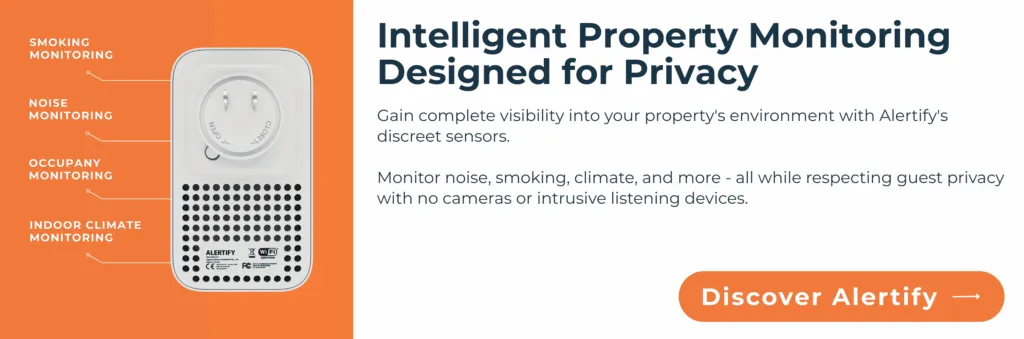
Before launch, communicate clearly with staff about what the system does and does not do. Alertify monitors decibel levels — not conversations, not individual behaviour. No audio is recorded at any point. Framing this correctly builds the staff trust and engagement that determines whether a monitoring programme succeeds or becomes a source of workplace friction.
After launch, the ongoing value of the system comes from the pattern data it accumulates. Regular review of noise incident trends by zone and time reveals systemic sources — a corridor that spikes during shift handover, a waiting area that generates sustained noise on weekend afternoons — enabling facilities to move from reactive incident management to proactive acoustic environment design. Alertify’s indoor climate monitoring data adds further context, giving facility teams a complete picture of the patient environment over time.
Fifteen Minutes to a Quieter, Safer, Better-Documented Hospital
Implementing a hospital noise monitoring system does not require months of planning, specialist contractors, or significant capital investment. With Alertify, it requires 15 minutes per device, a clear zone map, a set of calibrated thresholds, and a well-communicated alert workflow. The result is a facility that is quieter, safer, better documented, and more compliant — from day one.
Book a free demo with Alertify and get a personalized implementation plan for your facility from a specialist who understands healthcare environments.