When hospital administrators begin exploring acoustic management technology, one of the first and most important questions they ask is: what exactly does this device do? And crucially — does it record conversations? In a healthcare environment governed by HIPAA, patient confidentiality obligations, and institutional ethics, the answer to that second question determines whether the technology is viable at all.
The short answer is no — a purpose-built noise monitoring device for healthcare does not record audio. But understanding what it does measure, how it works in practice, and why that distinction matters is essential for any administrator evaluating solutions for their facility.
What a Noise Monitoring Device Measures: Decibels, Not Dialogue
A noise monitoring device designed for clinical environments operates as an environmental sensor, not a microphone. It detects the volume of sound in a space — measured in decibels (dB) — without capturing, storing, or transmitting any audio content. The device registers when ambient sound levels cross a pre-configured threshold and triggers a response. It knows that sound exceeding a set limit has occurred. It has no awareness of, and creates no record of, what was said.
This distinction is not just a legal technicality — it is the foundational design principle that makes this technology appropriate for hospitals in the first place. In environments where patient conversations, clinical consultations, and sensitive medical information are discussed continuously, any audio-recording capability would be ethically and legally untenable. The privacy-safe architecture of dedicated noise monitoring devices removes this barrier entirely.
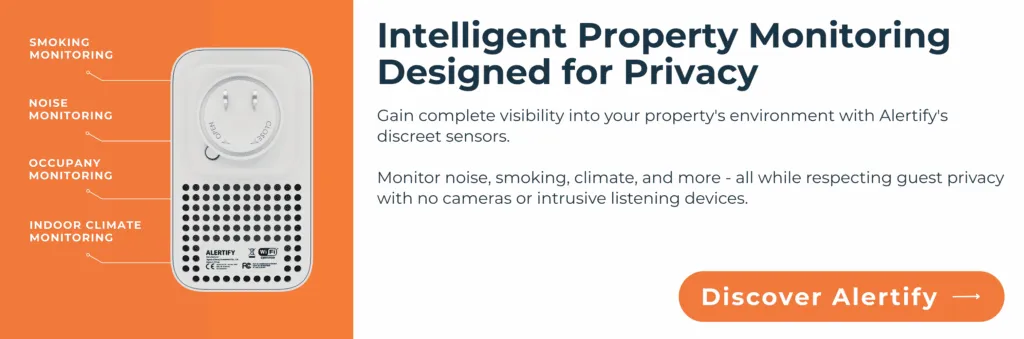
Alertify’s noise monitoring device is 100% privacy compliant — no microphone recording, no camera, no audio file created at any point in its operation. It plugs into a standard wall outlet, requires no specialist IT infrastructure, and is fully operational within 15 minutes. This is the standard that hospital noise monitoring technology must meet to be deployable in sensitive clinical settings — and it is what separates purpose-built healthcare monitoring solutions from generic consumer or commercial noise devices that were never designed with clinical privacy requirements in mind.
What Decibel Thresholds Mean in a Clinical Context
The World Health Organization recommends that noise levels in hospital patient areas should not exceed 35 dB during the day and 30 dB at night. In practice, most hospitals operate at levels significantly above these thresholds, with daytime ward noise commonly measured between 45 and 68 dB. A noise monitoring device creates the operational infrastructure to detect when levels exceed a clinically relevant threshold and to act before the exceedance causes measurable harm to patients or disrupts the working environment for staff.
Thresholds can and should be configured differently for different clinical zones. An ICU or neonatal unit may require an alert threshold as low as 40 dB, while a general corridor may be appropriately monitored at 55 dB or higher. Alertify allows fully customisable threshold configuration per device, meaning each zone in a hospital can be calibrated to its specific clinical and regulatory requirements. A useful practical guideline is to set thresholds 5 dB below the applicable regulatory limit for each zone, creating an intervention buffer before a formal violation is recorded and before patient sleep is disrupted.
Beyond Noise: What Else the Device Tracks
A high-quality monitoring device in a healthcare setting captures more than decibel levels. Alertify’s device also monitors indoor climate data — temperature, humidity, and indoor air quality — all directly relevant to infection control, mold risk management, and patient comfort. Occupancy monitoring provides an additional data layer that helps facility teams understand whether high noise readings correlate with overcrowding in specific areas, enabling more targeted and effective interventions.
All of these data streams feed into a centralized real-time dashboard accessible from any device, giving administrators a comprehensive view of their facility’s physical environment without requiring physical walkthroughs or manual spot checks.
The Importance of Documentary Evidence
Every noise event detected by Alertify is automatically timestamped and stored through the documentary evidence feature, creating a structured, searchable record of every threshold breach across the facility. This data is retained for a minimum of 180 days and is downloadable as a formatted incident report — providing court-admissible documentation for compliance audits, Joint Commission surveys, patient complaint investigations, and legal proceedings where objective, time-stamped evidence of acoustic environment management is required.
The Right Device Asks Nothing of Your Staff and Everything of Your Data
A noise monitoring device in a healthcare setting measures sound levels, not conversations. It is privacy-safe by design, clinically appropriate by function, and operationally straightforward to deploy. Understanding these fundamentals is the first step toward making an informed decision about the acoustic management infrastructure your facility needs. The technology is ready, the clinical case has never been stronger, and the privacy concerns that once made hospitals hesitant no longer apply.
Book a free demo with Alertify to see exactly how the device works in a healthcare environment and find out which configuration is right for your facility.