
Noise in hospitals has always been a clinical concern. In 2026, it is also a compliance and financial imperative. The regulatory framework governing acoustic environments in healthcare facilities has grown significantly more detailed and consequential over the past decade, and administrators who treat noise management as a soft quality-of-life issue rather than a hard compliance obligation are increasingly exposed to accreditation risk, reimbursement penalties, and legal liability.
Understanding the full landscape of hospital noise regulations — who sets them, what they require, and how to demonstrate adherence — is no longer optional. It is a core responsibility of healthcare facility leadership, and the financial consequences of falling short are substantial.
Hospital Noise Regulations: The Key Standards Administrators Must Know
The regulatory framework for hospital noise in the United States is shaped by several overlapping bodies of authority, each with different enforcement mechanisms and practical implications for day-to-day facility management.
The World Health Organization (WHO) sets the foundational international benchmark. WHO guidelines recommend that noise levels in hospital patient areas should not exceed 35 dB during the day and 30 dB at night — thresholds that the vast majority of healthcare facilities consistently and significantly exceed. While WHO guidelines are not directly legally enforceable in the United States, they underpin national standards and are increasingly referenced in litigation involving noise-related patient harm.
The Joint Commission is the primary accreditation body for hospitals and healthcare systems in the United States, and its standards identify noise as both a patient safety concern and a component of the physical environment that facilities are expected to actively manage. Accreditation surveys assess whether a facility has systematic, documented processes for monitoring and responding to environmental noise. Facilities that cannot demonstrate this risk adverse findings that affect their accreditation status — and with it, their eligibility to participate in Medicare and Medicaid programmes.
The Centers for Medicare and Medicaid Services (CMS) connects noise performance directly to revenue through the Hospital Value-Based Purchasing programme. According to CMS, HCAHPS survey scores — which include a dedicated measure on the quietness of the hospital environment — have been linked to Medicare reimbursements since 2012. Healthcare Finance News reports that up to 30% of CMS payments are linked to these survey outcomes, placing noise squarely at the intersection of clinical governance and financial performance.
What Healthcare Noise Compliance Actually Requires
The most important and frequently misunderstood aspect of healthcare noise compliance is that it requires documented, verifiable evidence — not just good intentions or informal cultural practices. A commitment to maintaining a quiet environment, however genuine, carries no weight during a Joint Commission survey or a legal proceeding without a data trail to support it.
What regulators, accreditation surveyors, and courts look for is a systematic record demonstrating that noise is monitored continuously, that threshold breaches are detected and responded to promptly, and that incident data is retained for review and audit. This is the operational gap that hospital noise monitoring technology closes directly.
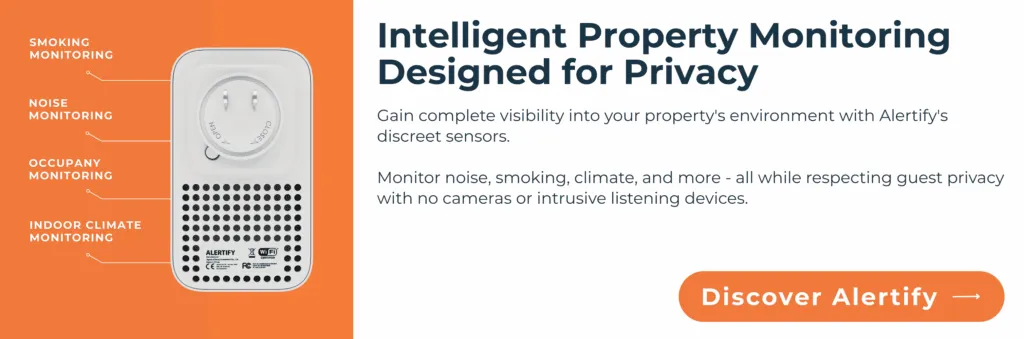
Alertify’s documentary evidence feature automatically timestamps and logs every noise event detected by the system, storing records in the cloud for a minimum of 180 days. These records are downloadable as formatted incident reports that provide court-admissible documentation of when and where noise exceeded threshold levels, for how long, and at what measured intensity. For administrators preparing for accreditation reviews or managing regulatory inquiries, this is not a convenience — it is a compliance infrastructure that replaces subjective assertions with objective, verifiable data.
The Financial Stakes of Non-Compliance
Non-compliance with healthcare noise standards carries consequences that are both direct and indirect. Direct consequences include adverse findings during Joint Commission accreditation surveys, which can affect a facility’s accreditation status and its ability to receive federal funding. Indirect consequences include reduced Medicare reimbursements tied to poor HCAHPS quietness scores, increased legal exposure from noise-related patient harm claims, and reputational damage in increasingly competitive patient-choice environments.
According to analysis of HCAHPS data, 25% of the Total Performance Score under the CMS Value-Based Purchasing programme is based on patient experience as measured by HCAHPS — and noise is one of its core components. Poor performance in this domain does not just affect quietness scores in isolation. It drags down overall HCAHPS ratings and reduces reimbursement across multiple performance categories simultaneously.
Compliance Without Data Is Just a Promise
Regulatory expectations around hospital noise are not aspirational guidelines — they are compliance requirements with direct financial and accreditation consequences. Meeting them requires not just behavioural change but technology infrastructure capable of generating the continuous, documented, auditable evidence that surveyors and courts require. The good news is that this infrastructure is now available, affordable, and deployable within 15 minutes.
Book a free demo with Alertify to find out how our noise monitoring and documentary evidence system can become the backbone of your facility’s acoustic compliance programme.