
Nurse burnout is one of the most serious and costly challenges in healthcare today. It drives turnover, undermines patient safety, increases clinical errors, and costs hospitals millions in recruitment and retraining every year. A great deal of attention has been paid to the systemic causes — staffing shortages, administrative burden, workload pressure — but one significant contributing factor remains consistently underaddressed: the acoustic environment that nurses work in every day.
The relationship between nurse burnout and hospital noise is not speculative. It is supported by a growing body of occupational health and patient safety research, and it has direct financial implications for every healthcare administrator managing a clinical workforce in environments where noise levels routinely exceed safe and sustainable thresholds.
Nurse Burnout and Hospital Noise: What the Evidence Shows
A 2024 systematic review and meta-analysis published in JAMA Network Open confirmed that nurse burnout — characterised by emotional exhaustion, depersonalisation, and diminished professional accomplishment — is consistently and significantly associated with reduced patient safety, lower quality of care, and worse patient outcomes. High noise environments are a documented contributor to this burnout cycle. Noise imposes a continuous and largely involuntary cognitive demand: the brain must work harder to filter irrelevant stimulation, maintain concentration on complex clinical tasks, and communicate clearly over competing background sounds. Over the course of a twelve-hour shift, repeated day after day, this acoustic stress accumulates into the fatigue and disengagement that characterise burnout.
Research highlighted by the AAMC found that close to 95% of operating room medical staff report experiencing physiological and psychological effects attributable to excessive noise — including fatigue, inattentiveness, agitation, and headaches. These are not peripheral discomforts. They are precursors to the clinical errors and deteriorating job satisfaction that feed the burnout cycle and ultimately drive staff to leave.
A PMC review on burnout and patient safety found that high levels of burnout among nurses are consistently associated with increased rates of medication error, healthcare-associated infection, and extended patient hospital stays. The review identified external workplace conditions — including the physical environment — as primary causal factors. Noise is one of those conditions, and critically, it is one of the most directly and cost-effectively controllable.
The Financial Cost of Getting This Wrong
The workforce economics of nurse burnout are unambiguous. According to the 2025 NSI National Health Care Retention and RN Staffing Report, as cited by the Wisconsin Center for Nursing, the average cost of replacing a single staff registered nurse reached $61,110 in 2024 — an 8.6% increase from the previous year, with costs ranging as high as $72,700 per nurse depending on specialty. Becker’s Hospital Review notes that the average hospital loses between $3.87 million and $5.79 million annually to nurse turnover. Burnout is consistently cited as one of the primary reasons nurses leave, and the work environment is a documented driver of that burnout. A facility that actively invests in reducing environmental stressors — including acoustic stress — is making a measurable and financially justifiable investment in workforce retention.
How Hospital Noise Monitoring Reduces Staff Burden
The connection between noise management and staff burden reduction operates on two levels. The first is environmental: a quieter working environment reduces the cognitive load on nurses, directly supporting the focus, communication accuracy, and situational awareness that safe clinical practice requires.
The second is operational. In most hospitals, when a noise incident occurs, it falls to nursing staff to identify it, decide how to respond, manage the interpersonal challenge of addressing guests or visitors directly, and document the incident. This is an invisible but real burden — emotionally demanding, time-consuming, and a source of friction in already-stretched clinical teams.
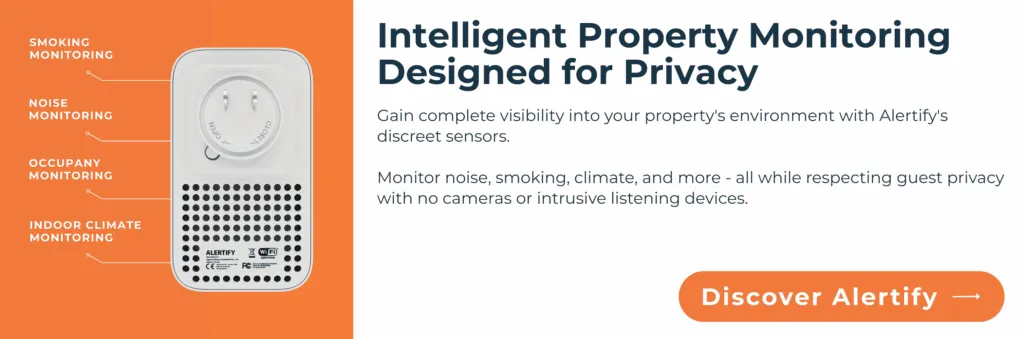
Alertify removes this burden systematically. Alertify’s noise monitoring system detects threshold breaches automatically and sends instant alerts to the relevant team member, or triggers an automated message through the Guest Alert feature. Ninety percent of noise incidents resolve within ten minutes without any direct staff involvement. Every incident is logged automatically through the documentary evidence feature, removing the need for manual noise complaint reporting entirely and providing objective data that replaces subjective disputes with verified records.
Your Nurses Shouldn’t Have to Fight the Environment as Well as the Illness
Nurse burnout has many causes, and hospital noise monitoring is one solution that healthcare administrators have the power to address today without significant structural change or capital investment. A privacy-safe, plug-and-play noise monitoring system that removes the complaint management burden from nursing staff, reduces environmental stress, and generates the documentation needed to demonstrate active acoustic environment management is a workforce investment with measurable returns. The technology is available, the evidence is clear, and the cost of inaction compounds with every nurse who walks out the door.
Book a free demo with Alertify to explore how automated noise monitoring can support staff wellbeing and reduce the operational burden on your clinical teams.