
Almost every property has a smoke-free rule. Far fewer can say it is applied consistently. Hotel no-smoking policy enforcement is where good intentions meet operational reality: incidents are discovered too late, guests deny them, and nobody wants to knock on a door at midnight. For general managers and rooms division leaders, the challenge is upholding the rule in a way that protects the room without damaging the relationship with the guest. This guide covers why traditional enforcement breaks down, how to build a policy guests actually follow, and how technology lets your team stay courteous while still holding the line.
Why Good Policies Break Down in Practice
Discovery Comes Too Late
Most enforcement still depends on finding evidence after the fact. A room attendant notices the odor at checkout, writes it up, and a charge is posted to a guest who has already left. By then, smoke has settled into soft goods and the hotel is negotiating from memory rather than evidence.
Confrontation Is Uncomfortable for Everyone
Handling guest smoking violations during a stay is harder still. A neighboring guest calls down about a smell, and the night auditor or security officer has to decide whether to knock. Guests often deny it, hallway conversations can turn tense, and a policy issue quickly becomes a service recovery problem. Understandably, many teams avoid the confrontation altogether.
Vaping and Inconsistency Make It Harder
The shift toward vaping adds another layer. CDC data shows that 15.5% of adults aged 21 to 24 used e-cigarettes in 2023, a core age group for leisure weekends and events. Aerosol fades faster and smells less obvious than cigarette smoke, so it often goes unnoticed until residue is left behind. And when enforcement depends on individual judgment, it varies by shift and property, which weakens brand standards and invites complaints of unfair treatment. San Diego State University researcher Georg Matt has urged hotels to continually remind guests about smoke-free policies and train staff to monitor and enforce compliance, because a rule that is not actively upheld cannot deliver the stay it promises.
Building Hotel No-Smoking Policy Enforcement Into the Guest Journey
A Touchpoint at Every Stage
The strongest approach works across the whole stay rather than relying on a single moment. Each stage reinforces the last:
- Before arrival: State the policy in booking confirmations and pre-arrival messages, and make clear it covers cigarettes, vapes, and cannabis. A branded pre-stay check-in such as WelcomeLink lets guests verify their ID and sign house rules before they reach the desk.
- At check-in: Offer a brief, friendly reminder and point to designated outdoor areas. Frame it as protecting the next guest, not policing this one.
- In the room: Keep in-room messaging short and visible, with the charge stated in plain language.
- During the stay: Respond in real time, privately and politely, the moment smoke is identified.
- After checkout: Apply charges consistently and back every one with a documented record, since a charge alone rarely covers the true cost of a smoking incident.
Consistency Builds Credibility
When guests know the rule is applied the same way every time, fewer test it, and staff feel confident upholding it. A shared playbook across shifts and properties also protects the company from claims that one guest was treated differently from another.
Training Staff to Respond Well
Even with clear communication, your team will still field questions and the occasional complaint. Give the front office, night audit, and security staff a short, shared script for neighbor reports and guest pushback, so every response sounds calm and consistent. Make sure they know who reviews incidents, when a charge applies, and how to explain the policy without sounding accusatory. Role-playing two or three common scenarios during pre-shift briefings builds confidence quickly, and it ensures that a guest at 2 AM hears the same professional message as a guest at noon.
Letting Technology Handle the Hard Part
Real-Time Awareness Without Cameras
Stage four is where most hotels struggle, and it is where smoke monitoring for hotels makes the biggest difference. Alertify places a compact, privacy-safe sensor in each room that identifies cigarette, vape, and marijuana smoke within seconds through its smoking monitoring, without cameras or microphones.
Courteous Reminders in Your Voice
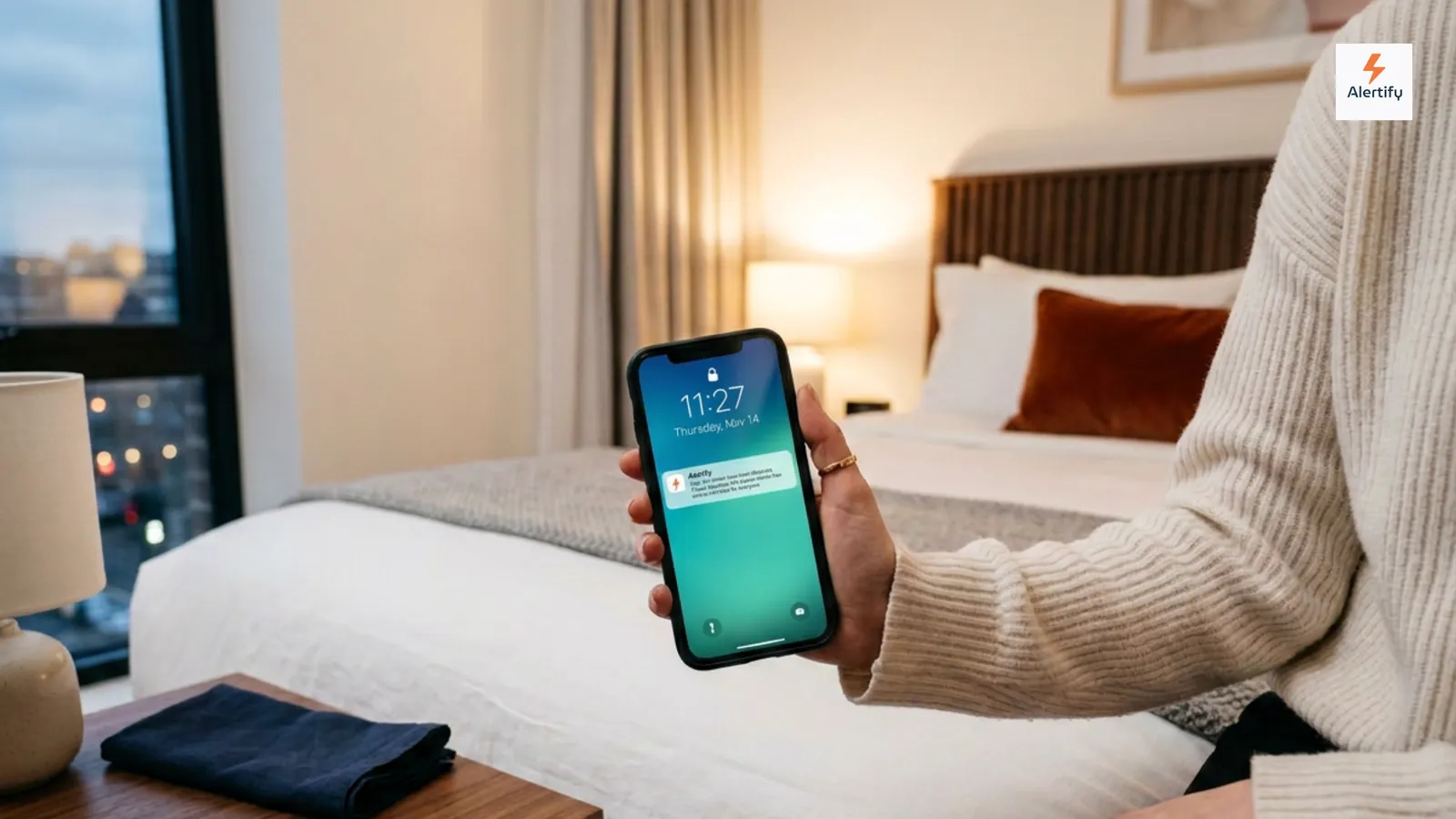
When smoke appears, Guest Alert delivers automated guest messaging by SMS, email, or in-app, written in your brand’s voice. The guest receives a discreet reminder that the room is smoke-free, with no knock on the door and no audience in the hallway. According to Alertify data, 90% of incidents resolve automatically within 10 minutes, and staff are notified so they can step in only when it truly matters.
One Standard Across Every Property
Every event is time-stamped and stored through Documentary Evidence, so the same standard applies on every shift and at every property in a portfolio. If a charge follows, it is supported by objective data rather than a judgment call, and Alertify customers see 75% fewer chargeback incidents.
A Policy That Protects Rooms and Relationships
The goal of enforcement is not to catch guests out. It is to keep every room ready for the next arrival while treating the current guest with respect. Early, private, consistent reminders achieve both, and they free your team from the most uncomfortable part of the job.
If you would like to see how this works with your rooms and PMS, book a demo with Alertify and we will walk your team through it.
Frequently Asked Questions
How do you enforce a no-smoking policy in a hotel without confronting guests?
Replace the knock on the door with a private, automated reminder. When a sensor identifies smoke, the guest receives a polite message by SMS, email or in-app, and staff step in only if the smoke continues. Most incidents end there, with no hallway conversation.
Should a hotel no-smoking policy cover vaping and cannabis?
Yes, and it should say so explicitly. State in booking confirmations, pre-arrival messages and in-room materials that the policy covers cigarettes, vapes and cannabis. Vape aerosol fades faster and smells less obvious than cigarette smoke, so clear wording matters even more.
Why is consistent enforcement so important?
When the rule is applied the same way on every shift and at every property, fewer guests test it and staff feel confident upholding it. Consistency also protects the hotel from claims that one guest was treated differently from another when a charge is disputed.