
Hospital administrators make resource allocation decisions under significant financial pressure, and any investment in environmental monitoring needs to compete with clinical equipment, staffing, and infrastructure priorities for capital budget. The case for investing in continuous air quality monitoring does not rest on clinical obligation alone, although that case is substantial. It rests on a financial analysis that shows, when the full cost picture is assembled, that the ROI of indoor air quality monitoring hospital decision-makers need to evaluate is among the strongest in the entire facilities management budget. The costs associated with poor air quality, including HAI treatment, regulatory fines, staff absenteeism, emergency HVAC repairs, and HCAHPS-linked reimbursement losses, consistently exceed the cost of the monitoring infrastructure that would have prevented them. This post assembles that full picture.
The Full Financial Cost of Poor Hospital Air Quality
Understanding the ROI of indoor air quality monitoring hospital administrators can build a business case around requires first assembling the complete cost of inaction. Most facilities management decisions focus on the direct, line-item costs of a failure: the fine, the repair bill, the treatment cost. The full cost of poor air quality is significantly higher because it cascades across multiple budget lines simultaneously.
Healthcare-associated infections represent the largest single financial exposure. The CDC estimates HAIs cost the US healthcare system between $28 and $45 billion annually, with individual case costs averaging $28,400 for common HAI types and rising significantly for complex surgical site infections, ventilator-associated pneumonia, and Clostridioides difficile infections. Poor ventilation is a documented contributing factor in the airborne transmission component of HAI rates, meaning that facilities with inadequate air quality management carry a structurally elevated HAI risk that manifests as ongoing treatment cost, extended length of stay, and the associated resource utilisation that follows.
Regulatory penalties add a second cost layer. Joint Commission environment-of-care findings range from recommendations to immediate threat-to-life citations, with each escalation level carrying progressively more serious financial and operational consequences. OSHA violations for documented air quality failures can run to tens of thousands of dollars per citation, with willful or repeat violations attracting significantly higher penalties. The legal costs associated with defending a citation, even a successfully defended one, add further expense.
Emergency HVAC costs represent a third category. A ventilation component that develops a fault between scheduled service intervals and is not detected until it has failed completely will require emergency repair rather than planned maintenance, at a cost premium that typically ranges from two to five times the equivalent planned maintenance cost. Continuous monitoring that detects developing faults before failure converts emergency costs into scheduled costs.
Staff absenteeism from occupational respiratory conditions, including asthma, chemical sensitisation, and VOC-related respiratory symptoms, generates agency and overtime costs, productivity losses, and workers’ compensation claims that accumulate steadily and are rarely attributed to air quality management failures in the absence of a documented causal analysis.
Hospital air quality cost savings from continuous monitoring accrue across all four of these categories simultaneously, making the net financial case significantly stronger than any single-category analysis suggests.
HCAHPS Scores, Value-Based Purchasing, and the Reimbursement Cost of Poor Air Quality
The most direct and quantifiable financial link between air quality management and hospital revenue runs through the HCAHPS survey and the CMS Hospital Value-Based Purchasing program. Understanding this link is essential for any administrator building a business case for environmental monitoring investment.
The HCAHPS survey is the national standardized patient experience tool administered by CMS. Its results are publicly reported and directly tied to reimbursement through the Hospital Value-Based Purchasing program, which adjusts Medicare DRG base payments upward or downward based on composite performance scores that include HCAHPS results. Hospitals that underperform across the VBP scoring domains can lose up to 2% of their total base Medicare DRG payments. For a hospital with $200 million in annual Medicare revenue, this represents $4 million per year in potential reimbursement reduction.
The HCAHPS environment domain, which covers noise at night, cleanliness of the room and bathroom, and the overall hospital environment, is directly shaped by the same conditions that air quality monitoring addresses. Patients who experience disruptive noise levels, perceive odours from undetected smoking violations, or feel uncomfortable due to temperature and humidity mismanagement are measurably more likely to report a negative environmental experience on their survey, regardless of how excellent their clinical care was in every other respect. HCAHPS reimbursement impact air quality monitoring delivers is therefore not a soft benefit or a patient satisfaction nicety. It is a hard revenue line.
The compound financial benefit of improving HCAHPS environment domain scores, simultaneously with reducing HAI costs and avoiding regulatory penalties, is where the true ROI of air quality monitoring becomes visible. These are not separate benefits achieved by separate interventions. They are all achieved by the same continuous monitoring infrastructure, making the per-dollar return on the investment significantly higher than any single-benefit analysis would suggest.
Alertify’s Feature Set as a Financial Risk Management Tool
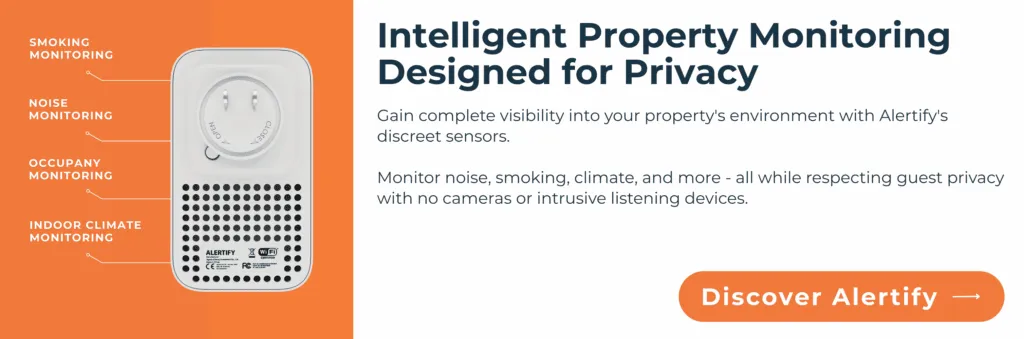
The healthcare environmental monitoring investment in Alertify delivers financial returns across every cost category identified above. Noise monitoring with automated guest alerts addresses the HCAHPS noise domain directly, with 90% of noise violations resolving automatically within 10 minutes of an alert being sent, before the disturbance reaches the level that patients report on surveys. Smoking detection eliminates the residual odour and particulate contamination that degrades HCAHPS cleanliness scores and creates clinical exposure risk simultaneously. CO2 and occupancy monitoring enables proactive ventilation management that reduces airborne infection transmission risk and improves the environmental comfort conditions that patients experience and report.
Tamper alerts ensure that devices are not interfered with in sensitive clinical areas, maintaining the integrity of the monitoring record. Mold risk assessments provide early warning of humidity conditions before they become costly remediation problems or reportable clinical incidents. Downloadable incident reports with full timestamps provide the court-admissible documentary evidence that protects the facility in regulatory inspections, accreditation surveys, litigation, and insurance claims.
Alertify customers across sectors report a 70% reduction in unwanted environmental incidents and 75% fewer liability and chargeback incidents following deployment. In a hospital context, these outcomes translate directly to measurable reductions in HAI-related costs, regulatory exposure, HCAHPS reimbursement risk, and the operational cost of reactive environmental management.
Hospital indoor air quality monitoring is not a peripheral concern for facilities serious about performance. It sits at the intersection of patient safety, regulatory compliance, staff occupational health, and Medicare reimbursement and the financial case for continuous, documented environmental oversight has never been stronger. Every unmanaged CO2 spike, every undetected smoking incident, every humidity exceedance that goes unrecorded is a liability that compounds over time. The facilities that act on this now are the ones that will be ahead of the next inspection, the next survey, and the next reimbursement cycle.
Ready to protect your facility? Book a free demo with Alertify today and see how continuous environmental monitoring can reduce risk, improve compliance, and create safer spaces for patients and staff.