For property managers, vacation rental hosts, and hotel owners, the smell of smoke in a non-smoking unit is the smell of lost revenue. A single smoking incident can cost over $600 in deep cleaning, takes a room out of service for days, and leads to the 1-star reviews that kill future bookings. The rise of discreet vapes has made this problem even harder to manage. Traditional alarms don’t work – they’re not designed to catch cigarette or vape smoke, and by the time you find out, the damage is done.
This is where a smart smoke detection system changes the game. Unlike a basic alarm, this new generation of technology provides instant, discreet alerts to your phone, giving you the documentary proof you need to enforce your rules. The science behind this powerful tool is its ability to monitor what is PM2.5 – the invisible particles from smoke and vape aerosol. This guide explains the technology, the benefits, and how a device like Alertify gives you 100% peace of mind.
The Hidden Costs of Unwanted Smoking in Your Property
Before we dive into the technology, let’s define the problem. For property professionals, unwanted smoking isn’t just a nuisance; it’s a direct threat to the bottom line. The challenge is twofold: the damage is costly, and it’s historically been impossible to prove.
For Hotels & Vacation Rentals: The “1-Star Review” Problem
In the hospitality industry, your reputation is your most valuable asset. A guest who checks into a room that smells of smoke, even faintly, is immediately going to feel cheated. This is a “make-or-break” moment that leads directly to negative online reviews, chargeback requests, and lost-in-translation arguments at the front desk.
The financial damage is just as severe. Thirdhand smoke (the toxic residue that clings to every surface) doesn’t just “air out.” It requires professional ozone treatment, deep-cleaning carpets, washing curtains, and repainting walls. While this is happening, the room is “out of service,” meaning you are losing potential revenue for every night it’s being cleaned. Without definitive proof, it’s your word against the guest’s, making it impossible to charge cleaning fees or win a dispute.

For Property Managers: The “Asset Depreciation” Problem
For multi-family property managers the challenge is about policy enforcement and long-term asset protection.
- Policy Enforcement: How do you enforce a no-smoking or no-vaping clause in a lease? By the time another resident complains or does a walkthrough, the offender is long gone. This creates a culture of impunity, where rules are seen as optional. Vaping indoors is a new epidemic, and it’s nearly impossible to catch without the right technology.
- Asset Protection: The long-term damage is staggering. Thirdhand smoke residue builds up over time, permanently staining drywall, destroying fixtures, and embedding itself in carpet and sub-flooring. When a smoking tenant moves out, you’re not just looking at a simple paint job but rather you’re often facing a full-scale renovation that costs thousands of dollars, all of which comes directly out of your operating budget.
For Homeowners: The “Indoor Air Quality” Problem
It’s not just a commercial problem. For homeowners, the concern is health and peace of mind. You want your home to be a sanctuary, but indoor air can be 2-5 times more polluted than outdoor air. PM2.5 from cooking, nearby wildfire smoke, or even a neighbor’s smoking on an adjoining balcony can infiltrate your home.
For families with children, elderly members, or anyone with asthma or respiratory issues, understanding indoor air quality is critical. You can’t fix a problem you can’t measure. A high-sensitivity PM2.5 monitor gives you the power to know when to ventilate, when to turn on an air purifier, and when your air is truly clean.
What is PM2.5? The Invisible Particle That Matters Most
The solution to catching this invisible threat is to monitor an even more invisible particle. This is the core of modern environmental monitoring.
PM2.5 stands for Particulate Matter that is 2.5 micrometers or smaller in diameter. These are microscopic particles suspended in the air that we breathe.
Defining PM2.5: The 30-to-1 Analogy
It’s difficult to visualize just how small PM2.5 is. Let’s use an analogy:
- A single human hair: About 70 micrometers in diameter.
- A grain of fine beach sand: About 90 micrometers in diameter.
- A PM2.5 particle: 2.5 micrometers in diameter.
This means you could fit almost 30 fine particles across the width of a single human hair. They are completely invisible to the naked eye and so light that they can stay suspended in the air for hours or even days. Because they are so small, they bypass the body’s natural defenses, lodging deep in the lungs and even entering the bloodstream.
Where Does PM2.5 Come From? (It’s Not Just Pollution)
These fine particles come from many sources, both indoors and outdoors.
- Outdoors: Vehicle exhaust, industrial processes, and smoke from wildfires (even hundreds of miles away) can all travel indoors.
- Indoors: Common sources include cooking (especially frying or toasting), burning candles, fireplace use, and even pet dander and dust.
However, one of the most common and intense indoor sources is combustion, specifically from tobacco smoke and vape aerosol. A single cigarette or vape pen releases a dense, massive cloud of billions of these PM2.5 particles into the air instantly.
Can Your Indoor PM2.5 Level Ever Be 0?
This is a common and excellent question. In a perfectly sterile, vacuum-sealed laboratory, perhaps. But in the real world, no, your PM2.5 level can never be a true 0.
Your indoor air is a living, dynamic environment. Even in the cleanest home, there are constant, low-level sources of particles: microscopic dust, skin cells, pet dander, and fibers from clothes or carpets. Furthermore, outdoor air (which always has some particles) constantly infiltrates your home through windows, doors, and ventilation.
Therefore, the goal is not to achieve an impossible “0.” The goal is to maintain a “Good” baseline – what the EPA considers a healthy level – and to be alerted to the sudden, dangerous spikes that indicate a problem.
The PM2.5 Air Quality Index: What the Numbers Really Mean
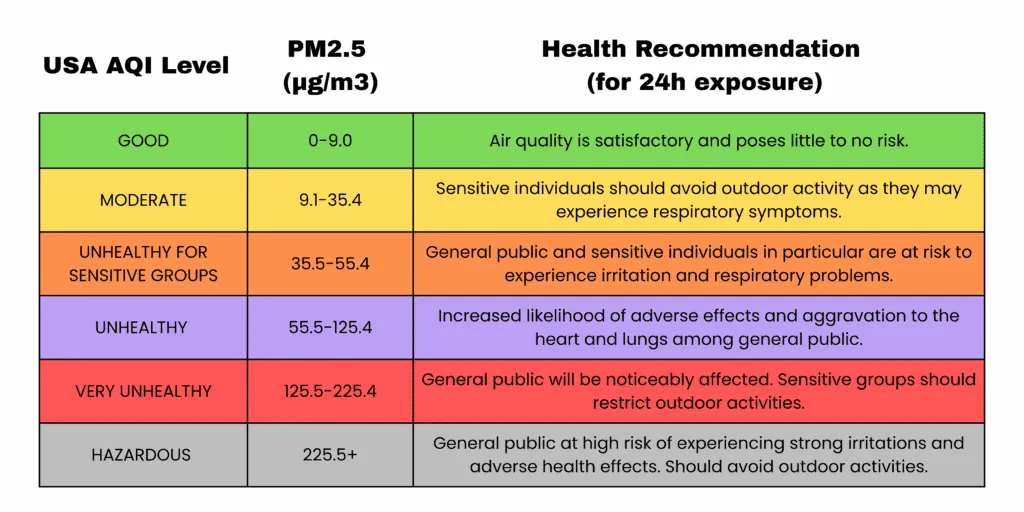
So, how do you know if your air is “clean” or “dirty”? We measure PM2.5 concentration in micrograms per cubic meter (μg/m3) and use the Air Quality Index (AQI) to translate these numbers into a simple-to-understand health advisory.
The “Good” Zone (AQI 0-50): Your Goal for Clean Air
This is your baseline and your goal. This range corresponds to a PM2.5 concentration of 0 to 12.0 μg/m3.
In a healthy, well-ventilated indoor space, you should see your levels in this range. It’s the “green” zone, where air pollution poses little to no risk.
The “Moderate” & “Unhealthy” Zones (AQI 51-200): When to Be Concerned
This is where things get more serious.
- Moderate (AQI 51-100 / 12.1-35.4 μg/m3): This is where you might land if you’re searing a steak, toasting bread, or if there’s a nearby wildfire. It’s not ideal, and sensitive groups might feel the effects.
- Unhealthy for Sensitive Groups (AQI 101-150 / 35.5-55.4 μg/m3): At this level, people with respiratory issues are at greater risk.
- Unhealthy (AQI 151-200 / 55.5-150.4 μg/m3): Everyone may begin to experience some adverse health effects.
The “Hazardous” Zone (AQI 301+): The “Smoking Gun” Signature
This range, which corresponds to a PM2.5 concentration of over 250.5 μg/m3, is the “maroon” or “hazardous” category.
This is the most critical point: It is almost impossible to reach this level from normal daily activity. Cooking or burning a candle might spike you to “Moderate” or “Unhealthy,” but it’s very difficult to hit “Hazardous.”
A single cigarette, however, is a PM2.5 “bomb.” When lit, it instantly releases a cloud of particles that will spike a room’s air quality from a “Good” 10 μg/m3 to a “Hazardous” 300-500+ μg/m3 in under a minute. It’s not a gradual rise but rather it’s a vertical, undeniable spike. This is the “smoking gun.”
How a Smart Smoke Detection System Uses PM2.5 to Provide Proof
This is where the technology becomes a game-changer. A smoking event has a unique “signature” that a high-sensitivity sensor can’t miss.
Advanced PM2.5 Sensing: How It Works
While a standard alarm is “blind” to the fine particles from smoke, the Alertify device is equipped with advanced sensors built for one purpose: to monitor particulate matter (μg/m3) in real-time.
Instead of relying on the old methods, this modern technology gives the device a new way to “see” the air. Here is the process:
- Establishes a Baseline: The device continuously measures the air in the room, understanding its normal, “Good” PM2.5 level (e.g., a clean 8 μg/m3).
- Detects the Spike: When a cigarette or vape is used, it releases a dense cloud of billions of particles. This causes the PM2.5 concentration in the room to skyrocket, jumping from “Good” (8 μg/m3) to “Hazardous” (300+ μg/m3) in seconds.
- Identifies the Signature: This sudden, vertical spike is the unmistakable “signature” of a smoking event. It’s completely different from the slow, gradual rise in PM2.5 that might come from cooking or dust.
- Generates Proof: The sensor instantly logs this data – the precise level and the exact time – creating the digital proof of the incident.
This is far more advanced than a traditional alarm. It’s not waiting for a large volume of thick, heavy smoke. It is a high-sensitivity instrument that scientifically measures the air quality and provides you with irrefutable, data-based evidence.
The “Smart” Difference: Discreet Alerts vs. Disruptive Alarms
This is the “smart” part of the smart smoke detection system. A traditional alarm is designed to do one thing: make a loud, disruptive noise to alert everyone in the building. This is the last thing a hotel manager wants.
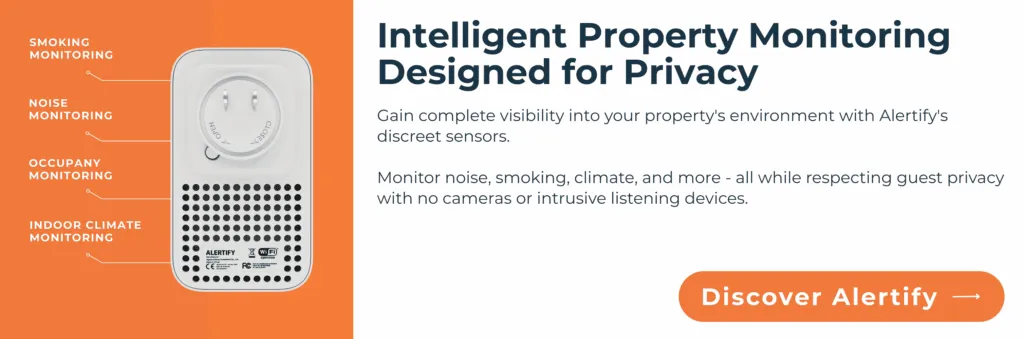
Alertify does the opposite. When it detects a PM2.5 signature from smoking, it doesn’t make a sound in the room. Instead, it instantly sends a silent, discreet notification to your phone, email, or management dashboard.
You, the manager, get an immediate alert with a timestamp and a data report. You now have irrefutable, documentary evidence of the policy violation. You can address the issue immediately, prevent further damage, and have the proof you need to charge cleaning fees, enforce a lease, or hold the person accountable. It’s about enforcement and protection, not panic.
The Ultimate Vape and Smoke Monitor for Modern Problems
This technology is also the only reliable way to solve one of the biggest new challenges for property managers: vaping.
Why Vaping is an Invisible Challenge (and How This Solves It)
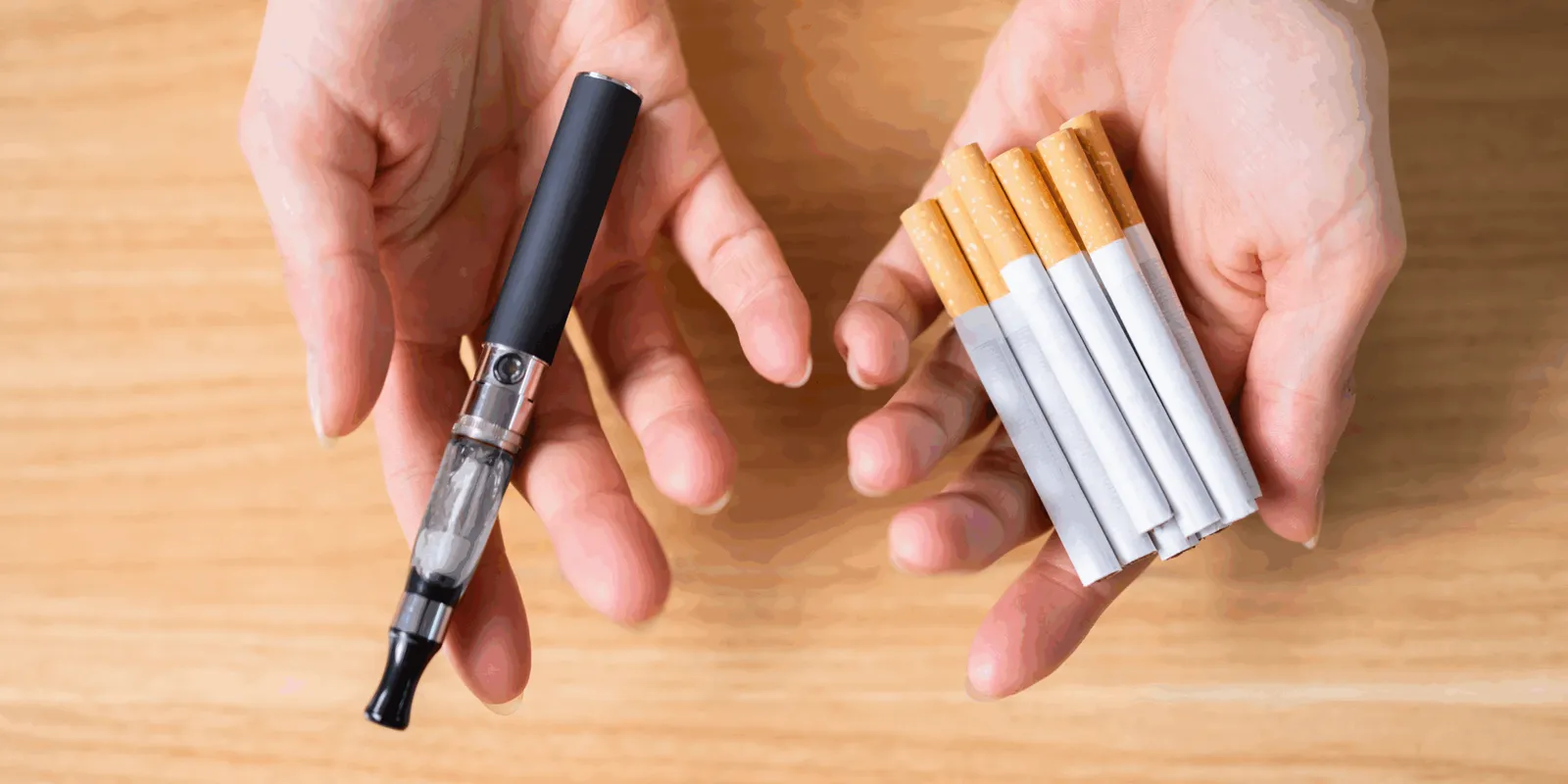
Vaping is notoriously difficult to police. The aerosol is often odorless or sweet-smelling (like fruit or mint), and it dissipates in seconds. A manager walking the halls has no chance of catching someone.
Many believe vape aerosol is “just water vapor.” This is dangerously false. It’s an aerosol cloud of billions of PM2.5 particles, including propylene glycol, glycerin, flavorings, and nicotine.
To Alertify’s high-sensitivity PM2.5 sensor, this cloud is just as “loud” and “obvious” as tobacco smoke. When a person vapes, the Alertify sensor sees the exact same “vertical spike” into the “Hazardous” PM2.5 range. It’s the perfect vape and smoke monitor because it’s not looking for a smell; it’s measuring the particles. This finally gives property managers the tool they need to enforce no-vaping policies.
Frequently Asked Questions (FAQs) About PM2.5 Smoke Monitoring
Q1: Will cooking or burning a candle set it off?
This is the most common question. While these activities do produce PM2.5, the “signature” is different. Alertify’s smart algorithm is designed to look for the signature of smoke – a very rapid, high spike – that is distinct from the more gradual rise of cooking. A cigarette spike is a vertical line; a cooking spike is a slow hill. This differentiation prevents the “false alarms” that plague other systems.
Q2: Is this legal to use in a rental or hotel room?
Yes, 100%. This is because Alertify is an environmental sensor, not a surveillance device. It is no different from a smart thermostat or a standard smoke alarm. It has no camera and no microphone to record audio or conversations. It only measures the environment – in this case, the particle concentration in the air – to protect your property and enforce the terms of your rental agreement.
Q3: How is this different from a standard smoke alarm?
This is the most important distinction. Standard alarms are designed for one purpose: to make a loud noise in a specific, high-intensity life-safety event. They are not sensitive enough to detect the low-concentration smoke from a single cigarette or a vape. Alertify is a high-sensitivity environmental monitoring tool. It is designed for asset protection and policy enforcement, alerting you discreetly, rather than alerting the occupant.
Q4: How do I install it? Is it complicated?
It’s designed for simplicity. There is no complicated hardwiring or technical setup. The Alertify device is “plug-and-play.” You simply plug it into a standard wall outlet and connect it to your Wi-Fi through a simple app, just like any other smart-home device. The entire process takes less than 5 minutes.
Take Control of Your Indoor Environment with Alertify
For years, property managers and owners have been forced to be reactive. You’ve been stuck cleaning up the damage from smoke after the guest has already left. You’ve been left to absorb the costs, fight for 5-star reviews, and argue over cleaning fees you can’t prove.
That era is over.
A smart environmental monitor like Alertify flips the script, allowing you to be proactive. It’s not just an alarm; it’s an asset protection system. By monitoring PM2.5, Alertify provides the real-time, documentary proof you need to stop damage as it’s happening.
You can’t be at your properties 24/7, but Alertify can. Stop guessing. Stop cleaning up the mess. It’s time to get proof.
Visit Alertify today to book a demo or learn how our smart monitoring device can protect your properties, save you money, and give you 100% peace of mind.