Most short-term rental hosts think of their no-smoking policy as a straightforward house rule, something guests agree to at booking and violate at the cost of a damage fee. The legal reality is more nuanced than that, and hosts who understand the legal landscape around smoking in vacation rentals are better positioned to enforce their policies, recover damages, and avoid the mistakes that turn a manageable incident into a protracted dispute.
From your right to prohibit smoking entirely to the specific enforceability of pre-disclosed damage fees, from the legal complexity of cannabis in legal-use states to the privacy implications of monitoring technology, the legal dimensions of smoking in STRs are worth understanding before you need to act on them.
Understanding vacation rental smoking laws and host rights before a violation occurs is not just about protecting yourself in a dispute. It is about building a policy framework that is defensible from the start, communicating with guests in ways that create genuine legal notice, and using technology in a manner that is both compliant and admissible. This is what you need to know.
Vacation Rental Smoking Laws and Host Rights — What the Law and Platforms Allow
As a short-term rental host, you have broad legal authority to set the terms under which guests use your property, including an absolute prohibition on smoking of any kind, anywhere on the premises. This right is well-established across US jurisdictions and is consistent with platform terms of service on both Airbnb and VRBO, which explicitly permit hosts to set and enforce no-smoking policies and provide damage claim mechanisms when those policies are violated.
The enforceability of your no-smoking policy is strongest when it meets three conditions. First, it must be clearly stated in your listing and house rules before the guest books, which constitutes formal notice and creates a binding condition of the rental agreement. Second, it must be specific enough to cover the types of smoking you are prohibiting, including cannabis and vaping if those are included in your policy. Third, the consequences of violation, including any damage fees, must be pre-disclosed rather than imposed after the fact. A damage fee that was clearly stated in your house rules before booking is significantly more enforceable through platform dispute resolution than one that appears for the first time in a post-stay claim.
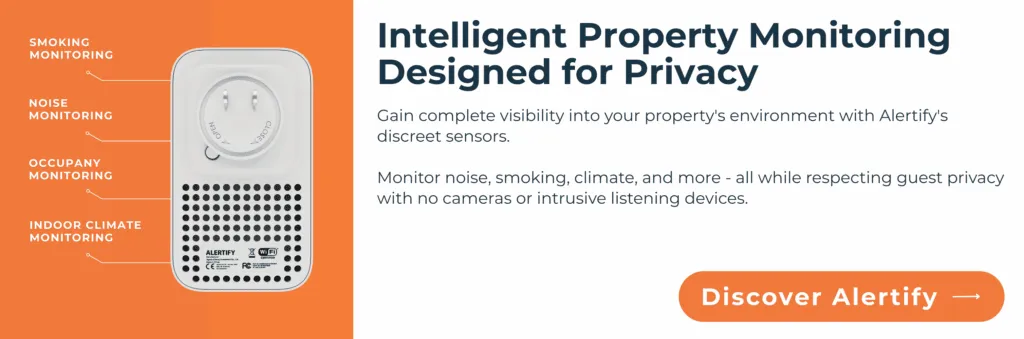
Your right to use monitoring technology to enforce your no-smoking policy is also well-established, subject to one critical condition: the monitoring device must not record audio or video. Privacy laws in the United States and in most international jurisdictions where STRs operate prohibit undisclosed audio and video surveillance of guests in their temporary residence. Devices that measure smoke or sound levels without recording any content, such as Alertify’s indoor smoking monitor, are legally compliant and do not require guest consent beyond the standard disclosure in your house rules. This is precisely why smoking monitoring for your vacation rental needs to be privacy-safe by design, not just by policy.
The Cannabis Complication — Legal Use States and STR Smoking Policy Legal Considerations
The legalization of recreational cannabis in a growing number of US states has introduced a genuine legal nuance into short-term rental smoking enforcement that hosts in those jurisdictions need to understand.
In states where recreational cannabis is legal, guests may have a reasonable expectation that cannabis use is not categorically prohibited, particularly if your no-smoking policy refers only to “smoking” without specifying cannabis. Courts and platform arbitrators in legal-use states have in some cases given guests the benefit of the doubt when policies were ambiguous on this point. The practical solution is straightforward: your no-smoking policy must explicitly name cannabis as a prohibited substance, not rely on an implicit reading of a general smoking prohibition.
The second cannabis-related legal issue involves the interaction between state legalization and federal law. Cannabis remains a Schedule I controlled substance under federal law, which means that properties subject to federal regulations, including those with federally backed mortgages, may have additional obligations around cannabis prohibition that extend beyond the host’s personal preference. Hosts in this situation should ensure their no-smoking policy explicitly addresses cannabis and that their monitoring and enforcement practices are consistent with that prohibition.
Alertify’s indoor smoking monitor detects cannabis smoke specifically, distinguishing its chemical signature from tobacco combustion, which gives hosts in legal-use states the specific documentary evidence they need to enforce an explicit cannabis prohibition. When a detection report identifies cannabis smoke rather than simply reporting an unspecified smoking event, the enforcement conversation is grounded in precise, type-specific evidence rather than general suspicion. Understanding your STR smoking policy legal obligations around cannabis is not optional in legal-use states; it is the difference between an enforceable policy and one that a guest can successfully dispute.
Guest Protections and the Limits of Host Enforcement Under Airbnb Smoking Guest Rights
Understanding the legal protections that guests retain, even after violating your no-smoking policy, is important for hosts who want to enforce their rules effectively without creating legal exposure of their own.
Guests who violate a no-smoking policy are liable for the documented damages their violation causes. They are not, however, liable for excessive or undocumented charges, and platforms will not support damage claims that are not substantiated by evidence. Charging a guest $2,000 for a smoking incident that your documentation supports only $400 in remediation costs is likely to result in a partially declined claim and a retaliatory review. The enforceable amount is the documented amount.
Guests also retain the right to dispute damage claims, and platforms give them a genuine opportunity to do so. A guest who argues that the damage pre-existed their stay, or that the remediation cost is inflated, will be given a fair hearing by platform resolution teams. This is why the combination of pre-stay documentation, post-stay photography, and objective monitoring data from a device like Alertify is so important, it is the evidence base that makes your claim specific, contemporaneous, and difficult to dispute in good faith. Understanding Airbnb smoking guest rights is not about giving ground to guests who have violated your policy; it is about building an enforcement process that is airtight enough that those rights cannot be used against a legitimate claim.
Finally, hosts should be aware that retaliatory review policies on both Airbnb and VRBO prohibit reviews that are filed as a response to a legitimate damage claim rather than as a genuine reflection of the guest’s experience. If a guest files a negative review after a smoking damage claim is submitted against them, platforms will in many cases remove the review if it can be demonstrated to be retaliatory. Documenting your enforcement process carefully, including the sequence and timing of your claim submission relative to any review, is worth doing as standard practice.
For the full framework on protecting your STR from smoking damage, visit our guide to smoking monitoring and damage prevention in vacation rentals.
Book a demo with Alertify to see how privacy-compliant monitoring technology supports legally defensible enforcement.