
You have just received a smoking alert. Or your cleaner has called to report the unmistakable smell. Either way, you now face one of the most delicate conversations in short-term rental hosting: telling a guest they have violated your no-smoking policy while keeping the interaction professional enough that it does not end in a retaliatory one-star review.
The anxiety around this conversation is real and understandable. In a review-driven marketplace, a single negative review can suppress your booking volume for months. But the hosts who handle smoking violations most successfully, both in terms of damage recovery and review outcomes, are not the ones who avoid the conversation. They are the ones who approach it with the right framing, the right tone, and the right evidence. Knowing how to handle a smoking guest in your vacation rental before a violation ever occurs is what separates hosts who recover quickly from those who lose weeks of bookings and a hard-earned review score to a single incident. Here is how to do that.
Why Framing Determines the Outcome When You Handle a Smoking Guest in Your Vacation Rental
The single most important variable in a smoking violation conversation is how you frame your first message. Hosts who lead with the accusation, “you smoked in my property and I am charging you for it,” almost always get a defensive, hostile response. Guests who feel accused, even accurately, tend to dig in, dispute the claim, and file a retaliatory review before the host has had any real opportunity to resolve the situation professionally.
Hosts who lead with documented evidence and a professional, non-confrontational tone get a fundamentally different response. The framing that works is informational rather than accusatory: you are not telling the guest they are a bad person or that you are punishing them. You are informing them that your monitoring device detected a smoking event, that this is inconsistent with the property’s no-smoking policy that they agreed to at booking, and that you would like to resolve the situation professionally.
This framing does several things simultaneously. It grounds the conversation in objective fact rather than subjective assertion, which is harder to dispute. It references the pre-agreed policy, which establishes that the guest was on notice. And it signals a willingness to resolve the situation without escalation, which gives the guest a path forward that does not require them to become aggressive in self-defense.
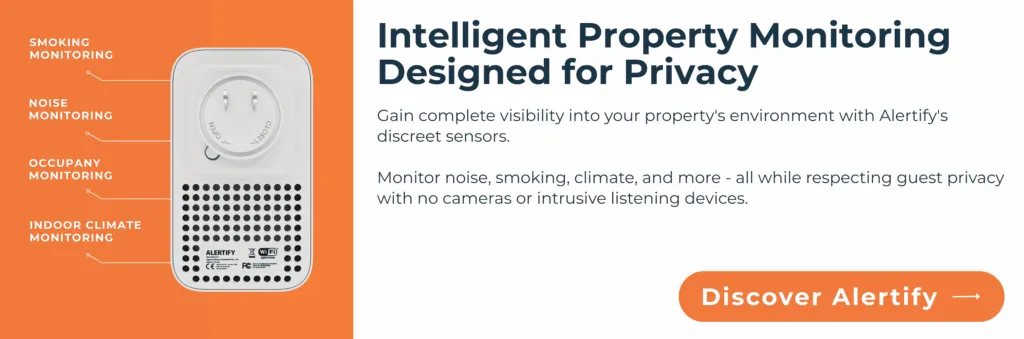
When Alertify’s indoor smoking monitor detects a smoking event during a guest’s stay, the system sends an automated, professionally worded notification to the guest informing them of the detection and requesting their cooperation with the property’s no-smoking policy. In 90% of cases, this is sufficient, the guest stops smoking, the incident is logged, and no further action is required. When a direct host conversation is needed, the monitoring data gives you the objective foundation that makes the framing above not just a tactic but a factual statement. Investing in smoking monitoring for your vacation rental is not just about catching violations; it is about giving you the evidence base to handle them calmly, professionally, and without putting your review score at risk.
What to Say — and How to Say It
Whether you are communicating with a guest during their stay after a monitoring alert or after checkout when damage has been discovered, the structure of your message should follow the same pattern: evidence first, policy reference second, resolution pathway third.
During the stay: If Alertify’s Guest Alert has sent an automated notification but you want to follow up directly, keep your message brief and factual. Reference the monitoring device, note the time of the event, reference the no-smoking policy from your house rules, and ask for their cooperation going forward. Do not threaten a damage fee in this message, your goal at this stage is compliance, not confrontation. A guest who stops smoking after your message has caused a fraction of the damage of one who continues for the remainder of their stay.
A message that works: “Hi [name], our property monitoring device detected elevated smoke readings this evening. As noted in our house rules, the property is smoke-free including all indoor and outdoor areas. We appreciate your cooperation with this, please feel free to reach out if you have any questions about the property.”
After checkout: If you are addressing the violation after the guest has left and damage has been confirmed, your message needs to include the documentary evidence you are relying on, the policy that was violated, and the specific amount you are claiming. Be factual, be specific, and be brief. Crafting the right Airbnb smoking violation message is not about being aggressive; it is about being precise, documented, and professional so that your claim is taken seriously by both the guest and the platform. Do not use language that could be read as threatening or hostile, platform resolution teams read these communications and tone matters.
A message that works: “Hi [name], following your recent stay, our cleaner identified smoke damage to [specific items/areas]. Our monitoring device logged a smoking event during your stay on [date/time]. In line with our house rules, which note a [fee amount] smoking violation fee plus remediation costs, we will be submitting a damage claim for [total amount]. We have attached the monitoring report and remediation invoice for your reference.”
Protecting Your Review Score Through STR Guest Communication on Smoking Violations
The review dynamic in smoking violation situations is one that most hosts handle reactively. The better approach is to manage it proactively, from the moment the violation is detected through to the review window’s close.
The most important thing to understand about retaliatory reviews is that both Airbnb and VRBO have policies against them. Reviews filed as retaliation for a legitimate damage claim rather than as a genuine reflection of the guest’s experience can be reported and removed. Documenting the sequence of events, detection timestamp, host communication, claim submission, guest response, creates a clear record that supports a review removal request if the need arises.
The second important thing is that the way you handle the violation conversation directly influences whether a retaliatory review is filed in the first place. Guests who feel they were treated fairly and professionally, even in a difficult situation, are significantly less likely to file a hostile review than guests who felt ambushed, accused without evidence, or handled with hostility. This is not about letting guests off the hook; it is about recognizing that effective STR guest communication on smoking violations is both more effective and better for your review score than emotional confrontation.
Hosts who use Alertify’s automated notification system as the first point of contact in a smoking violation, rather than a direct accusatory message from the host, consistently report better guest response and fewer retaliatory reviews. The automated alert is perceived as a system response rather than a personal accusation, which changes the emotional register of the interaction before a human conversation even begins.
Ready to see how Alertify handles the first and hardest part of the smoking violation conversation for you? Book a demo today.