
Compliance is one of those words that tends to generate paperwork rather than action. In hospital air quality management, that tendency is a liability. The regulatory frameworks governing indoor air quality in healthcare facilities are not advisory. They carry financial penalties, accreditation consequences, and reimbursement implications that make non-compliance one of the most expensive operational risks a hospital administrator can underestimate. Hospital air quality compliance is not a box to tick at the annual audit. It is a continuous operational discipline that requires real-time data, documented processes, and a clear understanding of what each regulatory body actually requires. This post breaks down the key frameworks, what they demand, and how continuous monitoring transforms compliance from a reactive obligation into a proactive advantage, including for HCAHPS environment domain compliance and the reimbursement performance it drives.
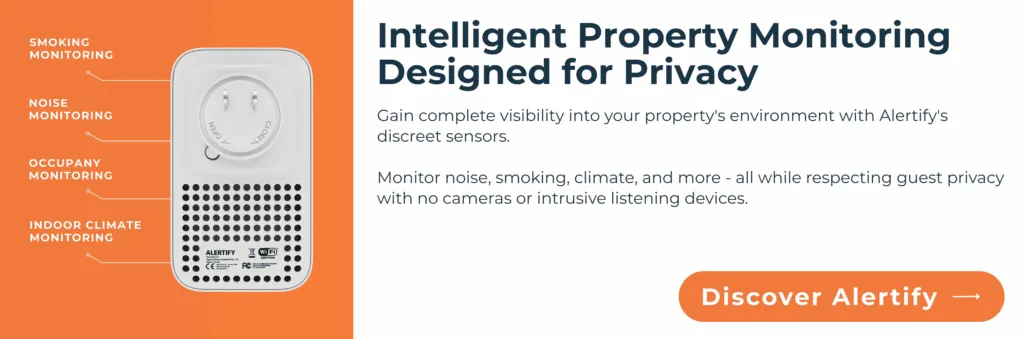
Alertify is a privacy-safe environmental monitoring device designed specifically for facilities that cannot afford compliance gaps. Its plug-and-play sensor network monitors noise levels, indoor smoking and VOC detection, CO2 concentration, temperature, humidity, occupancy, and indoor air quality in real time, across every area of a facility, simultaneously. Unlike scheduled HVAC servicing or periodic air testing, Alertify captures environmental conditions continuously, generating timestamped, downloadable incident reports that serve as court-admissible documentary evidence for Joint Commission surveys, OSHA inspections, CMS audits, and legal proceedings. For hospital administrators managing overlapping compliance obligations across ASHRAE 170, EC.02.05.01, OSHA’s General Duty Clause, and CMS Conditions of Participation, Alertify transforms air quality compliance from a reactive obligation into a continuous, documented, and defensible operational discipline. Setup takes 15 minutes. No audio or video recording. 100% privacy compliant.
The Regulatory Bodies That Govern Hospital Air Quality Compliance
Understanding hospital air quality compliance starts with knowing which bodies have authority over your facility and what each of them specifically requires. For most US hospitals, the compliance landscape involves at minimum four overlapping frameworks, each with its own standards, inspection cycles, and enforcement mechanisms.
ASHRAE 170 is the foundational technical standard for ventilation in healthcare facilities. It specifies minimum air change rates, pressure relationships, temperature ranges, and humidity bands for every category of clinical space, from operating theatres requiring 20 or more air changes per hour to patient rooms requiring a minimum of six. ASHRAE 170 is referenced in building codes across the United States and forms the basis of most state health department licensing requirements for hospital construction and operation. Compliance with ASHRAE 170 is not self-certifying. It requires documented evidence of ventilation performance across all regulated areas.
OSHA’s General Duty Clause requires hospitals to provide a workplace free from recognized hazards likely to cause serious harm. While OSHA does not have a dedicated indoor air quality standard for healthcare, its Technical Manual on Indoor Air Quality establishes clear guidance on pollutant thresholds, acceptable CO2 levels, VOC exposure limits, and ventilation adequacy requirements. Facilities with documented air quality failures that cause staff illness are exposed to OSHA citations and financial penalties, with the potential for public enforcement records that carry lasting reputational consequences.
The Joint Commission’s EC.02.05.01 standard governs the management of the environment of care in accredited hospitals and requires facilities to identify and manage environmental risks, including those related to air quality. Survey findings under this standard can range from recommendations to immediate threat-to-life citations depending on severity, and repeat findings carry progressively more serious consequences including potential loss of accreditation.
CMS Conditions of Participation require hospitals receiving Medicare and Medicaid funding to maintain a safe and sanitary environment as a condition of payment. Air quality failures that create patient safety risks can jeopardise a facility’s certification status, with the associated financial consequences extending well beyond any individual fine.
ASHRAE 170 healthcare compliance, taken together with OSHA, Joint Commission, and CMS requirements, creates a framework in which continuous, documented air quality monitoring is not just advisable. It is the only practical way to demonstrate ongoing compliance across all four bodies simultaneously.
What Non-Compliance Actually Costs
The financial consequences of hospital air quality compliance failures are substantial and come from multiple directions simultaneously, making the total cost of a single documented failure significantly higher than the face value of any individual penalty.
Joint Commission environment-of-care findings carry direct financial weight. Accreditation-related findings that are not resolved within specified timeframes can escalate to threat-to-life designations, triggering expedited re-surveys and, in the most serious cases, loss of accreditation. For a hospital whose Medicare and Medicaid reimbursement depends on accreditation status, the financial exposure from a sustained compliance failure is existential rather than merely operational.
OSHA citations for indoor air quality violations can range from several thousand to tens of thousands of dollars per citation, with willful violations carrying the highest penalties. More significantly, a public OSHA citation creates a documented record of environmental negligence that can be referenced in personal injury litigation and employment tribunal proceedings for years after the original finding.
HAIs attributable to air quality failures add an average of $28,400 per case to a hospital’s cost base, with the most complex cases exceeding this significantly. When air quality is identified as a contributing factor in an HAI cluster, the facility faces not only the treatment cost but potential regulatory investigation, litigation, and the reputational damage of a publicly reported outbreak.
Joint Commission environment of care standards failures also feed directly into HCAHPS performance. Facilities that are not actively managing their environment of care to regulatory standards are typically also not providing the environmental conditions that drive positive HCAHPS survey responses. Poor environment domain scores under HCAHPS contribute to reduced performance in the CMS Hospital Value-Based Purchasing program, where hospitals can lose up to 2% of their base Medicare DRG payments based on their overall score. HCAHPS environment domain compliance should therefore be treated with the same seriousness as OSHA or Joint Commission findings. It is not a patient satisfaction metric. It is a financial performance indicator with direct reimbursement consequences.
How Real-Time Data Makes Compliance Continuous
The fundamental limitation of traditional compliance approaches, including scheduled HVAC servicing, periodic air quality testing, and annual Joint Commission surveys, is that they are all point-in-time assessments of a continuously changing environment. A facility that meets every standard on the day of an inspection may fall out of compliance the following week, with no mechanism to detect or document the gap until the next scheduled review.
Continuous, real-time monitoring closes this gap by providing a permanent, timestamped record of environmental conditions across every monitored area of the facility. For hospital air quality compliance, this means that every CO2 exceedance, every temperature or humidity deviation, every smoking incident, and every noise threshold breach is captured, logged, and stored as documentary evidence that demonstrates both the occurrence of the event and the facility’s response to it.
Alertify’s documentary evidence feature stores incident data for 180+ days and provides downloadable reports that can be presented to Joint Commission surveyors, OSHA inspectors, CMS auditors, or legal counsel as a complete and verified record of environmental performance. This is the kind of continuous compliance documentation that transforms an audit from a high-stakes snapshot into a routine review of an already-documented record.
For administrators managing the full scope of hospital indoor air quality monitoring requirements, from ASHRAE ventilation standards to Joint Commission environment-of-care obligations to HCAHPS reimbursement performance, continuous sensor-based monitoring is the only approach that addresses all four dimensions simultaneously.
Ready to protect your facility? Book a free demo with Alertify today and see how continuous environmental monitoring can reduce risk, improve compliance, and create safer spaces for patients and staff.