Carbon dioxide monitoring sits at an interesting intersection in hospital facilities management: it is both one of the most technically straightforward measurements available and one of the most consistently overlooked. Most hospital HVAC systems are designed to deliver specified air change rates, but very few facilities have real-time visibility into whether those air change rates are actually producing acceptable CO2 concentrations in the spaces where patients and staff spend their time. The gap between designed ventilation performance and actual air quality conditions is where infection risk accumulates, where staff cognitive performance degrades, and where the patient experiences conditions that drive HCAHPS scores. CO2 monitoring in hospital facilities is not an advanced or specialist capability. It is a foundational data stream that every healthcare facility should be collecting continuously and using actively.
What Rising CO2 Levels Tell You About a Hospital’s Air
CO2 is the single most reliable indicator of ventilation adequacy in an occupied indoor space, because it is directly generated by the people in the room and directly removed by fresh air supply. When CO2 levels are rising, it means that the rate of air exchange is not keeping pace with the occupancy and activity level of the space. This relationship makes CO2 concentration a real-time proxy for ventilation performance that no HVAC specification document or scheduled service record can substitute for.
Outdoor air sits at approximately 400–420 ppm of CO2 under current atmospheric conditions. ASHRAE and OSHA guidance identifies 1,000 ppm as the threshold above which indoor ventilation is considered inadequate, and at this level the air in a space has been significantly recirculated relative to fresh outdoor supply. Research published in the journal Indoor Air has established that cognitive performance declines measurably at CO2 concentrations above 1,000 ppm, with decision-making accuracy, information processing speed, and response time all showing statistically significant deterioration. For clinical staff making time-sensitive decisions under pressure, this is not an abstract occupational health consideration. It is a patient safety variable.
Beyond the cognitive performance impact, elevated CO2 is an indicator of the same conditions that elevate airborne pathogen transmission risk. In a space where CO2 is rising, the proportion of recirculated air is increasing, and with it the concentration of any airborne biological or chemical contaminants that exhaled air carries. CO2 monitoring in hospital facilities does not just tell you about ventilation rates. It tells you about infection risk, cognitive performance risk, and the overall quality of the breathing environment for everyone in the space.
Hospital ventilation sensor data collected continuously and reviewed in real time allows facilities teams to respond to CO2 exceedances as they occur, adjusting ventilation, redistributing occupancy, or opening additional spaces, rather than discovering a sustained exceedance weeks later during a scheduled review.
Occupancy Overload and Its Effect on Air Quality and HCAHPS Scores
CO2 monitoring in hospital facilities becomes most valuable when it is combined with occupancy data that explains why CO2 levels are where they are and enables a targeted response. A CO2 exceedance in a waiting room that is operating at 150% of its designed capacity is a different problem from the same exceedance in a room operating at normal occupancy with a failing damper. The response to each is different, and without occupancy data alongside CO2 data, facilities teams are working from incomplete information.
Occupancy monitoring healthcare facility managers can deploy alongside CO2 sensors provides this context in real time. When occupancy data shows that a given area is consistently exceeding its designed capacity during morning admission peaks, that data can drive operational changes, including staggered admission scheduling, expansion of waiting areas, or targeted ventilation upgrades, that address the root cause rather than just the symptom.
A landmark Science study on SARS-CoV-2 transmission found that indoor occupancy density and ventilation adequacy were the two most significant environmental determinants of airborne transmission risk. Managing both variables simultaneously, through combined CO2 and occupancy monitoring, is therefore the most effective environmental intervention available for reducing airborne infection risk in a clinical setting.
The HCAHPS dimension of this is direct and financially significant. Patients in overcrowded, poorly ventilated spaces do not just face higher infection risk. They experience discomfort, stuffiness, elevated noise levels from crowding, and the general sense of environmental neglect that translates into negative HCAHPS environment domain responses. HCAHPS noise and environment scores in facilities that actively manage CO2 and occupancy consistently outperform those that rely on fixed ventilation settings and periodic inspection, because the environmental conditions that patients experience and report are actively maintained rather than passively assumed. Alertify’s occupancy monitoring and indoor climate tracking capabilities deliver both data streams through a single device, providing the integrated view that effective environmental management requires.
Alertify’s Dual Approach: Climate and Occupancy in One Device
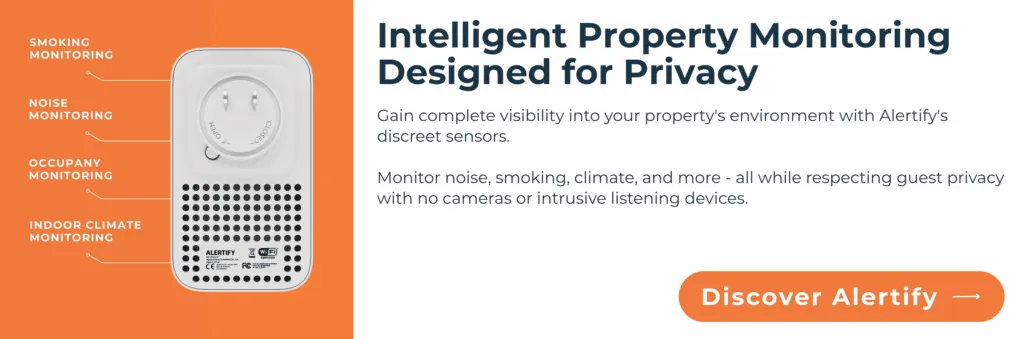
The practical case for CO2 monitoring in hospital facilities has historically been complicated by the assumption that it requires dedicated infrastructure, specialist installation, and ongoing technical maintenance. That assumption no longer reflects the available technology. Alertify’s monitoring device captures CO2 concentration, temperature, humidity, occupancy indicators, noise levels, and smoke particulates simultaneously through a single plug-and-play unit that sets up in 15 minutes with no specialist installation required.
For facilities managers overseeing multiple buildings or large clinical portfolios, the dashboard view provides a real-time consolidated picture of environmental conditions across all monitored spaces, with automated alerts triggered when any parameter exceeds its configured threshold. Every alert is time-stamped, and the full data history is stored for 180+ days, providing the continuous environmental record that regulatory compliance, clinical governance, and HCAHPS performance management all require.
Mold risk assessment is a further capability delivered by the same device. In clinical environments where humidity management is critical, early warning of conditions that precede visible mold growth enables remediation before patient exposure occurs, avoiding both the clinical harm and the serious regulatory and accreditation consequences of a mold-related adverse event.
Effective hospital indoor air quality monitoring connects clinical safety, regulatory compliance, financial performance, and patient experience into a single operational discipline. Every variable this article covers, from CO2 and VOC levels to temperature, humidity, occupancy, and smoking detection, is monitored continuously by Alertify, giving hospital administrators a complete, documented, and defensible picture of environmental performance across their entire facility.
Ready to protect your facility? Book a free demo with Alertify today and see how continuous environmental monitoring can reduce risk, improve compliance, and create safer spaces for patients and staff.