
Choosing the right hotel occupancy sensors is the most critical first step in building a modern hotel party prevention strategy. But with so many options, from old-school infrared to new smart devices, how do you choose? The biggest hurdle isn’t just technology but rather its guest perception and privacy. This guide cuts through the noise and provides a clear buyer’s framework, focusing on the technology that is 100% privacy-safe and 100% effective at stopping unauthorized parties before they start.
Why “Privacy-Safe” is the Only Option
Let’s be clear: when we talk about monitoring, we are never talking about cameras or audio recorders. The moment a guest even thinks they are being watched or listened to, you have lost their trust – and their business – forever.
The “Camera” Conundrum: A Non-Starter
Placing a camera or microphone in a private hotel room is a legal, ethical, and reputational nightmare. It is a non-negotiable “no.” Any strategy for monitoring must begin with a 100% privacy-first foundation. The goal is to monitor your property for policy violations, not to “spy” on your guests. This is where the distinction in technology becomes so important.
What Are Privacy-Safe Sensors?
This is the technology you need to look for. A true privacy-safe sensor is a device that collects no personally identifiable information (PII).
- It cannot see faces.
- It cannot hear or record conversations.
- It only detects anonymous, environmental data.
Think of it like a smart thermostat that senses temperature. A privacy-safe sensor simply “senses” the room’s environment. The data it collects is anonymous, tracking environmental metrics rather than personal information. For example, it shows: ’90 decibels,’ ‘high humidity,’ ‘smoke being detected,’ or a ‘CO2 level spike,’ which can indicate that more people have entered the room.
Comparing the Types of Hotel Occupancy Sensors
Not all sensors are created equal. The technology you choose will determine whether you are reactive (stopping a party at 2 AM) or proactive (stopping it at 9 PM).
The Old Guard: Motion (PIR) & Thermal Sensors
These are the sensors used in office buildings to turn on lights. A Passive Infrared (PIR) sensor detects body heat and motion.
- Pros: Cheap and widely available.
- Cons for Party Prevention: Utterly unreliable. They cannot tell the difference between one guest walking around their room and 15 guests standing still. A “quiet” party can easily fool them. This technology is not built for this application.
The “Almost There”: Noise-Only Sensors
This is a common first step for many hotels. A noise-only monitor simply tracks the decibel (dB) level in a room and sends an alert when it passes a set threshold (e.g., 85dB for 10 minutes).
- Pros: Good at detecting a symptom of a party (noise).
- Cons for Party Prevention: They are purely reactive. By the time a party is loud enough to trigger this alert, it has already been loud for several minutes. This means your other guests are already being disturbed. It also creates false positives from a single guest with a loud TV or movie.
The New Standard: Anonymous Device Counting (Wi-Fi/Bluetooth)
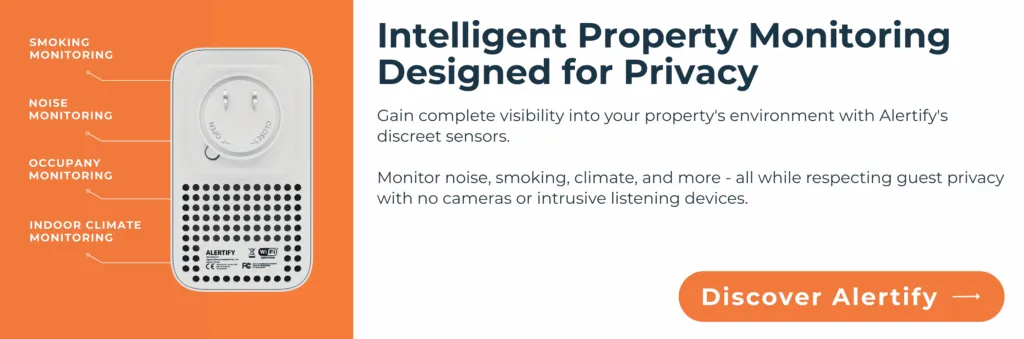
This is the game-changer. This technology, used by platforms like Alertify, works by anonymously counting the number of smart devices (phones, laptops, smartwatches) in a room by pinging smart devices nearby that are trying to connect to the WI-FI.
- Pros: This is the only sensor that provides a leading indicator. It doesn’t wait for the noise; it detects the crowd as it assembles. You get an alert when there is a sudden spike in occupancy, before the noise and complaints begin. It is 100% anonymous, as it only counts the signals; it does not read or identify any data.
- Cons: Requires a stable Wi-Fi connection, which is standard in all modern hotels.
The Rise of All-in-One Hotel IoT Devices
The best hotel party prevention strategy is about building an indisputable case. This is why the best hardware solutions are not single-taskers; they are all-in-one hotel IoT devices that combine multiple data points.
Why? Because data works better together.
- Occupancy: Set limit + Noise: 55dB = A quiet gathering. Maybe a pre-wedding group.
- Occupancy: Exceeded set limit + Noise: 90dB = An unauthorized party.
A true all-in-one sensor should combine the “big three” data points for party prevention:
- Anonymous Occupancy: The leading indicator that a crowd has formed.
- Noise Levels: The supporting indicator that the crowd is disruptive.
- Smoke/Vape Detection: The evidence for imposing cleaning fees and preventing long-term room damage.
When these three data points are in one log, a guest has no way to dispute a violation.
The Buyer’s Checklist: 4 Questions to Ask a Vendor
When you are ready to buy, arm yourself with these five questions:
- “Can you put in writing that your device has no camera and no audio recorder?” (If they hesitate, run.)
- “How do you measure occupancy? Is it anonymous?” (Look for “pinging smart devices” as the answer.)
- “Is this an all-in-one device?” (Demand occupancy, noise, and smoke.)
- “How is it installed and powered?” (Look for “plug-and-play” and “Wi-Fi.” Avoid complex, expensive hard-wiring.)
Choosing Your Foundation: The Smart Sensor Standard
Choosing the right hotel occupancy sensors is the foundation of your entire property protection strategy. Don’t settle for reactive, single-metric devices that only tell you a problem has already started. The new standard is proactive, 100% privacy-safe sensors that give you the leading indicators. By focusing on all-in-one hotel IoT devices that count occupancy anonymously, you’re not just buying a piece of hardware; you’re investing in peace of mind, guest satisfaction, and a protected bottom line.
Ready to see the new standard in action? Learn more about Alertify’s all-in-one, 100% privacy-safe sensor that combines occupancy counting with noise and smoke detection. Book a demo today.