
As a senior housing operator, you are tasked with navigating a complex landscape of regulations designed to ensure the health, safety, and well-being of your residents. While you are likely well-versed in rules regarding medication management, fall prevention, and nutrition, the standards for indoor air quality (IAQ) and ventilation can seem like a confusing maze. Yet, these environmental standards are becoming increasingly critical in defining a safe living space.
Adhering to these regulations is not just about checking a box for a surveyor but rather it’s about fundamentally protecting your residents from airborne threats. This guide will help you navigate the key standards and recommendations that govern air quality in senior care, explaining the “why” behind the rules and how modern technology can make compliance simpler and more effective. A core component of environmental health and safety in long-term care is the air that everyone in your facility breathes.
The Gold Standard: ASHRAE and Ventilation Rates
When regulators and public health officials talk about ventilation, they are almost always referring to the standards set by ASHRAE (American Society of Heating, Refrigerating and Air-Conditioning Engineers). This organization develops the technical guidelines that form the basis of building codes and best practices worldwide.
Understanding ASHRAE Standard 62.1
The key document for most commercial and residential buildings, including senior living facilities, is ASHRAE Standard 62.1, “Ventilation for Acceptable Indoor Air Quality.” This standard doesn’t just say “thou shalt have fresh air”; it provides specific calculations for how much outdoor air needs to be supplied to a space, measured in cubic feet per minute (CFM) per person and per square foot.
Meeting the ASHRAE standards for assisted living is critical because they are designed to do two things:
- Dilute Contaminants: Bringing in fresh outdoor air dilutes the concentration of indoor-generated pollutants like CO₂, VOCs, and airborne pathogens.
- Pressurize the Building: Proper ventilation helps control the pressure relationships between different areas, ensuring air flows from cleaner spaces (like resident rooms) to less clean spaces (like restrooms or janitorial closets).
The Challenge of Compliance
The difficulty for facility managers is that you can’t “see” ventilation. How do you know if your aging HVAC system is actually meeting these precise airflow requirements? How can you prove it to a surveyor? This is where monitoring becomes essential.
State and Local Health Department Regulations
Beyond the technical guidelines from ASHRAE, state and local health departments often have their own specific rules that directly impact air quality. These regulations are enforceable by law and are a key part of your facility’s licensing and inspection process.
Common Regulatory Requirements
While they vary by state, many health codes include specific nursing home ventilation requirements. These may mandate:
- Specific Air Exchange Rates: Some states may explicitly require a certain number of air changes per hour (ACH) in common areas or resident rooms.
- Exhaust Fan Operation: Rules often require that exhaust fans in bathrooms and kitchens be functional and operate correctly to remove moisture and odors at the source.
- Filter Maintenance: Regulations may specify the minimum efficiency (MERV rating) of filters to be used in HVAC systems and require documentation of regular filter changes.
Demonstrating compliance with these rules often relies on maintenance logs and the word of your staff. However, a more robust approach is to use data to show that your environmental management strategies are effective.
How Continuous Monitoring Simplifies Compliance
The traditional model of performing a ventilation check once or twice a year is no longer sufficient. Continuous IAQ monitoring provides the real-time, historical data needed to confidently manage and document a safe indoor environment.
Using CO₂ as a Proxy for Ventilation
Directly measuring airflow (CFM) is complex and expensive. However, monitoring indoor carbon dioxide levels is a simple and highly effective way to assess if your ventilation is adequate in real time. If CO₂ levels are consistently low, it’s a strong indication that you are meeting ventilation standards. If levels spike, it provides an immediate, actionable alert that a specific area needs more fresh air.
Creating a Defensible Record
An IAQ monitoring system creates a continuous, time-stamped log of your facility’s environmental conditions. This data provides a powerful, defensible record. In the event of an outbreak or a regulatory inspection, you can present detailed reports demonstrating that you were proactively managing your facility’s air quality. This data-driven approach is the future of indoor air quality for senior living, transforming compliance from a paperwork exercise into an active, dynamic process.
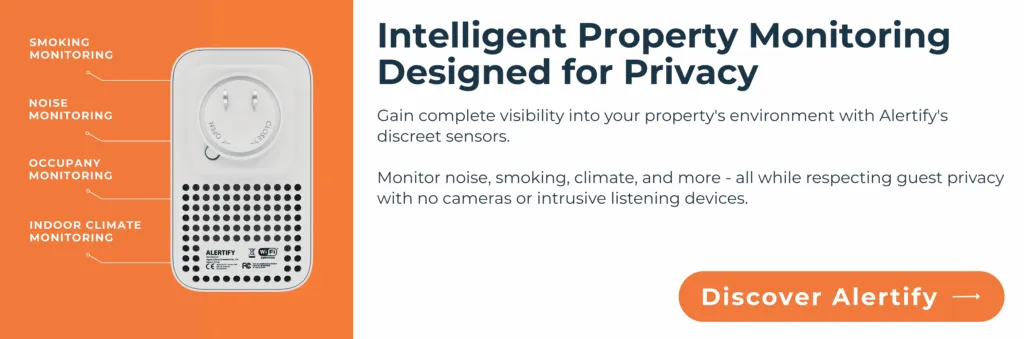
Compliance doesn’t have to be complicated. Alertify’s IAQ monitoring platform provides the data and documentation you need to confidently meet and exceed ventilation standards, ensuring a safe and healthy environment for your residents.