
Noise monitoring devices have become standard equipment for short-term rental operators with some cities, including Fort Lauderdale and New Orleans, now requiring one for an STR license. But the two platforms operators compare most often, Minut and Alertify, take very different approaches to what a property monitor should actually do.
Minut built its reputation on noise monitoring and has expanded into occupancy and smoke alerts. Alertify was built by an STR operator around a different idea: if a device is going to sit in your property anyway, it should measure everything that costs you money, such as noise, smoking, air quality, CO2, temperature, humidity, and mold risk, and hand you the evidence when something goes wrong.
This Alertify vs Minut comparison breaks down both platforms feature by feature, with real numbers on what incidents cost and what each system costs to run. Here’s how they stack up.
Minut vs Alertify: comparison table
| Feature | Alertify | Minut (M3) |
|---|---|---|
| Noise monitoring | ✔ 24/7 decibel monitoring | ✔ Real-time decibel monitoring |
| Smoking & marijuana monitoring | ✔ Dedicated infrared VOC + particulate sensing — detects cigarette and marijuana smoke | Basic — AI-inference from other sensor signals; no dedicated particulate sensor |
| Air quality tracking (PM2.5) | ✔ Dedicated PM2.5 sensor with live readings | ✘ Not available |
| Mold risk readings | ✔ Readings + trend data over time | Alerts only — no underlying readings to review |
| Temperature monitoring | ✔ Live readings + custom thresholds | ✔ Included in Indoor Climate |
| Humidity monitoring | ✔ Live readings + trends | ✔ Included in Indoor Climate |
| CO2 monitoring | ✔ Air quality + vacant-property (squatter) detection | ✘ Not available |
| Real-time notifications | ✔ Push, SMS, email + Slack/Teams webhooks | ✔ Push and team alerts |
| Auto-generated incident reports | ✔ Instant downloadable report for every event | Partial — time-stamped event log; no auto-generated report document |
| Privacy friendly | ✔ No cameras, no audio or video recording | ✔ No cameras, no audio recording |
| Power | ✔ Plug-in, always on (4-hr backup battery) | Battery-powered — requires recharging |
| Pricing (per unit) | $145/yr Pro · $195/yr AQ+, device included | From $150 hardware + $10–20/mo subscription |
Feature sets and pricing as of July 2026, based on each company’s published materials.
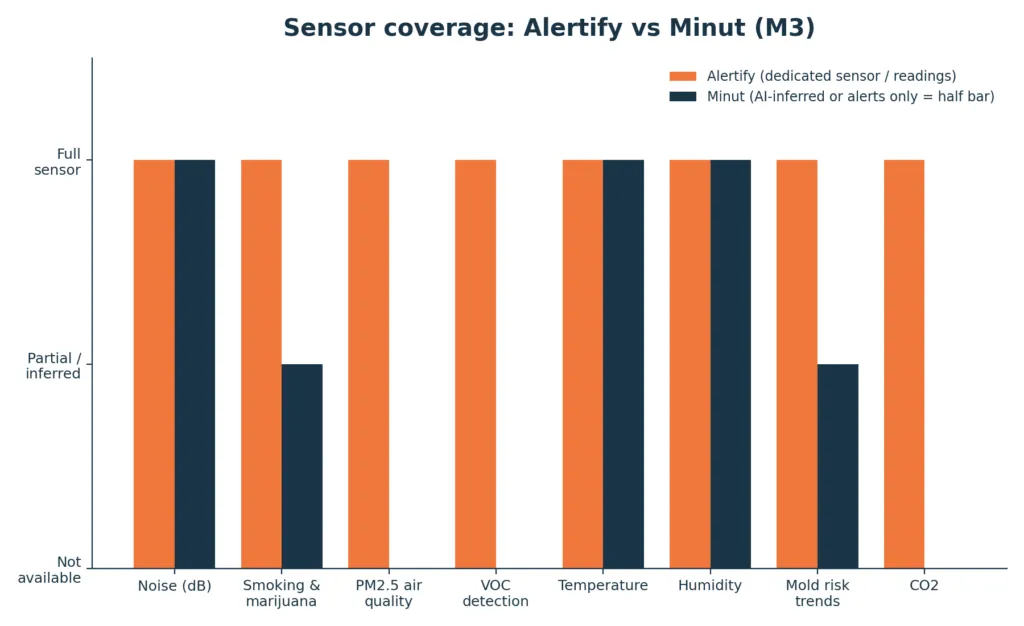
Alertify ships dedicated sensors for eight environmental parameters. Minut covers four fully, with smoking and mold risk handled indirectly.
What is Minut?
Minut is a Swedish company whose M3 sensor monitors noise, motion, temperature, and humidity, with add-on features for crowd detection, smoke alerts, and a home alarm mode. It’s a battery-powered device with a polished app, strong PMS integrations, and a genuine commitment to privacy — no cameras, no audio recording.
Minut is a capable noise monitor, and for operators who only need noise alerts, it does that job well. The gaps appear when you look at what the hardware physically measures.
What is Alertify?
Alertify is a plug-in property monitoring device built by a short-term rental operator. Each unit contains dedicated sensors for noise (24/7 decibel monitoring), air particulate matter (PM2.5), VOCs, temperature, humidity, and CO2 — feeding a dashboard that tracks violations in real time, sends alerts by push, SMS, email, or Slack/Teams webhook, and auto-generates a downloadable incident report for every noise or smoking event.
Because it plugs into a wall socket, it never needs recharging, and a built-in backup battery keeps it running for around four hours in a power outage. Every subscription includes the hardware, the dashboard, and WelcomeLink guest screening at no extra cost.
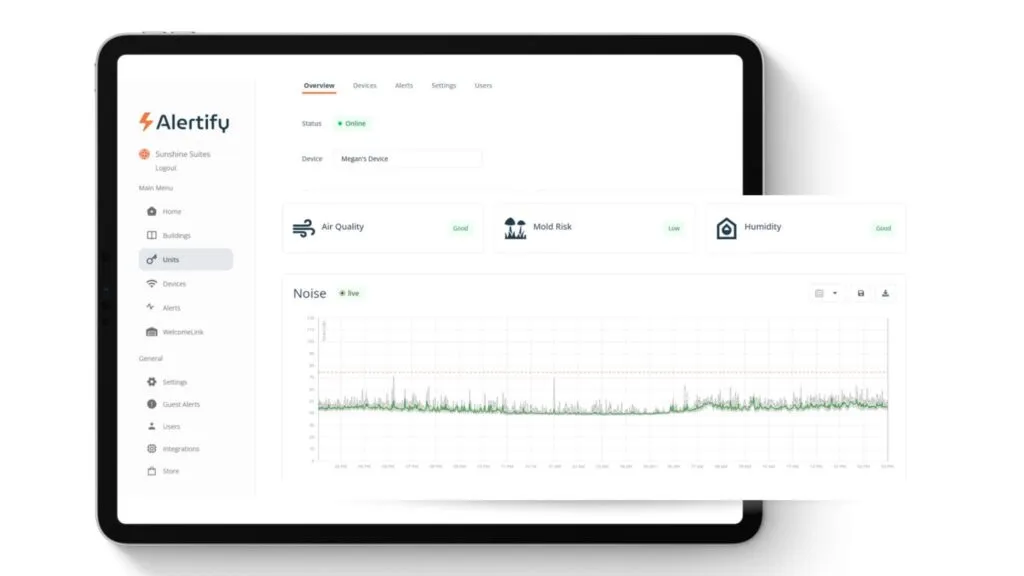
Image by Alertify
The biggest difference: how each device detects smoking
This is where the two platforms genuinely diverge, and it comes down to hardware.
Minut: AI-inference smoke detection
Minut’s smoking detection is software-based. Its AI analyzes signals from the M3’s existing sensors to infer that cigarette or marijuana smoke is likely present, then sends an alert. It works, and events are time-stamped — but there is no dedicated particulate or VOC sensor inside the device. Minut’s own positioning confirms the approach: “simple alerts, ready to act on — no graphs or charts to interpret.” That’s a reasonable philosophy, but it means when a guest disputes a smoking fine, you have an alert, not a measurement.
Alertify: infrared detection of VOCs and particulate matter
Alertify takes the direct route. Each device uses infrared sensing to detect volatile organic compounds (VOCs) and a dedicated PM2.5 sensor to measure air particulate matter — the physical evidence smoking actually leaves in the air. This is the most accurate way to monitor smoking events, because the device isn’t inferring that smoke is probably present; it’s measuring the particles and compounds themselves, in real time, whether the source is a cigarette, marijuana, or a vape.
The difference shows up at the worst possible moment: the dispute. When a guest denies smoking and challenges the $500 fee, Alertify hands you a time-stamped incident report showing the exact particulate spike — evidence you can submit to Airbnb, a payment processor, or an insurance adjuster. Smoking remediation runs $2,000–$4,000 per incident once deep cleaning, odor removal, and furniture replacement are counted, so winning that dispute matters.
Air quality, CO2, and mold: what Minut doesn’t measure
Beyond smoking, three of the ten features operators ask about most simply aren’t in Minut’s hardware:
- Air quality tracking: Alertify’s PM2.5 sensor tracks indoor air quality continuously, so you can catch ventilation and HVAC problems before they show up in reviews as “stuffy” or “smelled bad.” Minut has no equivalent.
- CO2 monitoring: Alertify monitors CO2 levels — useful for air quality, and uniquely useful for vacant-property protection. A CO2 spike in a unit that should be empty means someone is inside. Minut’s M3 has no CO2 sensor.
- Mold risk readings: Both platforms flag mold risk, but differently. Minut sends an alert when its algorithm judges conditions risky. Alertify gives you the actual temperature and humidity readings and their trends over time, so you can see the problem developing, verify it, and document the conditions for insurance if damage occurs.
For operators in humid markets, or anyone who has eaten a five-figure mold remediation bill, the difference between an alert and a data trail is not academic.
Incident reports: evidence you can actually use
Every noise or smoking event on Alertify automatically generates a detailed incident report including time-stamped decibel levels and duration for noise, detection events with precise timestamps for smoking, including guest details when connected to your PMS. Reports are downloadable from the dashboard the moment the event ends. This means no manual data entry, no extra work and no need for screenshots.
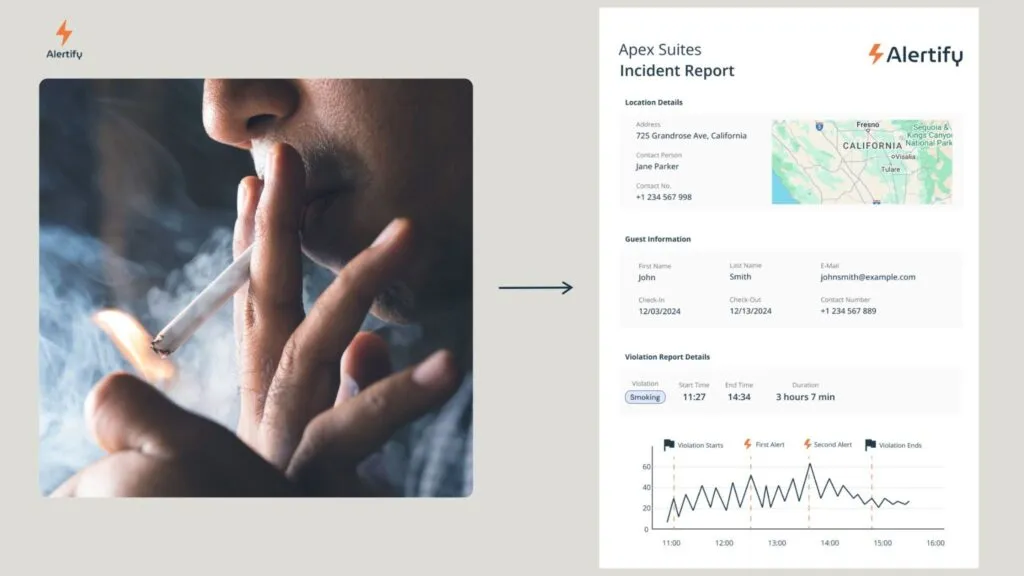
Image by Alertify
Minut time-stamps events and offers summary reports, which is enough to know something happened. It’s not a formatted, evidence-grade document you can attach to a damage claim thirty seconds after the guest checks out.
This matters because disputes are where monitoring pays for itself. Winning a single fraudulent chargeback with documented evidence can save $500–$3,000. Industry reporting puts average unauthorized-party damage at roughly $1,560 per incident, with severe cases reaching $10,000 or more, and noise fines alone run $250–$2,000 per incident in many jurisdictions, with New York City issuing $8.9 million in STR fines in a single year.
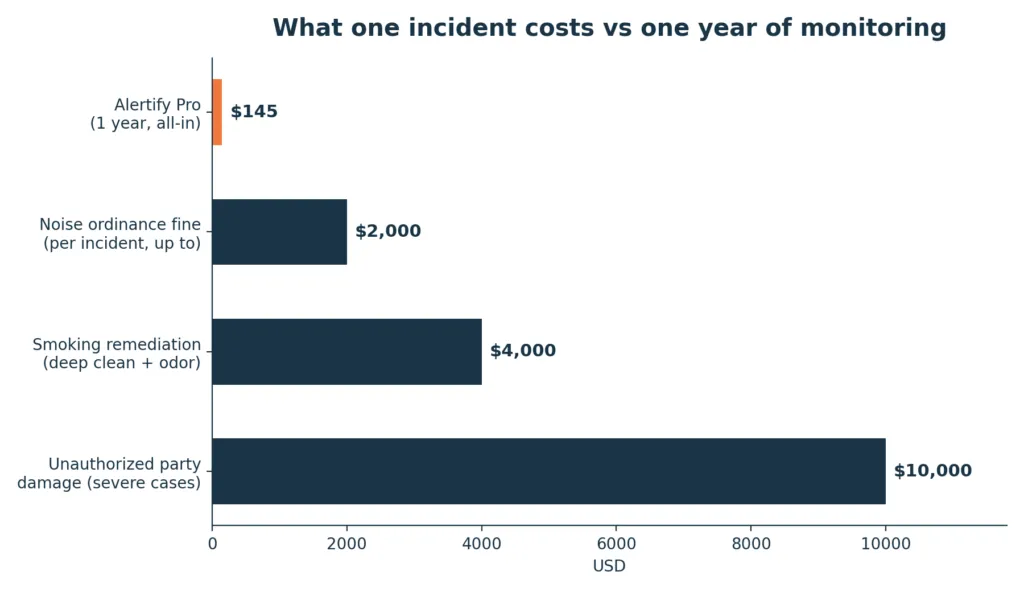
One documented incident can cost more than a decade of monitoring. Sources: industry damage surveys and municipal fine schedules; Alertify pricing as of 2026.
Pricing: Alertify vs Minut total cost of ownership
The pricing models are structurally different, and it changes the math more than the sticker prices suggest.
Minut sells hardware and subscription separately: the M3 sensor runs $150–$220 per unit, then plans run roughly $10–20 per unit per month depending on tier, with features like PMS integrations gated to higher tiers and Call Assist as a paid add-on.
Alertify bundles everything into one annual price: $145 per year for Alertify Pro or $195 per year for Alertify AQ+ — hardware included, dashboard included, WelcomeLink guest screening included, with volume pricing available for portfolios. There’s no upfront hardware purchase and no tier-gating on core features.
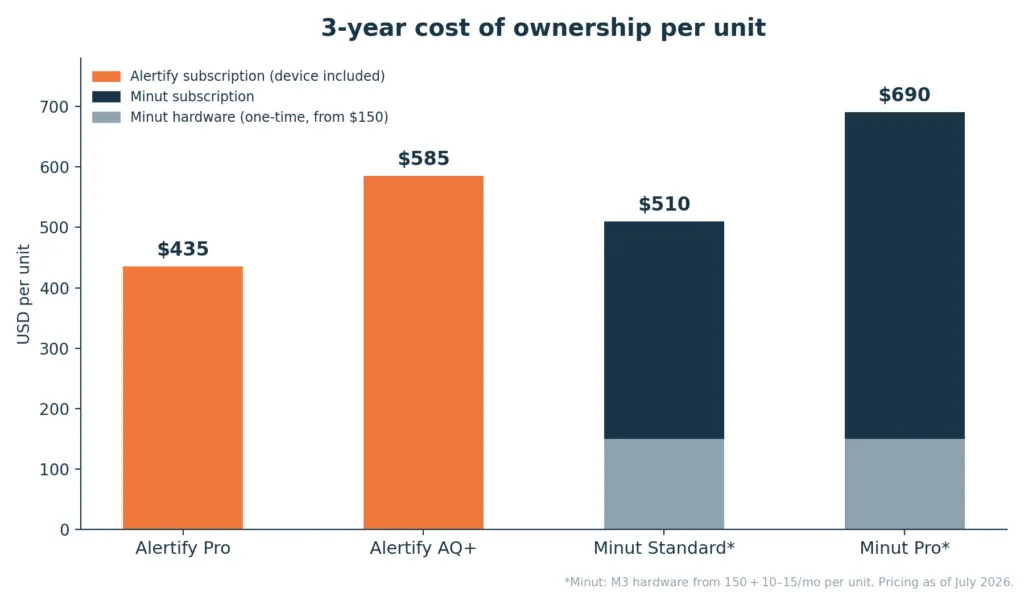
Over three years, one Alertify Pro unit costs $435 all-in. A comparable Minut setup runs $510–$690 per unit before add-ons.
Across a 20-unit portfolio over three years, that gap is roughly $1,500–$5,000 — before counting Minut add-ons, and before counting a single prevented incident.
Where Minut wins
A fair comparison cuts both ways. Minut is the more established brand with a larger integration ecosystem. Its optional Call Assist service (a third party phones noisy guests for you) is genuinely useful for hands-off operators. And its battery-powered design means you can mount it anywhere, including spots without a nearby socket, with the trade-off being recharge cycles that a plug-in device never has.
If all you want is a well-designed noise alert with minimal data, Minut delivers that.
Real-world example: the 2 a.m. party
Here’s how the same Saturday night plays out on each platform. At 11:40 p.m., noise passes your quiet-hours threshold. Both devices alert you — so far, identical. On Alertify, if you’re connected to a PMS, an automated message goes to the guest immediately: “We’ve detected elevated noise levels at the property…” In our experience, 9 out of 10 incidents where automated guest messaging is active resolve without the operator lifting a finger — guests self-correct when they know someone’s watching.
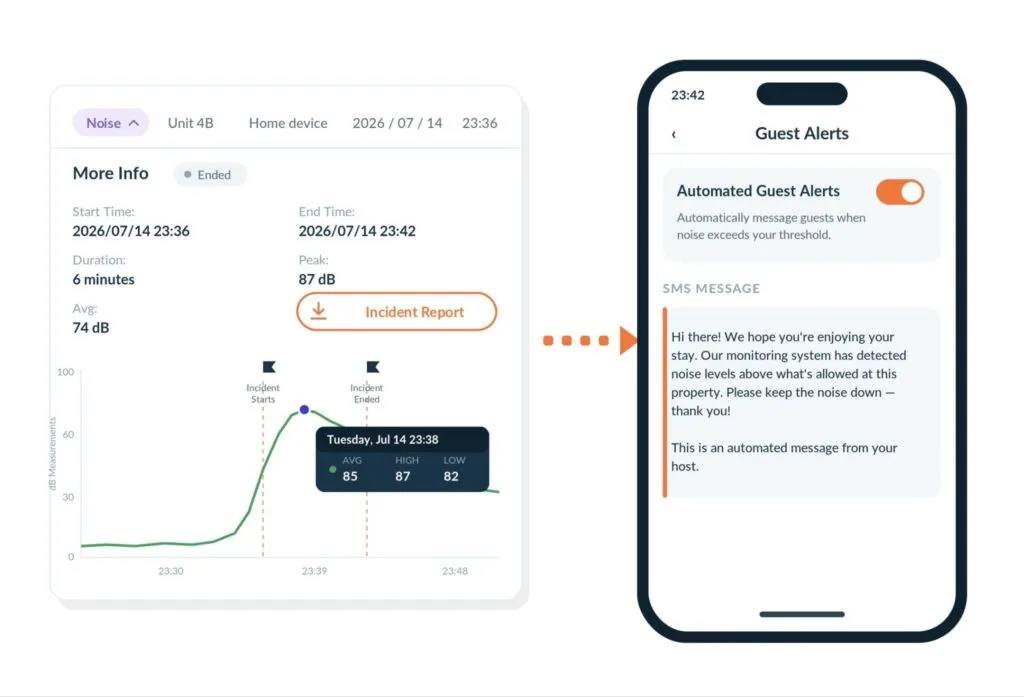
Image by Alertify
Now suppose it doesn’t resolve, and Sunday morning reveals cigarette burns and a lingering smoke smell. On Alertify, you download two auto-generated reports — the noise incident with decibel levels and duration, and the smoking incident with the PM2.5 spike — and attach them to your damage claim before checkout is even processed. On Minut, you have time-stamped alerts and a summary to build your case from. Both are better than nothing. One of them is evidence.
Minut vs Alertify: FAQ
Is Alertify or Minut better for Airbnb hosts?
Both handle noise well. Alertify adds dedicated smoking detection hardware, air quality, CO2, and auto-generated incident reports at a lower three-year cost, which makes it the stronger fit for operators who want evidence and damage prevention, not just alerts.
Does Minut detect smoking?
Yes, but indirectly — Minut’s AI infers cigarette and marijuana smoke from its existing sensors. It has no dedicated PM2.5 or VOC sensor. Alertify measures particulate matter and VOCs directly using infrared sensing, which is the most accurate method for detecting smoking events, including vaping.
Are these devices legal in rentals? Do they record guests?
Yes, and no recording — both platforms are privacy-first by design. Neither uses cameras or records audio; they measure environmental levels only, which keeps them compliant with Airbnb and Vrbo device policies when disclosed in your listing.
Do Alertify and Minut work with property management systems?
Both integrate with major PMSs. Alertify connects with Guesty, Hostaway, Hospitable, OwnerRez, iGMS, Lodgify, Mews, and more — and uses the connection to send automated guest alerts and pull guest details into incident reports. API access is available on both platforms.
What does each platform cost?
Alertify: $145/year (Pro) or $195/year (AQ+), hardware and all features included. Minut: $150–$220 for the M3 sensor plus $10–20 per unit per month, depending on tier.
The bottom line
Minut is a good noise monitor. Alertify is a complete property monitoring system — one device that measures noise, smoking, air quality, CO2, temperature, humidity, and mold risk, documents every incident automatically, and costs less over the life of the device.
If you’re comparing Minut vs Alertify for your properties, the question to ask is simple: when something goes wrong at 2 a.m., do you want an alert — or do you want proof.
Ready to see the difference? Book a demo at alertify.io/ or start protecting your first property for $145/year — device, dashboard, and WelcomeLink guest screening included.