
Making a noise complaint is one thing. Making a noise complaint that results in action is another. For tenants in affordable housing, the gap between reporting a problem and seeing it resolved often comes down to one thing: evidence. Housing officers, landlords, and courts cannot act on noise complaints without an adequate standard of proof, and subjective resident testimony — however sincere and however accurate — frequently falls short of that standard. This guide explains exactly how to document noise complaints as a tenant in a way that gives your complaint the best possible chance of being taken seriously, investigated properly, and resolved effectively.
Why Documentation Is the Difference Between Action and Inaction
In the absence of objective evidence, noise disputes in affordable housing become circular. You report the noise. Your neighbour denies it. Your housing officer has no independent basis for taking sides. The complaint stalls. The noise continues. This cycle repeats until one party gives up — and that party is usually the complainant, not the person causing the problem.
The Housing Ombudsman Service in England has identified inadequate evidence as one of the primary reasons noise complaints in social housing fail to reach resolution. Housing providers cannot pursue formal enforcement action — issuing a notice, pursuing a legal remedy, or applying for a noise abatement order — without meeting an evidentiary threshold. Your documentation is what makes that threshold reachable. Noise monitoring for affordable housing is increasingly recognised as the most effective tool for generating that evidence, and understanding how to build your evidentiary case — with or without technology — is an essential skill for any tenant dealing with persistent noise.
Step 1: Start a Noise Diary Immediately
The moment you decide to make a formal noise complaint, start a written noise diary. Record every incident with the following information: the date and day of the week, the start and end time, a description of the type of noise, an estimate of its volume and impact, and a note of how it affected you — did it wake you, prevent you from sleeping, force you to leave a room, or cause you distress?
Be specific and factual rather than emotive. “Loud music playing from 11.15pm to 1.40am, bass audible through the ceiling, prevented me from sleeping” is more useful than “neighbour was incredibly noisy all night again.” Specificity is what turns a diary into evidence. Keep your diary in a format that is easy to share — a dedicated notebook, a spreadsheet, or a notes app on your phone — and be consistent about updating it every time an incident occurs, as soon as possible after it happens while details are fresh.
Step 2: Submit Your Complaint in Writing
Always submit your noise complaint to your landlord or housing provider in writing — not just verbally. A written complaint creates a paper trail that documents when you first reported the problem and what your landlord’s response was. Send it by email if possible, as this creates an automatic timestamp. If you report in person or by phone, follow up immediately with a written summary: “As discussed today, I am writing to formally report…”
Keep copies of everything — every email, every letter, every response from your housing provider. This correspondence becomes part of your evidentiary record, particularly if you need to escalate your complaint to the Housing Ombudsman Service, a local authority environmental health department, or a court.
Step 3: Request Access to Monitoring Data
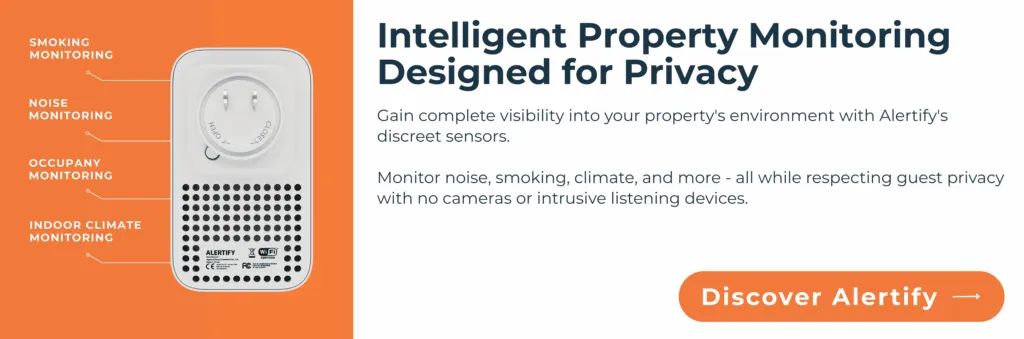
If your housing provider has noise monitoring for affordable housing technology installed in your building, request access to the incident data relevant to your complaint. Systems such as Alertify generate automatically timestamped records of every noise event that exceeds a pre-configured threshold, stored through the documentary evidence feature for a minimum of 180 days. This data can be downloaded as a formatted incident report that provides objective, verifiable corroboration of your noise diary — transforming your subjective account into an objectively evidenced case.
If your housing provider does not have monitoring technology in place, you are entitled to ask why not and to request that they consider installing it as part of their response to your complaint. Framing this request as a reasonable step toward gathering the evidence needed for formal action is both accurate and persuasive.
How to Document Noise Complaints as a Tenant: Step 4 — Escalate With Your Evidence
Once you have a written complaint on record, a detailed noise diary covering multiple incidents, and ideally corroborating data from a monitoring system, you are in a significantly stronger position to escalate if your landlord fails to act. In the United Kingdom, the escalation route for social housing tenants is the Housing Ombudsman Service, which investigates complaints that have exhausted the landlord’s internal complaints process. In the United States, unresolved habitability complaints in HUD-assisted housing can be reported to HUD’s complaint portal or to your local Public Housing Authority.
When escalating, submit your complete documentation package: your written complaint and all correspondence, your noise diary, any monitoring data, and a clear summary of what action you requested, what action was taken, and why you consider the response inadequate. The more organised and objective your submission, the more seriously it will be taken.
Step 5: Know When to Involve Environmental Health
In both the United States and United Kingdom, local authority environmental health departments have independent statutory powers to investigate noise nuisance — powers that operate regardless of tenure and regardless of whether your landlord has acted. If your landlord is unresponsive and the noise is severe, you do not have to wait for your housing provider to act before contacting environmental health. An environmental health officer can visit your property, conduct independent noise measurements, and issue a noise abatement notice if a statutory nuisance is confirmed. This independent investigation and the documentation it generates can also strengthen any parallel complaint you are pursuing through housing channels.
Evidence Is the Most Powerful Tool You Have
Documenting noise complaints effectively is not bureaucratic box-ticking — it is the practical mechanism through which your rights as a tenant become enforceable. The stronger your evidence, the stronger your position — and the harder it is for your housing provider, your noisy neighbour, or a court to dismiss your complaint. Build your case methodically, use every available tool including monitoring technology, and do not give up.
Book a free demo with Alertify — if you manage affordable housing and want to give residents the objective evidence support they need to resolve noise complaints fairly, find out how our monitoring system can help.