
Noise complaints are one of the most resource-intensive challenges facing housing associations today. They generate high volumes of officer time, are frequently difficult to resolve without objective evidence, carry significant legal and regulatory risk when mishandled, and have a direct impact on tenant satisfaction — and therefore on the reputation and regulatory standing of the organisations responsible for managing them. For housing associations looking for a smarter, more consistent, and more defensible approach to noise management, monitoring technology is no longer a luxury. It is an operational necessity.
This post explains how noise monitoring for housing associations works in practice, why it changes the noise management dynamic fundamentally, and what the operational and regulatory benefits look like at both the individual property and portfolio level.
The Scale of the Problem Housing Associations Face
The Housing Ombudsman Service’s annual complaints report consistently identifies noise and antisocial behaviour as the most common categories of complaint received from social housing tenants — and as the categories most frequently associated with findings of maladministration against housing providers. The reasons for this are structural: housing associations are managing large numbers of units in close proximity, often in older buildings with inadequate acoustic insulation, with limited officer resources and a high dependence on subjective resident testimony to investigate and resolve disputes.
The consequence is a noise management model that is inherently reactive — responding to complaints after harm has already occurred, struggling to meet the evidentiary standard needed for formal enforcement, and frequently failing to satisfy either the complainant or the regulatory expectations of the Regulator of Social Housing and the Housing Ombudsman. This is not a failure of intent. It is a failure of infrastructure — and it is one that noise monitoring for affordable housing technology is specifically designed to address.
How Real-Time Monitoring Changes the Noise Management Dynamic
The fundamental shift that noise monitoring technology brings to housing association noise management is the move from reactive to proactive. Rather than waiting for a resident to report a noise complaint — by which time the incident has already caused harm, already generated distress, and already created the conditions for a neighbour dispute — a monitoring system detects the noise event in real time, triggers an automated response before it escalates, and logs the incident as objective evidence before any complaint is even filed.
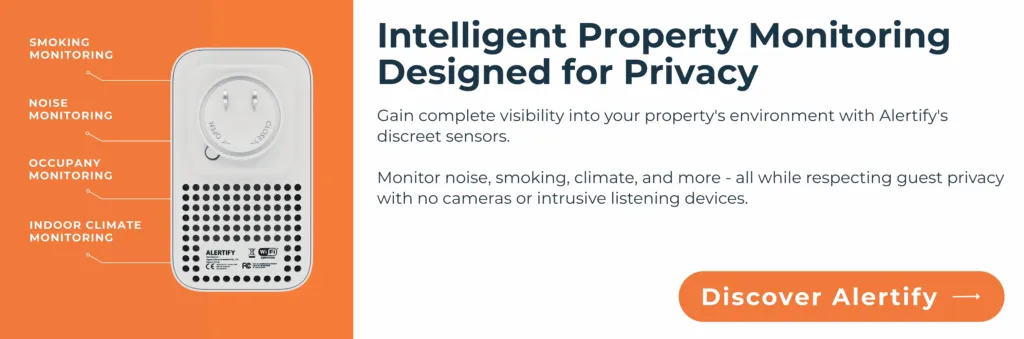
Alertify’s noise monitoring system measures ambient decibel levels continuously without recording any audio content — 100% privacy compliant and fully deployable in occupied residential units and communal areas. When noise exceeds a pre-configured threshold, an alert is sent instantly to the designated housing officer or property manager. Every incident is automatically timestamped and stored through the documentary evidence feature, creating a verifiable record that can be presented in formal proceedings, regulatory inspections, or Housing Ombudsman investigations.
Protecting Staff From Unsubstantiated Complaints and Allegations
One of the less-discussed benefits of noise monitoring technology for housing associations is the protection it provides to housing officers and management staff. When a resident makes a complaint that a housing officer failed to respond to a noise incident, or handled a dispute incorrectly, the absence of objective records leaves staff without a reliable basis for defending their actions. Subjective recollections of conversations and decisions, logged in case management systems after the fact, are a fragile evidential foundation.
Alertify’s documentary evidence system provides a complete, automatically generated record of every detected incident and every triggered response — making it straightforward to demonstrate precisely what happened, when it happened, and what action was taken. This protects housing officers from unfair allegations, supports transparent internal review processes, and gives housing association leadership confidence that their noise management practices are consistent, documented, and defensible.
Portfolio-Wide Visibility and Resource Allocation
For housing associations managing large portfolios across multiple sites, one of the most significant operational benefits of systematic noise monitoring is the portfolio-wide visibility it generates. When noise management is handled case by case — responding to individual complaints without aggregating data across properties — it is impossible to identify which properties generate the highest volumes of incidents, which times of day or week are most problematic, or which units are repeat sources of violations.
Alertify’s dashboard aggregates noise incident data across every monitored property in real time, giving housing association managers a complete picture of their portfolio’s acoustic environment. This data supports more targeted, evidence-based allocation of housing management resources — concentrating early intervention, tenant support, and enforcement activity where the evidence shows it is most needed — and enables more efficient maintenance planning through the additional indoor climate monitoring data that tracks temperature, humidity, and conditions relevant to mold risk across the estate.
Meeting Regulatory Expectations With Documented Evidence
The Regulator of Social Housing and the Housing Ombudsman both expect housing associations to demonstrate systematic, proportionate, and documented responses to antisocial behaviour complaints — including noise. Housing associations that cannot produce comprehensive records of their noise management activity risk adverse regulatory findings that affect their governance ratings, their access to financing, and their ability to develop new affordable housing.
Alertify’s monitoring and documentary evidence system provides exactly the kind of systematic, automatically generated record that meets these regulatory expectations — replacing fragmented case notes and subjective officer recollections with a continuous, objective, timestamped evidence trail that demonstrates active and consistent noise management across the entire portfolio.
Smarter Tools Build Better Communities
Noise management in housing associations is ultimately about the quality of life of the residents in your care. When noise is managed proactively, fairly, and with objective evidence, communities become more stable, residents feel more supported, and housing officers can focus their time on complex cases that genuinely require human judgment rather than spending it on disputes that technology could have resolved in minutes.
Book a free demo with Alertify and find out how our noise monitoring system can transform the way your housing association manages noise complaints — protecting your residents, your staff, and your regulatory standing.