
Ask most short-term rental hosts what a smoking guest costs them and they will say something like “$200 for an extra clean.” The real number is almost always higher, often three to five times higher, and that is before you factor in the costs that never appear on a single invoice but quietly drain your rental income over weeks and months.
Smoking is the single most expensive guest violation in the short-term rental industry. Understanding exactly what the smoking damage cost for your vacation rental is, line by line, direct and indirect, is the first step toward treating it as the serious financial risk it is rather than an occasional inconvenience. And once you see the full picture, the case for investing in smoking monitoring for your vacation rental becomes straightforward.
The Direct Smoking Damage Costs Your Vacation Rental Will Actually Face After an Incident
The direct costs of a smoking incident are the ones that arrive as invoices, and they add up faster than most hosts anticipate.
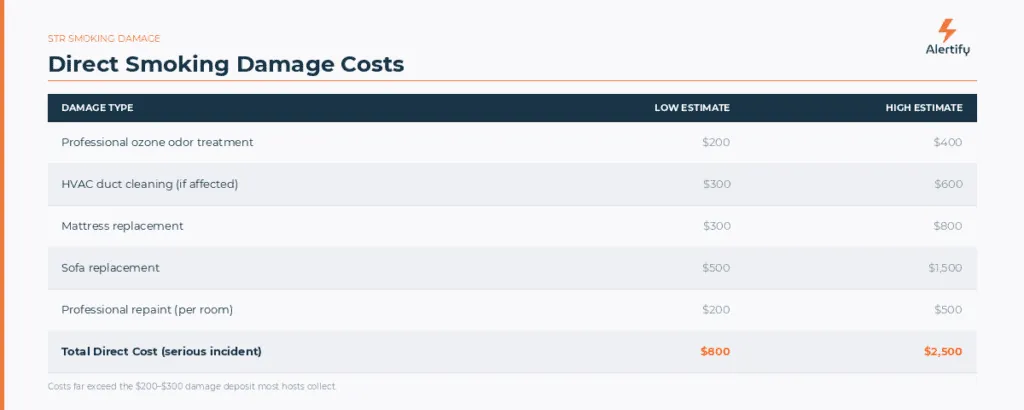
Professional odor remediation is the largest single line item. Unlike the smell of cooking or pets, cigarette, cannabis, and vape odor embeds itself into soft furnishings, walls, and HVAC systems at a chemical level that standard cleaning cannot address. Professional ozone treatment, the industry standard for smoke odor elimination, typically runs $200 to $400 for a standard vacation rental unit. If the contamination is significant, a second treatment may be required. If the HVAC system has been affected, which happens quickly when a guest smokes indoors and the system is running, duct cleaning adds another $300 to $600 to the bill.
Soft furnishing replacement is the cost that most frequently surprises hosts. Mattresses, sofas, curtains, and rugs that have absorbed smoke odor cannot always be fully remediated, particularly after a prolonged or repeated smoking incident. A single mattress replacement runs $300 to $800 depending on size and quality. A sofa, $500 to $1,500. When multiple items are affected, the total replacement cost can exceed the remediation cost itself.
Repainting and surface restoration rounds out the direct cost picture. Cigarette smoke leaves a yellowing residue on walls and ceilings that is visually detectable and cannot be painted over without a specialist primer. A professional repaint of a smoking-affected room runs $200 to $500 depending on size. In severe cases, multiple rooms are affected.
Add these components together and a realistic total for a serious smoking incident sits between $800 and $2,500, well above the $200 to $300 damage deposit that many hosts collect and far beyond what a platform Airbnb smoking damage claim will recover without strong documentation.
The Indirect Costs: What Never Appears on an Invoice but Defines the True STR Smoking Incident Financial Impact
The direct costs are significant. The indirect costs are what make a smoking incident genuinely damaging to a short-term rental business.
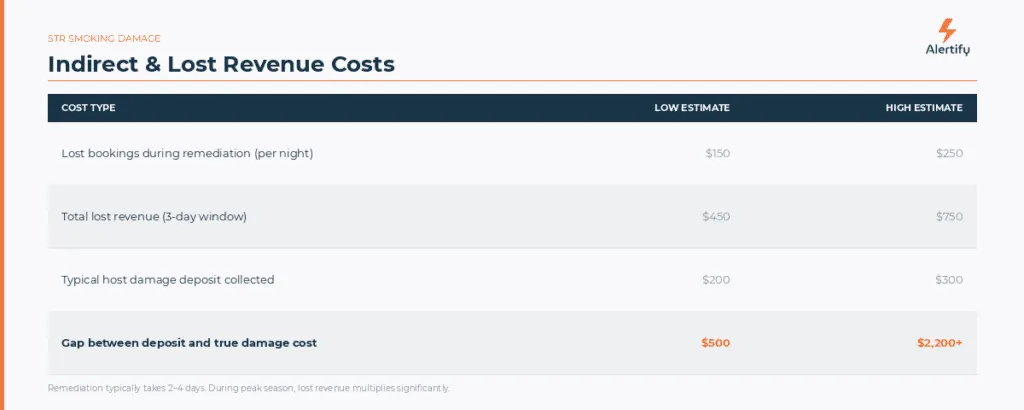
Booking downtime is the most immediate indirect cost. While remediation is underway, which typically takes two to four days for a thorough professional treatment, your property cannot be listed or occupied. At an average nightly rate of $150 to $250, a three-day remediation window represents $450 to $750 in lost booking revenue on top of every remediation invoice. If the incident occurs during a high-demand period, that lost revenue multiplies significantly.
Review damage is the most lasting indirect cost. If a subsequent guest checks in before remediation is complete, or if the remediation is incomplete and a residual smell remains, the resulting review can suppress your booking volume and damage your search ranking on Airbnb or VRBO for months. A single one-star review citing smoke smell reduces booking conversion meaningfully in a market where guests read reviews carefully and have abundant alternatives. Recovering a listing’s reputation after a smoke-related review requires a sustained run of positive feedback that can take an entire season to accumulate. This is the dimension of STR smoking incident financial impact that most hosts only fully understand after they have lived through it once.
The detection lag premium is perhaps the least visible cost of all. When a smoking violation goes undetected until checkout, every additional hour the guest smoked in the property compounded the surface damage. A violation detected in real time, when a guest has smoked one cigarette, costs a fraction of a violation discovered two days later when a guest has smoked throughout their stay. Alertify’s indoor smoking monitor addresses this directly, sending an automated Guest Alert to the host and guest within minutes of a detection event so that intervention happens before damage compounds. The documentary evidence generated by every logged detection event also means that when damage does occur, your claim is supported by precise, timestamped data rather than a cleaner’s report written the day after checkout. The financial value of early detection is not theoretical, it is the difference between a $150 ozone treatment and a $1,500 remediation project.
Ready to put a number on what smoking violations are costing your property? Book a demo with Alertify and see how real-time detection changes the financial equation for STR hosts.