
Noise is one of the most common sources of tension in shared spaces, from apartment complexes to short-term rentals. Whether it’s guests celebrating a birthday or a TV turned up a bit too loud, understanding how noise works, and what your noise thresholds actually mean, can help you take smarter, faster action before things escalate.
In this post, we’ll break down how sound is measured, what decibel levels really indicate, how excessive noise affects health and relationships, and how to set ideal thresholds using your Alertify noise monitoring device.
How Noise Works
At its core, sound is vibration. When an object vibrates, like a speaker cone, a person’s vocal cords, or a car engine, it pushes air molecules around it. These movements create sound waves, which travel through the air until they reach our ears.
Our ears detect changes in air pressure, and our brains interpret these changes as specific sounds: a whisper, laughter, or the hum of a refrigerator.
What’s fascinating is that sound energy doesn’t travel linearly. A small increase in vibration strength doesn’t produce a small increase in perceived loudness – it produces a much larger one. Because of this, scientists use a logarithmic scale to measure sound intensity in a way that makes sense for human hearing.
The Logarithmic Scale Explained
The logarithmic scale is used to represent large differences in sound intensity in a compact, meaningful way. On this scale, every 10-decibel increase means the sound intensity is 10 times stronger, and roughly twice as loud to the human ear.
For example:
- A normal conversation at 60 dB is about 10 times louder than background home noise at 50 dB.
- A noisy party at 80 dB is 1,000 times more intense than that same quiet room at 50 dB.
This exponential difference is why small number changes on a decibel scale actually represent major differences in real-world sound. It’s also why a jump from 55 dB to 70 dB – which might look small – can mean the difference between acceptable guest chatter and a full-blown neighbor complaint.
What Are Decibels (dB)?
The decibel (dB) is the unit that measures sound pressure levels relative to the quietest sound the human ear can detect. Because human ears are more sensitive to some frequencies (like high-pitched sounds), sound is usually measured using A-weighted decibels (dBA) – a standard that adjusts the reading to match how we perceive loudness.
Here’s how different sounds compare in decibels, to put your noise monitor readings into perspective:
| Sound Level (dB) | Example | Description / Context |
| 30 dB | Whisper, rustling leaves | Extremely soft; typical of a quiet bedroom at night. |
| 40 dB | Library or quiet home | Comfortable background noise; typical for residential areas. |
| 50 dB | Quiet conversation or refrigerator hum | Normal household activity – ideal for daytime levels. |
| 60 dB | Normal conversation, laughter, or TV on low | Noticeable but not disruptive. |
| 70 dB | Vacuum cleaner, shower, busy street | Loud; sustained exposure can be stressful. |
| 80–85 dB | Blender, loud music, traffic inside a car | Hearing damage possible after 2–4 hours. |
| 90–95 dB | Hair dryer, lawn mower, city nightlife | Hearing loss is possible after about 1 hour of exposure. |
| 100+ dB | Nightclub, motorcycle, concert | Can cause pain and hearing damage in less than 15 minutes. |
A 2023 study by the World Health Organization (WHO) found that consistent exposure above 70 dB can increase stress hormone levels, elevate heart rate, and disturb sleep – even if the noise isn’t perceived as “loud”.
Noise Levels and Decibel Chart:

When Noise Becomes Harmful
Sustained levels of loud noise can become a public health issue. The WHO estimates that over 20% of Europeans are regularly exposed to harmful noise levels that can negatively impact their well-being.
Hearing Health
- Prolonged exposure above 85 dB (like power tools or city traffic) can lead to noise-induced hearing loss.
- At 100 dB, hearing damage can occur after just 15 minutes.
- At 110-120 dB, such as in nightclubs or concerts, the risk becomes almost immediate.
Physical and Mental Health
Noise can also trigger the stress response system. Chronic exposure above 55-60 dB has been linked to:
- Increased cortisol and adrenaline levels, leading to fatigue and anxiety.
- Sleep disruption, even if you don’t fully wake up – studies show noise as low as 40 dB at night can cause micro-awakenings that reduce deep sleep.
- Cardiovascular strain: the WHO links long-term noise exposure above 65 dB to higher rates of hypertension and heart disease.
Social and Neighbor Impacts
In the world of short-term rentals, excessive noise quickly turns from a guest issue to a community one. For example, in Ottawa, hosts can be fined up to $1,000 per incident if nighttime noise exceeds 45 dB – roughly the sound of a quiet conversation.
When unmonitored, noise events often lead to neighbor complaints, city citations, and even delisting from platforms like Airbnb. Noise complaints make up one of the top three reasons short-term rentals lose licenses or face enforcement action in many municipalities.
Ideal Noise Monitoring Settings for Your Alertify Device
Your Alertify device is designed to detect and alert you before noise becomes a real problem – not to punish guests, but to give you the data you need to step in early and preserve the peace.
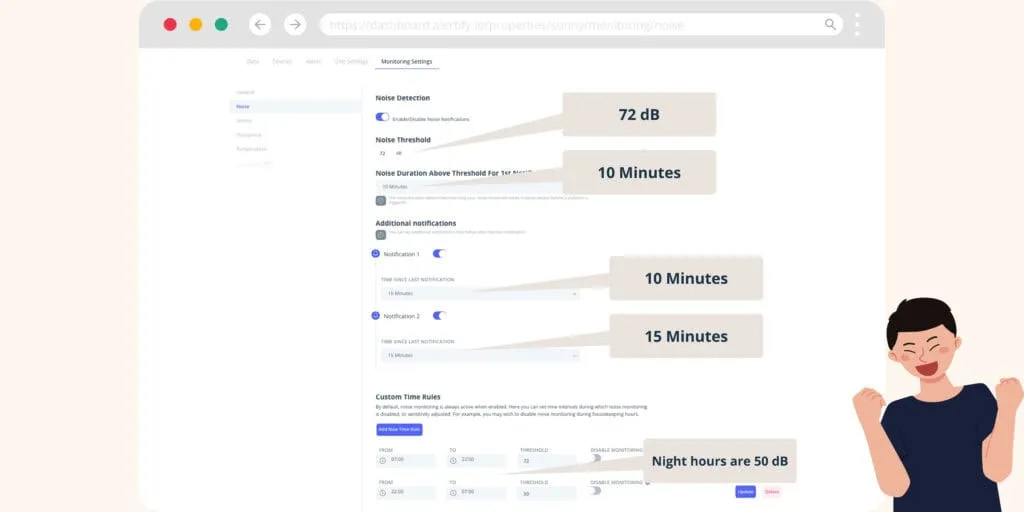
Here’s how to configure your device effectively:
1. Daytime Thresholds (7 a.m. – 10 p.m.)
- Recommended setting: 68-72 dB
- Why: This range allows for normal daytime activities like TV, conversations, or light music but will catch when gatherings start to get louder (around 73-78 dB).
- Example: A group playing background music and chatting will average around 60 dB, but once music or shouting begins, levels climb fast toward 72+ dB – a sign to intervene early.
2. Nighttime Thresholds (10 p.m. – 7 a.m.)
- Recommended setting: 45-55 dB
- Why: Matches municipal quiet hours in most regions (including Ottawa, New York, and London). Keeps noise low enough for guests to rest and prevents complaints from nearby residents.
- Example: A TV or conversation in another room averages 40-45 dB, but if guests begin playing music or singing, levels can rise to 60+ dB within seconds.
3. Alert Duration and Filtering
- Recommended alert trigger: Noise exceeds threshold for 10-15 minutes.
- Why: Prevents false alarms from short bursts like a door slam, barking dog, or brief laughter.
- Example: A 2-minute spike might be a dropped object – a sustained 10-minute rise at 75 dB is more likely a gathering.
4. Bonus Tip: Understand Your Property’s Acoustics
Every property is different. A small studio may hit 60 dB faster than a large open home. Start with the recommended ranges, observe your first week of readings, and fine-tune thresholds based on real guest behavior and neighbor proximity.
In Summary
Understanding how noise monitoring works isn’t just about numbers, it’s about protecting your property, relationships, and reputation.
By knowing what your noise thresholds indicate and setting your Alertify device to the right levels, you can:
- Prevent parties before they start
- Protect guests’ comfort and neighbors’ peace
- Stay compliant with local bylaws
- And avoid costly fines or lost listings
Noise doesn’t have to be a mystery. With the right knowledge and tools, it becomes a measurable, manageable part of creating a better guest experience – and a safer, quieter neighborhood.
Noise Monitoring FAQs
Can noise monitoring ever be 0 dB?
No – in real-world environments, 0 dB is practically impossible. Zero decibels represent the threshold of human hearing, meaning the faintest sound detectable in a completely silent, soundproof laboratory. Even in an empty home, there’s always some background soun, like HVAC systems, distant traffic, wind, or electrical hum that registers on your noise monitor. In practice, the lowest readings you’ll see indoors are typically around 30–35 dB.
When my guests are not there, why is my noise monitor reading 40 dB? Is my device broken?
Not at all! A baseline reading of 35–45 dB in an unoccupied property is completely normal. This range reflects ambient noise your device picks up from:
- Air conditioning or refrigerators cycling on and off
- Outside traffic, wind, or nearby conversations
- Electrical interference or subtle building vibrations
If your readings stay stable around 40 dB, it means your device is working correctly and detecting background environmental sounds as expected.
Got a question about your noise monitor? As our support experts by messaging support@alertify.io