
If you operate an Airbnb, Vrbo, or any other short-term rental (STR) in the unincorporated areas of Clark County, Nevada, one rule catches more hosts off guard than almost any other: you are legally required to install noise monitoring devices on your property and keep them running the entire time your unit is rented. This guide breaks down exactly what the Nevada noise ordinance requires, where the monitors must go, what noise limits apply, how long you have to keep the data, and how to stay compliant without turning your rental into a surveillance operation.
| Quick answer Under Clark County Code 7.100.170(r), every licensed STR must have noise monitoring devices at the front and rear property lines and near any outdoor pool or spa. The devices must run continuously during rentals, alert the host when sustained noise exceeds County limits, and log data that is kept for at least 60 days and produced to authorities within 48 hours on request. |
Why Nevada Requires Noise Monitors for Short-Term Rentals
Nevada’s short-term rental noise rules grew out of a statewide push to regulate STRs. In 2021, Assembly Bill 363 required Clark County to stop banning short-term rentals in residential neighborhoods and instead license and regulate them. The County adopted its STR ordinance (Title 7, Chapter 7.100 of the Clark County Code) in June 2022.
A central concern driving the ordinance was noise. The Board of County Commissioners explicitly found that using STR properties “to host large, disruptive parties in residential neighborhoods… causes harm to the quality of life for the permanent residents of Clark County and constitutes a public nuisance.” The noise monitoring device requirement is the County’s answer: continuous, objective, around-the-clock evidence of how loud a rental gets — so problems can be caught and resolved before neighbors ever pick up the phone.
The Noise Monitoring Device Requirement, Explained
The core rule lives in Clark County Code Section 7.100.170(r). Here is the exact language:
| Clark County Code 7.100.170(r) — Noise Monitoring Devices “Each licensee must install noise monitoring devices at each property line in both the front and rear yard of the Short-term Rental Unit, as well as in the vicinity of any outdoor pool or spa.” |
Read closely, the ordinance sets out four distinct obligations that every host must satisfy:
- Continuous operation and alerts. The devices must be in continuous operation while the property is rented and must alert the licensee or local representative when sustained noise levels exceed the County’s noise standards.
- 60-day data retention. Noise level data must be maintained by the licensee for no less than sixty (60) days.
- 48-hour production. Upon request of the County or any law enforcement agency, the licensee must provide the noise level data within forty-eight (48) hours.
- Multifamily exemption. The requirement does not apply to STR units within multifamily dwellings that have common (shared) entrances that are already surveilled or monitored.
Where You Must Place Noise Monitors
Placement is not left to your discretion. The ordinance names three specific locations, and a typical single-family STR will need a device at each:
- Front-yard property line — a monitor positioned at the boundary of the front yard.
- Rear-yard property line — a monitor positioned at the boundary of the back yard, where most late-night gatherings occur.
- Vicinity of any outdoor pool or spa — an additional monitor near pool/spa areas, which tend to be the loudest amenity on the property.
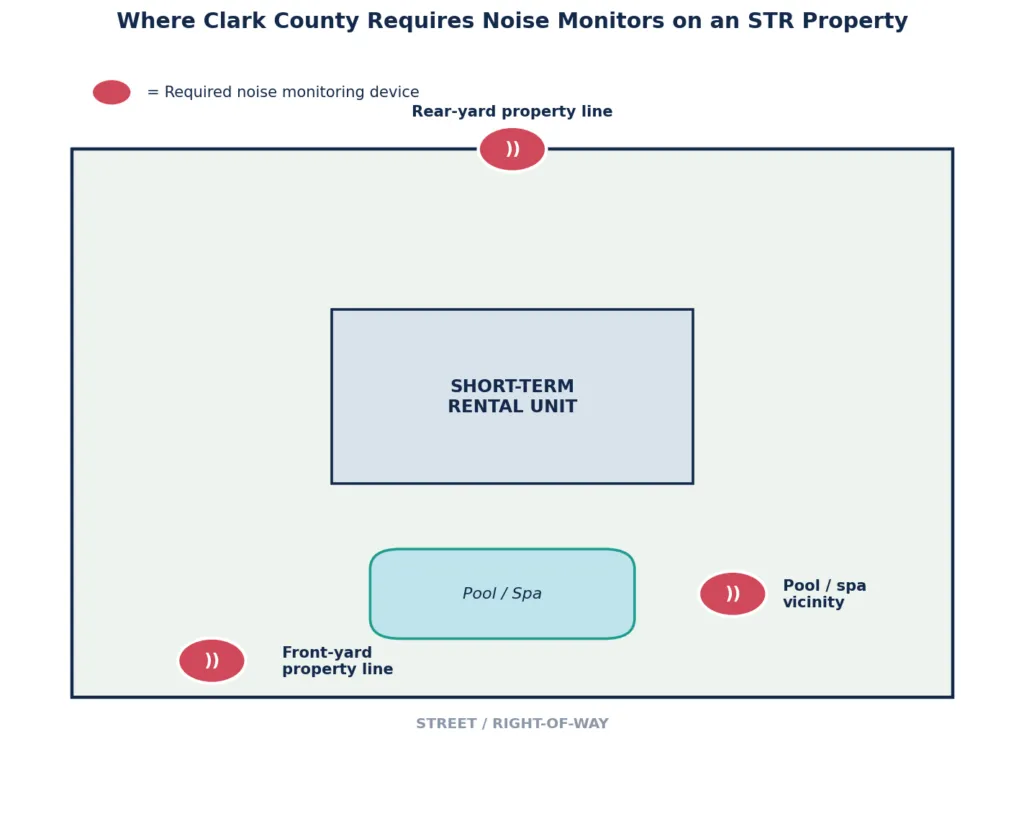
Figure 1: The three monitoring locations required under Clark County Code 7.100.170(r).
If your property has no outdoor pool or spa, you still need monitors covering the front and rear property lines. Properties with expansive yards, multiple gathering areas, or several pool/spa features may need more than three devices to genuinely capture sound at each required location.
Clark County Noise Limits: The Decibel Standards That Trigger an Alert
A noise monitor is only useful if it knows what “too loud” means. The STR ordinance ties its noise standards to Clark County Code Title 30.68.020, the County’s site environmental noise standards. For residential zones, those limits are:
| Period | Hours | Maximum sound level |
|---|---|---|
| Daytime | 7:00 AM – 10:00 PM | 47 dB (at 1000 Hz) |
| Nighttime | 10:00 PM – 7:00 AM | 37 dB (at 1000 Hz) |
| Short-term allowance | Once per day, ≤ 15 min | Limits may be exceeded by up to 10 dB |
Sound is measured at the property lines, at least four feet above the ground, using a sound level meter built to American National Standards Institute (ANSI) specifications. To put those numbers in perspective, the nighttime limit of 37 dB is roughly the level of a quiet suburb after dark — which is why an outdoor party can blow past the threshold almost instantly:
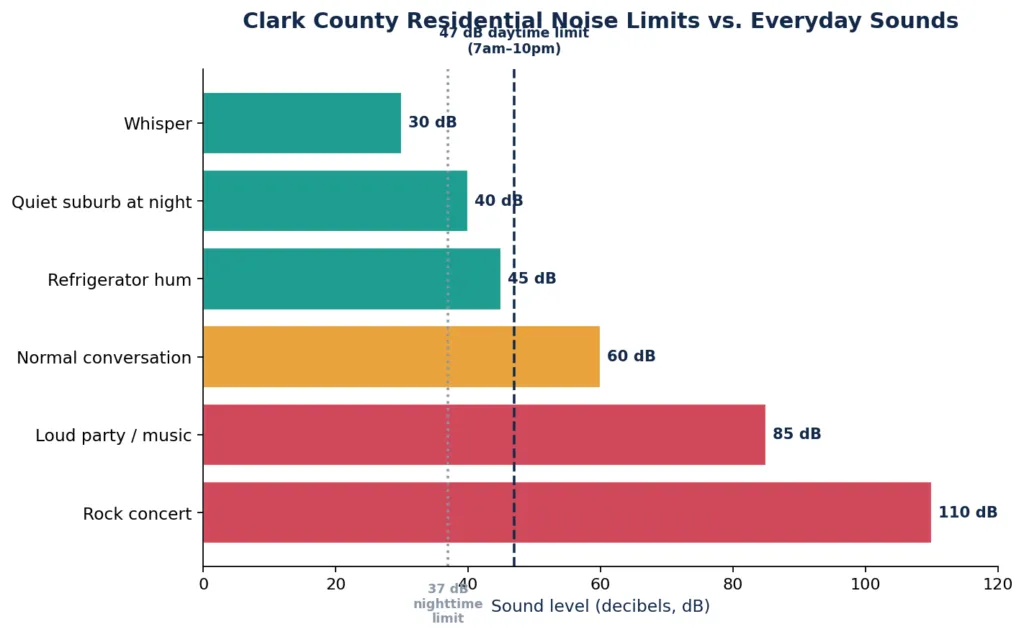
Figure 2: Clark County residential noise limits compared to common household and outdoor sounds.
| Two extra STR-specific noise rules Beyond the decibel caps, Section 7.100.180 adds that amplified sound (radios, stereos, instruments, speakers) is permitted only inside an enclosed unit, and the use of outdoor amenities — pools, spas, barbecues, and firepits — is prohibited between 10:00 PM and 7:00 AM. |
Data Retention and the 48-Hour Rule
The monitoring requirement does not end when the device sounds an alert. The ordinance treats your noise data as an evidentiary record. You must be able to store it, retrieve it, and hand it over quickly:
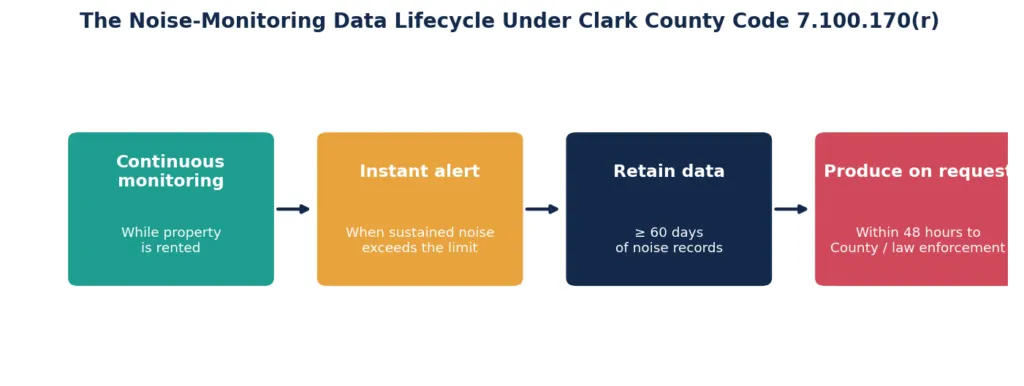
Figure 3: The data lifecycle every compliant STR noise monitor must support.
- Retain for at least 60 days. Noise level data must be kept for no fewer than sixty days — a rolling record that has to survive guest turnover, device resets, and Wi-Fi hiccups.
- Produce within 48 hours. If the County or any law enforcement agency requests the data, you have just two days to deliver it. That means your system needs exportable, timestamped reports — not a device that only shows a live reading.
The Multifamily Exemption
There is one carve-out. The noise monitoring device requirement does not apply to short-term rental units located within multifamily dwellings that have common entrances to the residential units that are already surveilled or monitored. In practice this covers certain condo- or apartment-style buildings with monitored shared entryways. If your STR is a standalone home or a unit with its own private yard and entrance, assume the requirement applies to you.
Penalties for Non-Compliance
Noise monitors sit inside a broader operational framework, and the County enforces it aggressively. Falling short on the noise requirement — or any other operational rule — exposes hosts to real consequences:
- Daily fines. Violations can carry fines ranging from $500 to $1,000 per day.
- Complaint response duties. A local representative must be reachable 24/7, respond to the property within 30 minutes, and resolve the issue within 60 minutes. A $250 fee applies each time a County employee has to respond.
- License suspension or revocation. The County can suspend or revoke an STR license for any violation of the chapter, including emergency suspensions.
- Public nuisance declaration. Operating out of compliance with the ordinance can be declared a public nuisance, opening the door to abatement actions.
Important: The Current Legal Status (2026)
| Enforcement is partially paused — but the rules still stand In December 2025, U.S. District Court Judge Miranda Du issued a preliminary injunction in a lawsuit brought by the Greater Las Vegas Short-Term Rental Association. The ruling temporarily bars Clark County from requiring an STR license, issuing or enforcing daily fines, declaring STRs a public nuisance, or recording liens while the case proceeds. The County voted to appeal on January 6, 2026, and the underlying ordinance — including the noise monitoring requirement — remains on the books. Hosts who want to keep operating smoothly (and be ready the moment enforcement resumes) are well advised to stay compliant now. This guide is informational and not legal advice; confirm the current status with the County or a Nevada attorney before making decisions. |
Henderson, Nevada: Noise Rules for Short-Term Vacation Rentals
Clark County is not the only Nevada jurisdiction with teeth on STR noise. The City of Henderson — the state’s second-largest city — enforces its own short-term vacation rental noise requirements under the Henderson Municipal Code (HMC). If your rental sits inside Henderson city limits, these are the rules that apply to you, and they differ from the County’s in a few important ways.
Henderson quiet hours
Every Henderson short-term vacation rental must comply with the city’s noise standards in HMC Section 8.84 (Noise Control), plus defined quiet hours. Crucially, Henderson’s quiet hours are longer on weekends than on weekdays:
- Weekends: quiet hours run from 10:00 PM to 10:00 AM.
- Weekdays: quiet hours run from 10:00 PM to 7:00 AM.
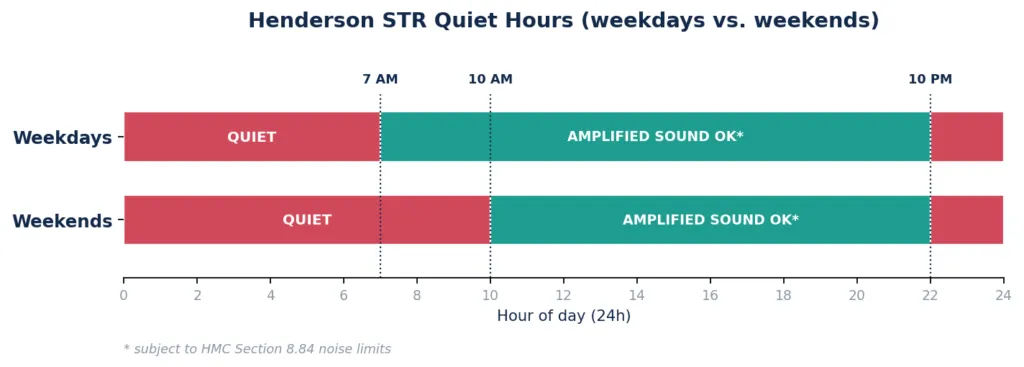
Figure 4: Henderson short-term rental quiet hours differ between weekdays and weekends.
During quiet hours, Henderson prohibits all outdoor amplified sound, and bans yelling, shouting, hooting, whistling, or singing that unreasonably annoys or disturbs neighbors. Outside of quiet hours, outdoor amplified sound is allowed but must still comply with the HMC’s noise regulations. All rear- and side-yard outdoor lighting must be turned off during quiet hours, except motion-sensitive security lighting and landscape lighting.
The required noise management plan
Where Clark County simply mandates monitoring devices, Henderson goes further and requires every STR to maintain a formal noise management plan. That plan must include all of the following:
- Continuous device operation — noise monitoring device(s) running continuously the entire time the property is rented.
- On-site posting — quiet hours and the penalties for HMC violations must be conspicuously posted at the property.
- 30-minute response commitment — the owner and registered local contact must commit to act within 30 minutes of notification to stop and prevent recurrence of unreasonable noise, disturbances, or disorderly conduct.
- Two-month data retention — noise level data records kept by the owner for a minimum of two months.
- Indoor and outdoor monitoring — noise monitoring equipment located both indoors and outdoors, in common areas.
- Pool/spa coverage — additional monitoring equipment installed at pool/spa areas for non-multi-unit dwellings with a pool or spa.
Henderson’s inspection right
Henderson also reserves the right to request an inspection of any short-term vacation rental. With the owner’s consent, an inspection is conducted at a reasonable time and limited to what’s needed to confirm compliance with the city’s registration requirements. If the owner agrees, the owner or registered local contact must meet the City inspector at the property.
Clark County vs. Henderson at a glance
| Requirement | Clark County | Henderson |
|---|---|---|
| Continuous monitoring while rented | Yes | Yes |
| Monitor placement | Front & rear property lines + pool/spa | Indoor + outdoor common areas + pool/spa |
| Quiet hours | 10 PM–7 AM (outdoor amenities) | 10 PM–7 AM weekdays; 10 PM–10 AM weekends |
| Data retention | ≥ 60 days | ≥ 2 months |
| Formal noise management plan | Not required | Required |
| On-site posting of quiet hours | Placard (hotline, occupancy, license) | Quiet hours + penalties posted |
| Response time to disturbances | 30 minutes (local rep) | 30 minutes (owner / local contact) |
Clark County STR Noise Compliance Checklist
| Requirement | Code reference |
|---|---|
| Monitor at front-yard property line | 7.100.170(r) |
| Monitor at rear-yard property line | 7.100.170(r) |
| Monitor in the vicinity of any outdoor pool or spa | 7.100.170(r) |
| Devices run continuously while the unit is rented | 7.100.170(r)(1) |
| Automatic alert when sustained noise exceeds limits | 7.100.170(r)(1) |
| Respect 47 dB daytime / 37 dB nighttime limits | 30.68.020 |
| No amplified sound outdoors; no outdoor amenities 10 PM–7 AM | 7.100.180 |
| Retain noise data for at least 60 days | 7.100.170(r)(2) |
| Produce data within 48 hours on request | 7.100.170(r)(3) |
MEET THE REQUIREMENT WITH
How Alertify Meets Clark County’s Noise Monitor Requirements
Alertify is an AI-powered noise and smoking monitoring platform built specifically for short-term rentals, hotels, and multifamily properties — and it is designed to satisfy exactly the kind of ordinance Clark County has put in place. Here is how Alertify maps to each part of the rule:
Continuous, real-time monitoring at every required location
Alertify devices monitor decibel levels continuously and are built to be placed exactly where the ordinance demands — covering the front and rear yards and the pool or spa area. Each unit takes about five minutes to set up, ships pre-configured with the correct US plug, and includes a backup battery (up to four hours) so monitoring keeps running even if a guest unplugs it. A hardwired option is available for tamper-resistant, always-on coverage.
Automatic alerts the moment noise crosses your threshold
You set custom decibel thresholds — easily matched to Clark County’s 47 dB daytime and 37 dB nighttime limits — and Alertify sends instant notifications by SMS, email, mobile push, or webhook when sustained noise exceeds them. This satisfies the ordinance’s requirement that the device “alert the licensee or the local representative” when limits are breached. Alertify can even message the guest directly, resolving roughly 90% of noise incidents within about ten minutes without host involvement — which pairs neatly with the County’s 30-minute response window.
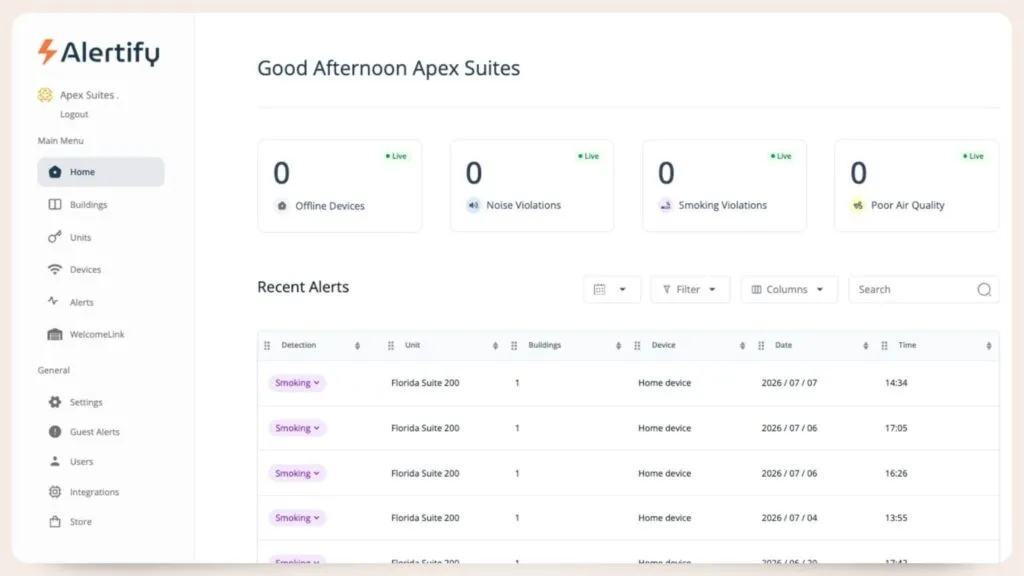
Image: Alertify home page summary
Exportable data that beats the 60-day and 48-hour rules
Alertify stores historical noise data and auto-generated incident reports for 180+ days — comfortably exceeding both Clark County’s 60-day and Henderson’s two-month retention minimums. When the County, the City, or law enforcement requests records, you can pull timestamped reports from the dashboard and export them well within the required 48-hour window, giving you documentary evidence that a compliance request demands.
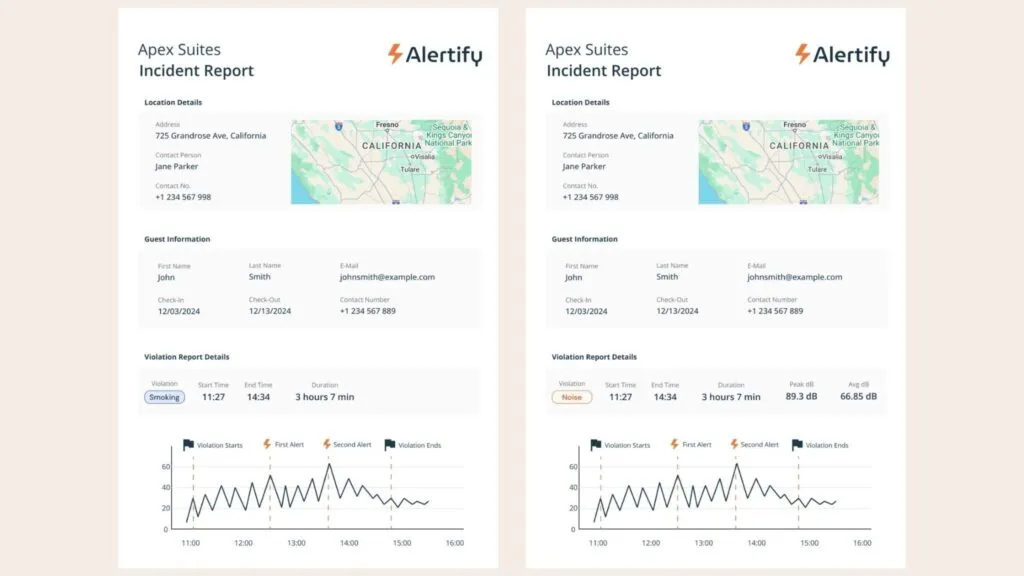
Image: Alertify incident reports
Ready for Henderson’s indoor + outdoor and noise-management-plan rules
Because Alertify offers both indoor and outdoor-capable devices with continuous operation, custom thresholds, and automated 30-minute-friendly guest alerts, it maps directly onto Henderson’s noise management plan requirements too — including continuous monitoring while rented, indoor and outdoor/common-area coverage, added pool/spa monitoring, and exportable records kept well beyond two months. One platform keeps you covered whether your property sits in unincorporated Clark County or inside Henderson city limits.
Nevada is not an outlier here, and the direction of travel is consistent: our ultimate guide to noise monitoring for Airbnb and short-term rentals covers how monitoring works and what to look for in a device, while local noise and STR laws you need to know tracks how comparable mandates are spreading across other markets. If you are weighing specific hardware against the ordinance's requirements, NoiseAware vs Alertify compares the two devices hosts most often shortlist on exactly the points Clark County cares about — placement, retention, and alerting.
Privacy-safe by design
Because the ordinance touches guest-occupied spaces, privacy matters. Alertify devices measure noise decibel levels and air particulate data only — they have no audio or video recording capability — so you get objective proof of a violation while guaranteeing complete guest privacy.
Built-in extras that reduce complaints in the first place
Beyond the core noise requirement, Alertify adds occupancy monitoring to catch unauthorized parties and over-occupancy, indoor smoking detection, tamper alerts, and guest pre-screening and messaging tools (WelcomeLink and Guest Alert). Together, these help hosts prevent the “large, disruptive parties” the Clark County ordinance was written to stop — protecting your license, your neighbors, and your bottom line.
| Alertify at a glance for Clark County hostsContinuous decibel monitoring • custom thresholds matched to 47/37 dB limits • instant SMS/email/push/webhook alerts • automated guest messaging • 180+ days of exportable, timestamped reports • 100% privacy-safe (no audio/video) • 5-minute setup • backup battery & hardwired options. |
Learn more or book a demo at alertify.io.
Frequently Asked Questions
Do all Nevada short-term rentals need noise monitors?
The Clark County requirements described here apply to licensed STRs in the unincorporated areas of the County, while the City of Henderson enforces its own noise standards and noise management plan under the Henderson Municipal Code (see the Henderson section above). Other Nevada jurisdictions — such as the cities of Las Vegas and Reno and Washoe County — have their own STR rules, which vary. Always check the specific ordinance for the jurisdiction where your property sits.
How many noise monitors do I actually need?
At minimum, one at the front-yard property line and one at the rear-yard property line, plus one near any outdoor pool or spa. Larger lots or multiple amenity areas may require additional devices to cover each required location effectively.
Does the monitor record what my guests are saying?
A compliant device should not. Clark County’s rule is about sound levels, not content. Privacy-safe monitors like Alertify measure decibel levels only and do not record audio or video.
How long do I have to keep the noise data?
At least 60 days under the ordinance. If the County or law enforcement requests it, you must provide it within 48 hours, so choose a system that retains and exports timestamped records.
What happens if I ignore the requirement?
Non-compliance can lead to daily fines of $500–$1,000, license suspension or revocation, and a public-nuisance declaration — though note the enforcement pause described above while litigation is ongoing.
This article is provided for general informational purposes only and does not constitute legal advice. Ordinances and their enforcement change frequently; verify current requirements with Clark County or a licensed Nevada attorney before acting. Sources: Clark County Code Title 7 Ch. 7.100 (uploaded ordinance); Clark County Code Title 30.68.020; Henderson Municipal Code (short-term vacation rental noise standards & HMC Section 8.84); Avalara MyLodgeTax (Jan. 27, 2026); alertify.io.