
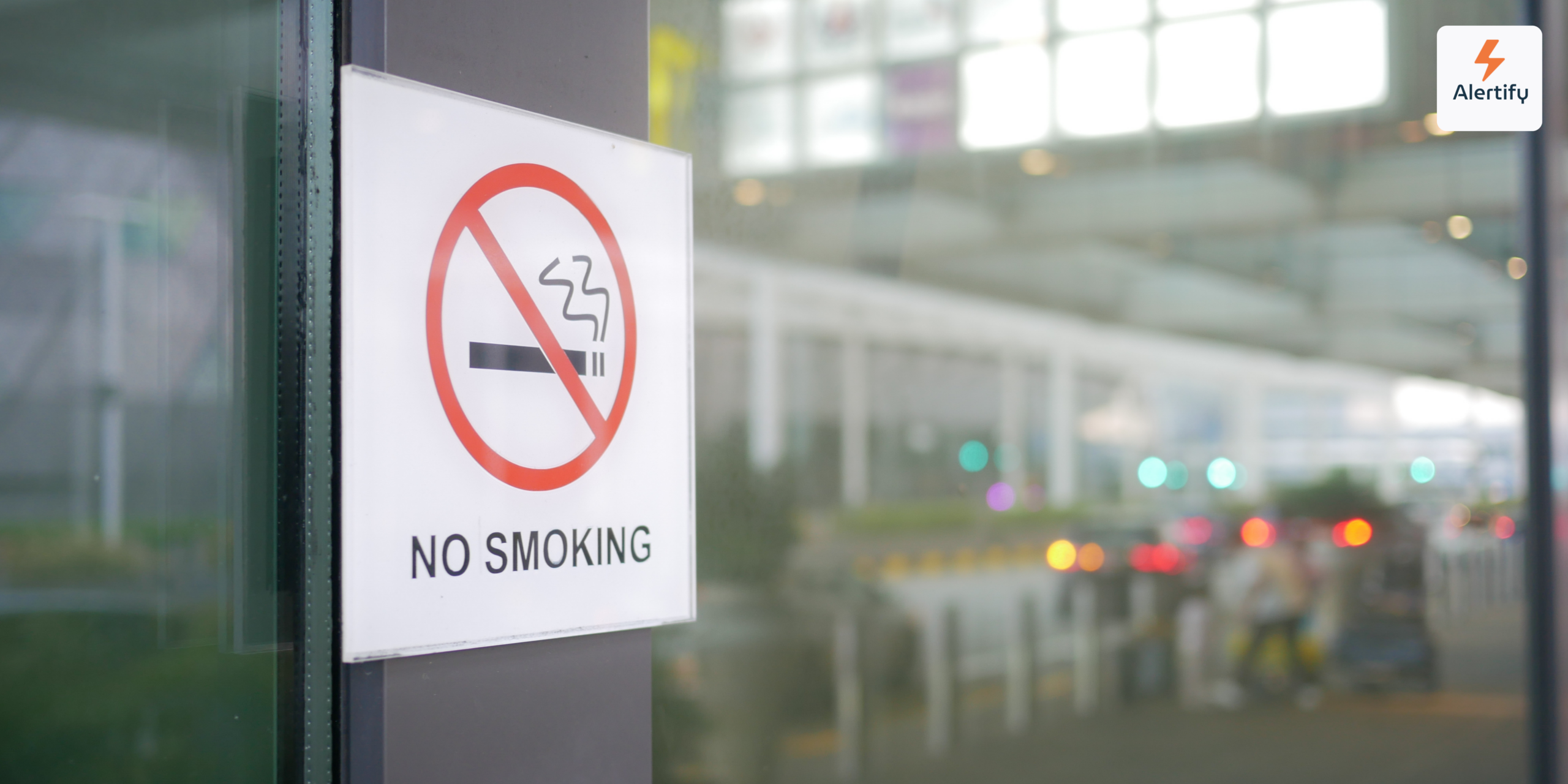
Every hospital in the United States operates under a formal smoke-free policy. Most have clearly posted signage, documented enforcement procedures, and staff training programmes designed to prevent smoking on hospital grounds. And yet indoor smoking detection healthcare data tells a different story. Violations continue to occur in patient rooms, stairwells, unmonitored corridors, and long-term care wings at a rate that policy documentation alone has consistently failed to reduce. The consequences extend well beyond the immediate clinical risk to the individual patient nearby. Undetected smoking violations generate residual odours and particulate contamination that patients and visitors perceive and report, directly impacting the HCAHPS environment and cleanliness scores that determine reimbursement under the CMS Hospital Value-Based Purchasing program. A written smoke-free policy without active detection technology is not a smoke-free facility. It is an unmonitored one.
The Reality of Smoking Violations in Clinical Settings
The persistent occurrence of smoking violations in hospitals despite formal policies reflects a structural enforcement problem rather than a failure of intent. Clinical staff are managing patient care responsibilities that cannot be interrupted to investigate a suspected violation. Security teams cannot be everywhere simultaneously. And the typical smoking violation, a brief incident in a restroom, stairwell, or unoccupied bay, is over in minutes, leaving no visible evidence by the time anyone responds to a complaint.
Research on smoke-free policy compliance in healthcare settings has consistently found that violation rates remain significant even in facilities with well-documented enforcement programmes, with patient and visitor violations more common than staff violations in most settings. The patient populations most frequently involved in these incidents include long-term care residents, psychiatric patients, and individuals with addiction histories, precisely the populations who are most clinically vulnerable to the effects of smoking in a healthcare environment.
The clinical population at greatest risk from undetected violations includes cardiac patients, for whom secondhand smoke exposure is a documented trigger for acute coronary events; respiratory patients, including those with COPD, asthma, and pulmonary fibrosis, who face immediate physiological harm from smoke particulate exposure; and post-surgical patients, whose recovery environments should be completely free of chemical and particulate contaminants. In areas where piped oxygen is in use, a smoking violation creates an immediate fire and explosion hazard that no written policy can mitigate after the fact.
Hospital smoking policy enforcement is not a matter of stricter rules. It is a matter of detection capability. Without the ability to identify a violation in real time, enforcement is by definition reactive, occurring after exposure has already taken place.
Why Your HCAHPS Scores Are Paying the Price
The impact of undetected smoking violations extends well beyond the immediate clinical environment. Residual tobacco and cannabis smoke leaves chemical compounds and odours that persist in soft furnishings, wall surfaces, and HVAC systems for hours after a brief violation. Patients in adjacent rooms, visitors passing through affected corridors, and staff working in compromised areas all experience these residual conditions even when they had no direct knowledge of the violation itself.
The HCAHPS survey’s cleanliness and environment domain captures exactly this kind of patient-reported sensory experience. A patient who notices a persistent smoke odour in their corridor, or whose room smells of stale tobacco that has drifted through ventilation, is likely to reflect that experience in their survey response regardless of how clinically excellent their care was in every other respect. HCAHPS cleanliness scores smoking violations represent a direct and often invisible mechanism by which patient experience scores are degraded without any corresponding clinical incident report being generated.
Under the CMS Hospital Value-Based Purchasing program, hospitals can lose up to 2% of their base Medicare DRG payments based on composite performance scores that include HCAHPS. For a mid-to-large facility, this represents millions of dollars annually. When the environment domain score is depressed by conditions that a detection and response system could have prevented, that reimbursement loss is directly attributable to an unresolved enforcement gap.
Proactive indoor smoking detection healthcare facilities deploy protects HCAHPS scores as much as it protects patients. The two objectives are not separate. They are the same investment addressing two dimensions of the same problem.
How Alertify’s Smoking Detection Works in a Clinical Context
Alertify’s approach to indoor smoking detection healthcare settings require is built around a core requirement: detection must be reliable, immediate, and completely privacy-safe. In a clinical environment, the deployment of any monitoring technology carries a heightened duty of privacy compliance. Patients have a right to dignity and confidentiality in their care environment, and any detection system that captures audio or video would create legal and ethical risks that outweigh any enforcement benefit.
Alertify’s sensor detects the chemical particulates associated with tobacco and cannabis smoke without capturing any audio or video data whatsoever. When particulate levels consistent with smoking are detected, the system triggers an immediate real-time alert to the designated staff member or facilities manager, enabling a response within minutes rather than hours. In Alertify’s broader customer base, 90% of violations auto-resolve within 10 minutes of the automated alert being sent, without requiring direct confrontation between staff and the individual involved.
Every incident is time-stamped and stored as a downloadable incident report, providing the documentary evidence that smoke-free facility compliance enforcement requires. For facilities managing repeat violations from specific patients or in specific areas, the historical incident log provides the documented pattern of behavior needed to support clinical or disciplinary action. For facilities demonstrating their smoke-free policy to regulators or accreditation bodies, the same log provides verifiable evidence of active monitoring and systematic response.
Effective hospital indoor air quality monitoring goes beyond any single environmental variable. Alertify’s platform monitors noise, smoking, CO2, VOCs, temperature, humidity, and occupancy simultaneously – providing the continuous, documented oversight that ASHRAE 170, Joint Commission, OSHA, and CMS all require. Ready to protect your facility?
Book a free demo with Alertify today and see how continuous environmental monitoring can reduce risk, improve compliance, and create safer spaces for patients and staff.