
A patient who cannot sleep is a patient who cannot heal. It sounds simple, but the clinical reality behind that statement is one of the most consistently under addressed challenges in modern healthcare. Noise is not a peripheral inconvenience in hospitals — it is a direct and measurable barrier to the recovery process, and the evidence linking hospital noise and patient recovery has been building for decades. For administrators and clinical directors looking to improve patient outcomes, understanding this connection is not optional. It is foundational.
Hospital Noise and Patient Recovery: What the Research Tells Us
Sleep is the biological window during which the human body performs the vast majority of its cellular repair, immune regulation, and hormonal restoration. When that window is repeatedly disrupted — as it routinely is in hospital environments — the consequences are clinical, not just uncomfortable.
A clinical review published in the Annals of Intensive Care found that ICU patients experience severely fragmented sleep, with almost no time spent in the deep restorative stages essential for physical recovery. The review identified noise as the primary environmental cause of this disruption, with alarms and staff conversation consistently cited as the most disruptive sources. The downstream effects are significant: patients experiencing chronic sleep disruption during hospitalisation demonstrate slower wound healing, elevated cortisol and stress hormone levels, heightened sensitivity to pain, and longer lengths of stay.
For patients in intensive care, the stakes are even higher. Research published in Frontiers in Neurology found that poor sleep in the ICU is closely associated with delirium — a condition affecting between 60% and 80% of mechanically ventilated patients — which carries significantly elevated risks of morbidity, extended length of stay, and mortality. The noise level on a ward is not just a comfort metric. It is a clinical variable with life-and-death implications for the most vulnerable patients in a facility’s care.
The Scale of the Problem in Real Hospitals
The gap between what noise levels should be and what they actually are in most hospitals is striking. The World Health Organization recommends that patient room noise should not exceed 35 dB during the day and 30 dB at night. Research reviewed by RN.com shows that average daytime hospital noise levels globally have risen from approximately 57 dB in 1960 to over 72 dB today, with nighttime levels climbing from 42 dB to 60 dB over the same period. These are not marginal exceedances — they represent acoustic environments that are two to three times louder than clinical guidelines permit.
A study measuring noise on surgical wards at Queen’s Medical Centre found that peak noise levels on every measured ward regularly exceeded 80 dB, with one recording a peak of 95.6 dB — equivalent to standing beside a heavy truck. Not a single ward consistently met WHO nighttime noise guidelines. The sources were varied: staff conversation, equipment trolleys, alarms, and the structural acoustics of buildings not designed with sound management in mind. The outcome was consistent: patients were unable to sleep, and their recovery suffered as a direct result.
Why Conventional Approaches Fall Short
Hospitals have tried to address noise through culture change campaigns, quiet hour policies, and staff awareness programmes. These efforts are valuable but consistently insufficient on their own. Without objective, real-time data on when and where noise thresholds are being exceeded, these initiatives rely entirely on individual staff compliance — which is difficult to sustain in high-pressure clinical environments operating around the clock, across multiple shifts, and often with stretched staffing resources.
The missing layer is technology. Specifically, the kind of continuous, privacy-safe hospital noise monitoring that detects threshold breaches in real time, triggers an automated response before the noise event sustains long enough to disrupt a patient’s sleep, and logs every incident as documentary evidence for clinical and compliance review. Without this infrastructure, noise management in hospitals remains reactive — responding to complaints after harm has already occurred rather than preventing harm before it begins.
How Alertify Supports Patient Recovery Through Noise Management
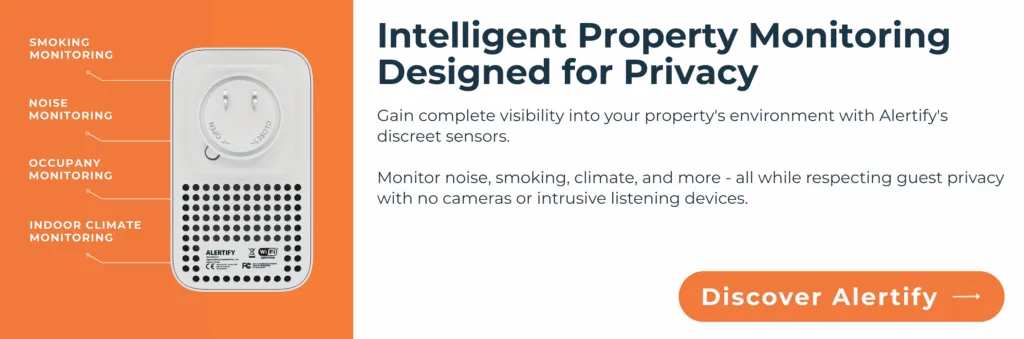
Alertify’s noise monitoring system measures ambient decibel levels continuously without recording any audio content — 100% privacy compliant and suitable for the most sensitive clinical environments, including ICUs, neonatal units, and post-operative wards. When noise crosses a pre-configured threshold, an instant alert is sent to the relevant staff member or triggers an automated guest alert, enabling intervention before the disruption compounds.
Ninety percent of noise incidents managed through Alertify’s system resolve within ten minutes without requiring direct staff confrontation. Every event is timestamped and stored through Alertify’s documentary evidence feature, creating an auditable log that identifies recurring problem areas — a specific corridor during shift changes, a nursing station during handover — so that systemic improvements can be made rather than just individual incidents managed reactively. The result is a measurably quieter environment that gives patients the uninterrupted sleep their recovery depends on, and gives clinical teams the data they need to demonstrate that the facility is actively managing its acoustic environment.
Sleep Is Not a Luxury, It’s a Clinical Outcome
Patient recovery outcomes are directly affected by sleep quality, and sleep quality is directly undermined by noise. Every hour of disrupted sleep in a hospital ward is time the body is not healing. The technology to address this problem is available, privacy-safe, and operational within 15 minutes. The question is no longer whether to act — it is how quickly your facility can implement the infrastructure to protect the recovery of every patient in your care.
Ready to see what a difference real-time noise monitoring can make to patient outcomes in your facility? Book a free demo with Alertify and speak with a specialist who understands the clinical demands of healthcare environments.