
When guests book your short-term rental, they’re not just paying for a roof over their heads, they’re paying for a comfortable experience. And two of the biggest (and most overlooked) factors in that comfort? Temperature and humidity.
Get them right, and guests barely notice, they just feel at home. Get them wrong, and you end up with one-star reviews mentioning a “stuffy room,” a “weird smell,” or a property that felt “damp and cold.” Worse still, the wrong humidity levels can quietly cause mold, wood warping, and structural damage that costs thousands to repair.
This guide covers exactly what the science says about ideal indoor temperature and humidity ranges, why they matter for STR hosts specifically, and what you should do when conditions drift outside of those ranges.
Why Temperature and Humidity Matter More in STRs Than in Regular Homes
In a primary residence, the same people come and go every day. They adjust the thermostat, open windows, and develop habits that keep the indoor environment relatively stable. In a short-term rental, it’s a revolving door, different guests, different habits, different climates they’ve come from, and different expectations.
Here’s why this creates unique challenges for STR operators:
- Turnover gaps create risk. Between check-out and check-in, a property can sit empty for hours or days. In summer, indoor temperatures can spike. In winter, they can drop dangerously low. With no one inside making adjustments, problems fester undetected.
- Guests don’t treat your HVAC like it’s their own. Some guests crank the heat and leave windows open. Others set the AC to 60°F and leave it running 24/7. Unusual thermostat behavior can strain systems and spike your utility costs.
- Humidity abuse is invisible, until it’s not. Long hot showers with no exhaust ventilation, leaving windows open in humid climates, cooking without venting: all of these push humidity up quickly. And unlike a noisy party, rising humidity doesn’t trigger a complaint until the damage is already done.
- Reviews are unforgiving. Guests expect hotel-level comfort. A property that was 78°F and stuffy on arrival, or had a musty smell from elevated humidity, will almost certainly earn a mention in the review and that review is permanent.
What the Data Says: Ideal Indoor Temperature for Short-Term Rentals
According to the U.S. Department of Energy and ASHRAE (the American Society of Heating, Refrigerating and Air-Conditioning Engineers), the ideal indoor temperature comfort range for occupied residential spaces is:
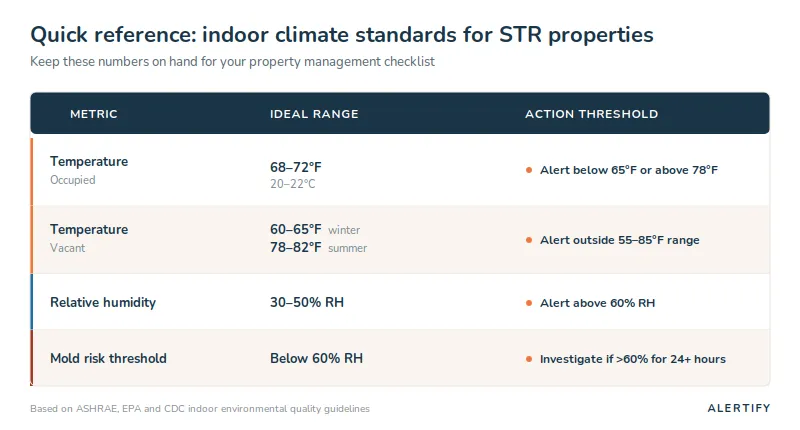
🌡️ Recommended Temperature Range: 68°F – 72°F (20°C – 22°C) for most occupants
This range reflects the thermal comfort sweet spot for the majority of adults, accounting for normal activity levels and typical clothing. That said, individual preference varies, some guests prefer a cooler 66°F bedroom for sleeping, while others want a warmer 74°F living space.
Seasonal Considerations
Temperature management in STRs isn’t a “set it and forget it” situation. Seasonal variance matters:
- Summer: Guests expect cooling. Ideal indoor temps during peak summer should hover around 70–74°F. Anything above 76°F will likely generate comfort complaints, especially in humid climates where heat feels more intense.
- Winter: The minimum safe indoor temperature for occupied spaces is generally considered 65°F (18°C) by most health guidelines. Below 60°F, pipes in older homes become vulnerable to freezing. Below 55°F, mold risk paradoxically increases as surfaces become cold and condensation forms.
- Shoulder seasons: Spring and fall bring the most variability. A property may need both heating and cooling within the same week. If your HVAC is set to a seasonal mode (heat-only or cool-only), monitor it carefully.
The Vacant Property Problem
Most hosts set thermostats to an “away” temperature between guest stays, typically 60–65°F in winter and 78–82°F in summer. These ranges are reasonable for energy efficiency, but there are two critical risks:
- If a guest checks out early and the next guest arrives before the HVAC has had time to stabilize, the property may be uncomfortably hot or cold on arrival.
- If an HVAC system fails between stays during extreme weather, temperatures can swing to property-damaging extremes and no one will know until the next guest arrives (or the next maintenance check).
Industry data: HVAC failures during vacancy account for a disproportionate share of STR property damage claims, particularly frozen pipe incidents in winter and mold events in summer.
Ideal Indoor Humidity Levels for Short-Term Rentals
If temperature is the obvious comfort metric, humidity is the hidden one and arguably more consequential for property health. The EPA and ASHRAE both recommend maintaining indoor relative humidity (RH) within the following range:
💧 Recommended Humidity Range: 30% – 50% relative humidity (RH) for occupied spaces
This range balances guest comfort, air quality, and property protection. Here’s what happens outside of it:
Too Low: Below 30% RH
Excessively dry air is most common in cold climates during winter, when heated indoor air loses moisture rapidly. The effects include:
- Guest discomfort: Dry skin, irritated eyes, scratchy throats, and worsened allergy or asthma symptoms.
- Property damage: Hardwood floors and wood furniture shrink and crack. Grout can dry out and develop hairline fractures over time.
- Static electricity: A minor inconvenience for guests, but a signal that relative humidity is well below optimal.
Too High: Above 60% RH
This is the danger zone for STR properties and it builds silently. Elevated humidity is most common in:
- Warm, coastal, or tropical climates (Florida, Hawaii, Gulf Coast states)
- Properties with poor ventilation or aging HVAC systems
- After extended occupancy (back-to-back bookings with lots of showers, cooking, or laundry)
The consequences escalate the longer it goes unaddressed:
⚠️ At 60–65% RH: Guest discomfort: air feels heavy and “muggy.” Condensation may begin forming on windows and cool surfaces.
⚠️ At 65–70% RH: Dust mites thrive. Soft furnishings, mattresses, and upholstery become breeding grounds for allergens. Musty odors begin developing.
🚨 Above 70% RH sustained for 24–48 hours: Mold spores present on any surface, and they’re everywhere, can begin germinating. Mold remediation can cost $2,000–$10,000+ depending on the affected area.
The EPA is explicit: “indoor humidity levels above 60% create conditions favorable to mold growth.” And once visible mold appears, you’re looking at a closed property, emergency remediation costs, and potentially devastating reviews.
The Mold Risk Window
What makes mold particularly dangerous for STR operators is that it’s not an event, it’s a process. High humidity over consecutive days creates an accumulating risk that isn’t visible until it’s well-established. By the time a guest notices a musty smell or spots discoloration on a wall, mold may have been growing for weeks.
Common high-risk locations in STR properties:
- Bathrooms (especially with poor exhaust ventilation)
- Under kitchen sinks and around dishwashers
- Behind and under refrigerators
- Basement or ground-floor rooms in humid climates
- Spaces with exterior walls and limited insulation
The 5 Most Common Causes of Temperature & Humidity Problems in STRs
Understanding root causes helps you prevent problems before they start:
1. HVAC underperformance or failure. Aging systems, clogged filters, or refrigerant leaks result in inconsistent heating and cooling and often elevated humidity as a secondary effect, since air conditioning is also responsible for dehumidifying the air.
2. Inadequate bathroom ventilation. Exhaust fans that are too small, vented incorrectly, or simply not used by guests allow shower steam to build up rapidly, pushing humidity up throughout the property.
3. Guest behavior during vacancy gaps. A guest who leaves windows open on a humid Florida afternoon, then checks out, leaves the next guest (and the property) with a humidity problem.
4. Back-to-back bookings with no buffer. With minimal time between checkouts and check-ins, there’s no opportunity for the property to normalize. If one group has been running hot showers and cooking for a week, the next group arrives into a humid environment.
5. Seasonal HVAC transitions. In climates with moderate shoulder seasons, property owners sometimes delay switching between heating and cooling modes. During that transition window, humidity control often suffers.
Practical Steps to Maintain Ideal Conditions
There are structural measures every STR host should have in place:
- Set your thermostat to “auto” not “on.” “Auto” mode means the fan only runs when actively heating or cooling, which means it also dehumidifies more effectively. “On” mode runs the fan continuously and can actually redistribute moisture.
- Change HVAC filters regularly. Every 30–90 days depending on usage frequency. A clogged filter reduces airflow and hurts both temperature regulation and humidity control.
- Install or upgrade bathroom exhaust fans. Size them appropriately for the room (calculate using the 1 CFM per square foot rule). Consider fans with humidity sensors that automatically run until moisture drops below a set level.
- Use a dehumidifier in high-risk rooms. For properties in humid climates or with known problem areas (basements, ground-floor bathrooms), a standalone dehumidifier is a low-cost, high-impact safeguard.
- Include ventilation reminders in your guest guide. A simple reminder to run the exhaust fan during and after showers can make a measurable difference, especially if you frame it as protecting the property.
- Inspect during every turnover. Instruct your cleaning team to note any unusual odors, condensation, or temperature anomalies. They’re your eyes and ears on the ground.
These measures are important but they’re all reactive. They depend on someone noticing a problem and acting on it. The real gap in most STR operations is the period when no one is there.
The Gap That Manual Management Can’t Close And How Alertify Fills It
Here’s the honest reality: between guest check-outs and check-ins, during multi-week vacancy periods, or simply overnight when no one is monitoring anything, your property’s temperature and humidity can drift well outside of healthy ranges with no one the wiser. That’s where continuous monitoring changes everything.
Alertify’s property monitoring device includes both a temperature sensor and a humidity sensor that track conditions 24/7, 365 days a year, whether your property is occupied or vacant.
What Alertify Tells You (That You’d Otherwise Never Know)
Alertify doesn’t just collect data, it gives you actionable intelligence. Here’s what that looks like in practice:
- Which property has the issue. If you manage multiple properties, you’ll know immediately which unit has crossed a threshold, not just that “something is off.”
- How long the issue has been developing. Alertify’s dashboard shows you historical trend data, so you can see whether humidity has been creeping up for six hours or six days, a critical distinction when assessing mold risk.
- Exactly when conditions cross your thresholds. You set the thresholds, for example, alert me if temperature drops below 60°F or humidity exceeds 60%, and Alertify notifies you the moment those lines are crossed.
- Real-time alerts on your phone. Notifications come through immediately via SMS, email, or your preferred messaging platform, so you can respond before a minor issue becomes major damage.
What You Can Do When You Get the Alert
An alert without context is noise. An alert that tells you the property, the reading, the location, and how long it’s been out of range? That’s something you can act on fast.
Common responses to temperature and humidity alerts:
- Remotely adjust your smart thermostat if the HVAC has drifted
- Contact your HVAC technician for same-day service before the next check-in
- Message an incoming guest to let them know conditions are being corrected
- Dispatch your property manager or cleaner to open windows or run a portable dehumidifier
- Delay a check-in if conditions are genuinely unsafe or uncomfortable
The earlier you’re alerted, the more options you have. Responding at hour two of an elevated humidity event is a maintenance task. Responding at day five is a remediation project.
Mold Risk Detection Before Mold Appears
One of Alertify’s most valuable capabilities for STR operators is mold risk tracking – not just point-in-time humidity readings, but trend analysis over time. When humidity stays elevated for an extended period, Alertify flags the accumulated risk, giving you an early warning window that visual inspection alone would never provide.
For a property in a humid climate running back-to-back bookings, this kind of proactive detection can be the difference between a preventive dehumidifier deployment and a five-figure remediation bill.
Protecting Your Investment Year-Round
Beyond guest comfort, keeping temperature and humidity within healthy ranges directly protects your revenue:
- No mold remediation costs: Average remediation ranges from $2,000 to $10,000+ depending on severity and affected surface area and that’s before accounting for lost booking revenue during closure.
- No surprise HVAC failures: Temperature anomalies between guests are often the first signal of an HVAC system that’s underperforming or failing. Catching it early means a service call, not an emergency replacement.
- No negative reviews from comfort issues: Guests who arrive to a comfortably conditioned property are far less likely to note environmental issues in their review and far more likely to rebook.
- Better guest experience, better ratings: According to research from AirDNA and similar platforms, properties with consistently high review scores command meaningfully higher nightly rates and higher occupancy. Environment is a foundational part of that experience.
The Bottom Line
Maintaining ideal indoor temperature and humidity in your short-term rental isn’t optional, it’s the baseline for protecting your property, earning great reviews, and running a sustainable operation.
The challenge is that the periods when your property is most at risk, between guests, during extreme weather, over long vacancy stretches, are exactly the periods when no one is watching. Thermostat settings get overridden, HVAC systems struggle silently, and humidity creeps up in the background.
Alertify gives you eyes on your property when you can’t be there. By monitoring temperature and humidity continuously, alerting you the moment conditions fall outside your thresholds, and tracking trends over time to identify building mold risk before it becomes visible damage, Alertify turns reactive property management into proactive protection.
Because the best time to deal with a humidity problem isn’t when your next guest leaves a one-star review. It’s 48 hours earlier, when a real-time alert gives you time to do something about it.